

CHAPTER 6 • Organic Chemical Reaction Rates in the Ocean:
151
MCA, Kanaoka et al. 1977; Hoppe 1983), and leucyl-,B-naphthylamide (LL,BN, Somville
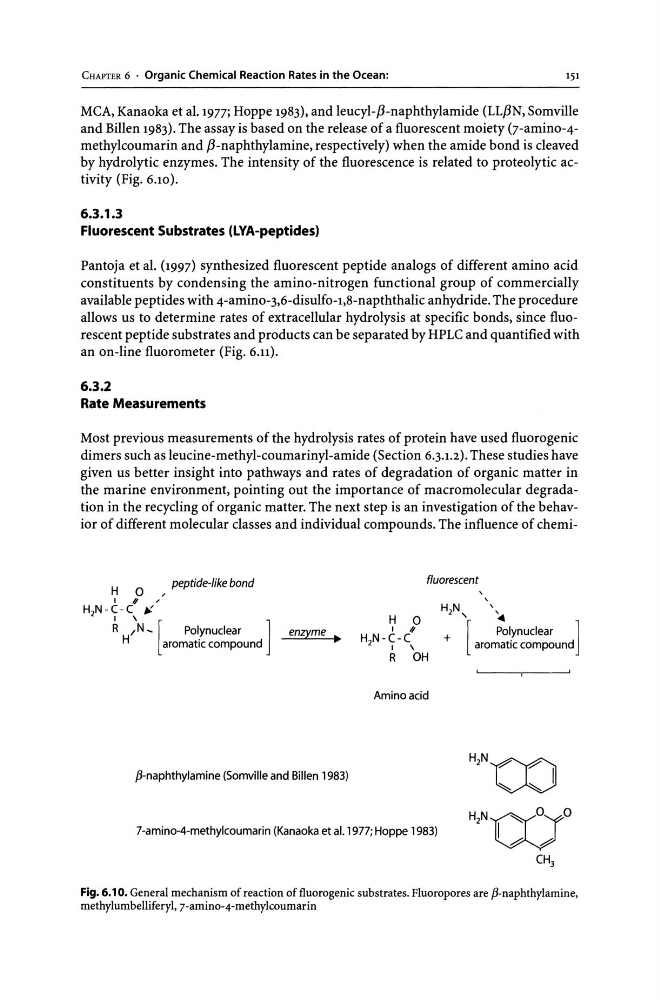
and Billen 1983). The assay is based on the release of a fluorescent moiety (7-amino-4methylcoumarin and ,B-naphthylamine, respectively) when the amide bond is cleaved
by hydrolytic enzymes. The intensity of the fluorescence is related to proteolytic activity (Fig. 6.10).
6.3.1.3
Fluorescent Substrates (LYA-peptides)
Pantoja et al. (1997) synthesized fluorescent peptide analogs of different amino acid
constituents by condensing the amino-nitrogen functional group of commercially
available peptides with 4-amino-3,6-disulfo-1,8-napththalic anhydride. The procedure
allows us to determine rates of extracellular hydrolysis at specific bonds, since fluorescent peptide substrates and products can be separated by HPLC and quantified with
an on-line fluorometer (Fig. 6.11).
6.3.2
Rate Measurements
Most previous measurements of the hydrolysis rates of protein have used fluorogenic
dimers such as leucine-methyl-coumarinyl-amide (Section 6.3-1.2). These studies have
given us better insight into pathways and rates of degradation of organic matter in
the marine environment, pointing out the importance of macromolecular degradation in the recycling of organic matter. The next step is an investigation of the behavior of different molecular classes and individual compounds. The influence of chemiH 0
peptide-like bond
I
Q
,
H2N-~-C, ~
R H/ N , [
Polynuclear
]
enzyme.
aromatic compound
j3-naphthylamine (Somville and Billen 1983)
fluorescent
H 0
I
Q
H2N-~-C,
R OH
Amino acid
, ,
H2N
"
, . .
+ [
Polynuclear
]
aromatic compound
7-amino-4-methylcoumarin (Kanaoka et al. 1977; Hoppe 1983)
Fig. 6.10. General mechanism of reaction of fluorogenic substrates. Fluoropores are j3-naphthylamine,
methylumbelliferyl,7-amino-4-methy1coumarin
151
MCA, Kanaoka et al. 1977; Hoppe 1983), and leucyl-,B-naphthylamide (LL,BN, Somville
and Billen 1983). The assay is based on the release of a fluorescent moiety (7-amino-4methylcoumarin and ,B-naphthylamine, respectively) when the amide bond is cleaved
by hydrolytic enzymes. The intensity of the fluorescence is related to proteolytic activity (Fig. 6.10).
6.3.1.3
Fluorescent Substrates (LYA-peptides)
Pantoja et al. (1997) synthesized fluorescent peptide analogs of different amino acid
constituents by condensing the amino-nitrogen functional group of commercially
available peptides with 4-amino-3,6-disulfo-1,8-napththalic anhydride. The procedure
allows us to determine rates of extracellular hydrolysis at specific bonds, since fluorescent peptide substrates and products can be separated by HPLC and quantified with
an on-line fluorometer (Fig. 6.11).
6.3.2
Rate Measurements
Most previous measurements of the hydrolysis rates of protein have used fluorogenic
dimers such as leucine-methyl-coumarinyl-amide (Section 6.3-1.2). These studies have
given us better insight into pathways and rates of degradation of organic matter in
the marine environment, pointing out the importance of macromolecular degradation in the recycling of organic matter. The next step is an investigation of the behavior of different molecular classes and individual compounds. The influence of chemiH 0
peptide-like bond
I
Q
,
H2N-~-C, ~
R H/ N , [
Polynuclear
]
enzyme.
aromatic compound
j3-naphthylamine (Somville and Billen 1983)
fluorescent
H 0
I
Q
H2N-~-C,
R OH
Amino acid
, ,
H2N
"
, . .
+ [
Polynuclear
]
aromatic compound
7-amino-4-methylcoumarin (Kanaoka et al. 1977; Hoppe 1983)
Fig. 6.10. General mechanism of reaction of fluorogenic substrates. Fluoropores are j3-naphthylamine,
methylumbelliferyl,7-amino-4-methy1coumarin