

CHAPTER 6 • Organic Chemical Reaction Rates in the Ocean:
155
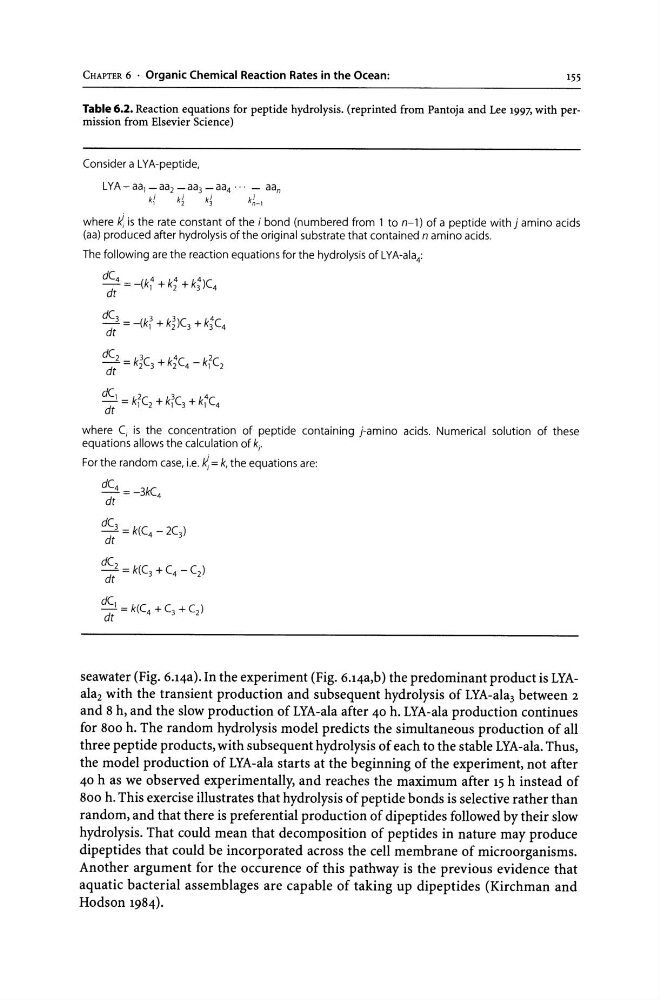
Table 6.2. Reaction equations for peptide hydrolysis. (reprinted from Pantoja and Lee 1997, with permission from Elsevier Science)
Consider a L VA-peptide,
L Y A - aa, - aa2 - aa3 - aa. . .. - aan
k{
ki
k~
k~_l
where k; is the rate constant of the i bond (numbered from 1 to n-l) of a peptide with j amino acids
(aa) produced after hydrolysis of the original substrate that contained n amino acids.
The following are the reaction equations for the hydrolysis of L YA-ala.:
dC.
• • •
-=-(kl +k2 +k3 )C.
dt
dC,
2
3
•
-
= k, C2 + k, C3 + k, C.
dt
where Ci is the concentration of peptide containing j-amino acids. Numerical solution of these
equations allows the calculation of k;For the random case, i.e. k; = k, the equations are:
dC4 = -3kC
dt
4
dC3 = k(C - 2C )
dt
•
3
seawater (Fig. 6.14a). In the experiment (Fig, 6.14a,b) the predominant product is LYAala2 with the transient production and subsequent hydrolysis of LYA-ala3 between 2
and 8 h, and the slow production of LYA-ala after 40 h. LYA-ala production continues
for 800 h. The random hydrolysis model predicts the simultaneous production of all
three peptide products, with subsequent hydrolysis of each to the stable LYA-ala. Thus,
the model production of LYA-ala starts at the beginning of the experiment, not after
40 h as we observed experimentally, and reaches the maximum after 15 h instead of
800 h. This exercise illustrates that hydrolysis of peptide bonds is selective rather than
random, and that there is preferential production of dipeptides followed by their slow
hydrolysis. That could mean that decomposition of peptides in nature may produce
dipeptides that could be incorporated across the cell membrane of microorganisms.
Another argument for the occurence of this pathway is the previous evidence that
aquatic bacterial assemblages are capable of taking up dipeptides (Kirchman and
Hodson 1984).
155
Table 6.2. Reaction equations for peptide hydrolysis. (reprinted from Pantoja and Lee 1997, with permission from Elsevier Science)
Consider a L VA-peptide,
L Y A - aa, - aa2 - aa3 - aa. . .. - aan
k{
ki
k~
k~_l
where k; is the rate constant of the i bond (numbered from 1 to n-l) of a peptide with j amino acids
(aa) produced after hydrolysis of the original substrate that contained n amino acids.
The following are the reaction equations for the hydrolysis of L YA-ala.:
dC.
• • •
-=-(kl +k2 +k3 )C.
dt
dC,
2
3
•
-
= k, C2 + k, C3 + k, C.
dt
where Ci is the concentration of peptide containing j-amino acids. Numerical solution of these
equations allows the calculation of k;For the random case, i.e. k; = k, the equations are:
dC4 = -3kC
dt
4
dC3 = k(C - 2C )
dt
•
3
seawater (Fig. 6.14a). In the experiment (Fig, 6.14a,b) the predominant product is LYAala2 with the transient production and subsequent hydrolysis of LYA-ala3 between 2
and 8 h, and the slow production of LYA-ala after 40 h. LYA-ala production continues
for 800 h. The random hydrolysis model predicts the simultaneous production of all
three peptide products, with subsequent hydrolysis of each to the stable LYA-ala. Thus,
the model production of LYA-ala starts at the beginning of the experiment, not after
40 h as we observed experimentally, and reaches the maximum after 15 h instead of
800 h. This exercise illustrates that hydrolysis of peptide bonds is selective rather than
random, and that there is preferential production of dipeptides followed by their slow
hydrolysis. That could mean that decomposition of peptides in nature may produce
dipeptides that could be incorporated across the cell membrane of microorganisms.
Another argument for the occurence of this pathway is the previous evidence that
aquatic bacterial assemblages are capable of taking up dipeptides (Kirchman and
Hodson 1984).