

CHAPTER 6 . Organic Chemical Reaction Rates in the Ocean:
143
carbon skeleton and the inorganic nitrogen are presumed to be subsequently used by
microorganisms. The second example (Section 6.3) covers degradation of peptides in
seawater. Here, we will concentrate on the microbial extracellular hydrolytic step prior
to mineralization, because it appears to be a key reaction in degradation of organic
matter in the ocean.
6.2
Oxidative Deamination of Amino Acids in Sea Water by Cell Surface
Deaminases
Nitrogen is one of the essential nutrients for phytoplankton growth. One of the major
steps in the nitrogen cycle in the sea is the uptake of inorganic nitrogen by phytoplankton as a nutrient source for the synthesis of proteins and nucleic acids.
Traditionally, it was thought that phytoplankton only obtain the nitrogen they require from inorganic nitrogen compounds, e.g. nitrate, nitrite and ammonium. Depending on the nitrogen source we differentiate between new and regenerated production, concepts of great ecological value (e.g. Eppley and Peterson 1979). Regenerated production is commonly estimated as ammonium uptake, because ammonium
is regenerated by heterotrophic processes in the photic zone. More recently, however,
phytoplanktonic uptake of regenerated nitrogen in the form of dissolved organic nitrogen has been identified in some marine systems, but evidence of its uptake by phytoplankton is not straightforward (Antia et al. 1991; Paerl1991).
A new mechanism of removal of amino acids and amines from seawater was proposed by Palenik and Morel (1990a, 1991). They showed that certain phytoplanktonic
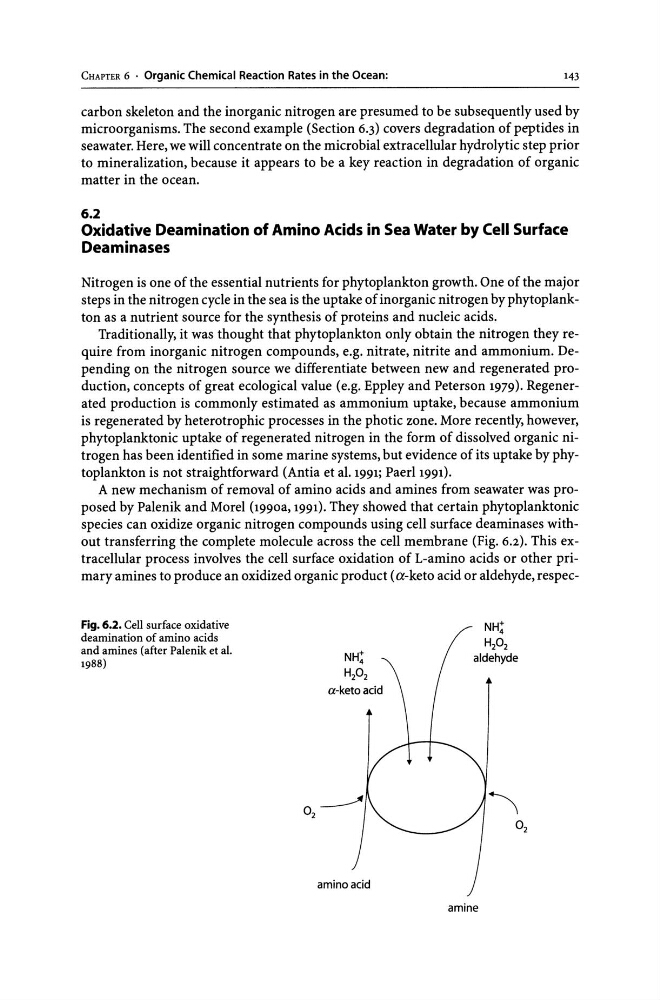
species can oxidize organic nitrogen compounds using cell surface deaminases without transferring the complete molecule across the cell membrane (Fig. 6.2). This extracellular process involves the cell surface oxidation of L-amino acids or other primary amines to produce an oxidized organic product (a-keto acid or aldehyde, respecFig. 6.2. Cell surface oxidative
deamination of amino acids
and amines (after Palenik et al.
1988)
amino acid
NH~
H 2 0 2
aldehyde
amine
143
carbon skeleton and the inorganic nitrogen are presumed to be subsequently used by
microorganisms. The second example (Section 6.3) covers degradation of peptides in
seawater. Here, we will concentrate on the microbial extracellular hydrolytic step prior
to mineralization, because it appears to be a key reaction in degradation of organic
matter in the ocean.
6.2
Oxidative Deamination of Amino Acids in Sea Water by Cell Surface
Deaminases
Nitrogen is one of the essential nutrients for phytoplankton growth. One of the major
steps in the nitrogen cycle in the sea is the uptake of inorganic nitrogen by phytoplankton as a nutrient source for the synthesis of proteins and nucleic acids.
Traditionally, it was thought that phytoplankton only obtain the nitrogen they require from inorganic nitrogen compounds, e.g. nitrate, nitrite and ammonium. Depending on the nitrogen source we differentiate between new and regenerated production, concepts of great ecological value (e.g. Eppley and Peterson 1979). Regenerated production is commonly estimated as ammonium uptake, because ammonium
is regenerated by heterotrophic processes in the photic zone. More recently, however,
phytoplanktonic uptake of regenerated nitrogen in the form of dissolved organic nitrogen has been identified in some marine systems, but evidence of its uptake by phytoplankton is not straightforward (Antia et al. 1991; Paerl1991).
A new mechanism of removal of amino acids and amines from seawater was proposed by Palenik and Morel (1990a, 1991). They showed that certain phytoplanktonic
species can oxidize organic nitrogen compounds using cell surface deaminases without transferring the complete molecule across the cell membrane (Fig. 6.2). This extracellular process involves the cell surface oxidation of L-amino acids or other primary amines to produce an oxidized organic product (a-keto acid or aldehyde, respecFig. 6.2. Cell surface oxidative
deamination of amino acids
and amines (after Palenik et al.
1988)
amino acid
NH~
H 2 0 2
aldehyde
amine