

144
s. Pantoja
tively), H20 2, and NHt in equimolar concentrations. They also demonstrated that the
ammonium produced was assimilated by the cells, whereas the organic product and
hydrogen peroxide remained in solution.
If oxidative deamination is a major pathway, the consequences of this reaction are:
1. Ammonium produced by this mechanism is another source of NHt for regenerated
production.
2. If bacteria consume the a-keto acids produced, whereas the ammonium is taken up
by phytoplankton, carbon and nitrogen may be decoupled.
3. Deamination of amino acids to a-keto acids is another pathway for the removal of
amino acids, (in addition to heterotrophic consumption by bacteria).
4. Oxidative deamination is another source of hydrogen peroxide in sea water.
However, the quantitative importance of amino acid oxidation in natural waters is
difficult to assess. This mechanism (or any involving cell surface processes) may be
easily overlooked due to methodological constraints. Amino acid recycling is usually
studied using radiolabelled amino acids e 4 C, 3H) which are added to natural sea water or sediment, and the label is followed into the bacterial biomass, with no information on routes of uptake. Because of the complexity of the sources and sinks of amino
acids, a-keto acids, aldehydes, H20 2, and NHt in sea water, measuring the changes in
concentration of these compounds due only to cell surface oxidation is not easily accomplished (note that even if radio labelling any molecule in Fig. 6.2, it would be difficult to trace its pathway inside and outside the cell, and more difficult to determine
oxidation rates alone).
6.2.1
Synthesis of a Fluorescent Analog of L-Iysine as Substrate for Amino Acid
Oxidases in the Ocean
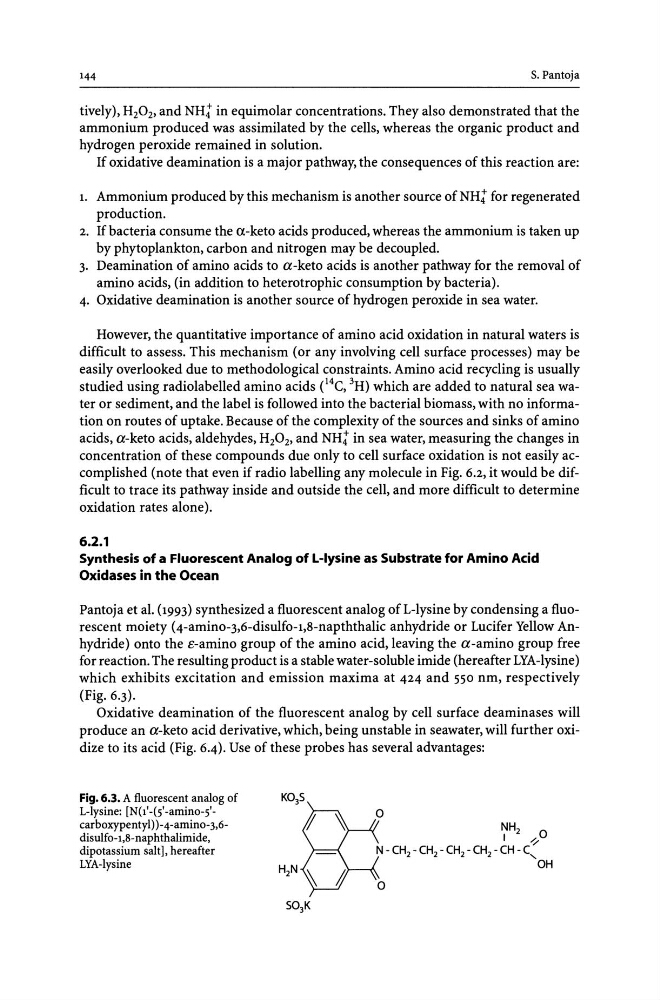
Pantoja et al. (1993) synthesized a fluorescent analog of L-Iysine by condensing a fluorescent moiety (4-amino-3,6-disulfo-l,8-napththalic anhydride or Lucifer Yellow Anhydride) onto the e-amino group of the amino acid, leaving the a-amino group free
for reaction. The resulting product is a stable water-soluble imide (hereafter LYA-Iysine)
which exhibits excitation and emission maxima at 424 and 550 nm, respectively
(Fig. 6.3).
Oxidative deamination of the fluorescent analog by cell surface deaminases will
produce an a-keto acid derivative, which, being unstable in seawater, will further oxidize to its acid (Fig. 6.4). Use of these probes has several advantages:
Fig. 6.3. A fluorescent analog of
carboxypentyl»-4-amino-3,6disulfo-l,8-naphthalimide,
dipotassium salt), hereafter
LYA-lysine
s. Pantoja
tively), H20 2, and NHt in equimolar concentrations. They also demonstrated that the
ammonium produced was assimilated by the cells, whereas the organic product and
hydrogen peroxide remained in solution.
If oxidative deamination is a major pathway, the consequences of this reaction are:
1. Ammonium produced by this mechanism is another source of NHt for regenerated
production.
2. If bacteria consume the a-keto acids produced, whereas the ammonium is taken up
by phytoplankton, carbon and nitrogen may be decoupled.
3. Deamination of amino acids to a-keto acids is another pathway for the removal of
amino acids, (in addition to heterotrophic consumption by bacteria).
4. Oxidative deamination is another source of hydrogen peroxide in sea water.
However, the quantitative importance of amino acid oxidation in natural waters is
difficult to assess. This mechanism (or any involving cell surface processes) may be
easily overlooked due to methodological constraints. Amino acid recycling is usually
studied using radiolabelled amino acids e 4 C, 3H) which are added to natural sea water or sediment, and the label is followed into the bacterial biomass, with no information on routes of uptake. Because of the complexity of the sources and sinks of amino
acids, a-keto acids, aldehydes, H20 2, and NHt in sea water, measuring the changes in
concentration of these compounds due only to cell surface oxidation is not easily accomplished (note that even if radio labelling any molecule in Fig. 6.2, it would be difficult to trace its pathway inside and outside the cell, and more difficult to determine
oxidation rates alone).
6.2.1
Synthesis of a Fluorescent Analog of L-Iysine as Substrate for Amino Acid
Oxidases in the Ocean
Pantoja et al. (1993) synthesized a fluorescent analog of L-Iysine by condensing a fluorescent moiety (4-amino-3,6-disulfo-l,8-napththalic anhydride or Lucifer Yellow Anhydride) onto the e-amino group of the amino acid, leaving the a-amino group free
for reaction. The resulting product is a stable water-soluble imide (hereafter LYA-Iysine)
which exhibits excitation and emission maxima at 424 and 550 nm, respectively
(Fig. 6.3).
Oxidative deamination of the fluorescent analog by cell surface deaminases will
produce an a-keto acid derivative, which, being unstable in seawater, will further oxidize to its acid (Fig. 6.4). Use of these probes has several advantages:
Fig. 6.3. A fluorescent analog of
carboxypentyl»-4-amino-3,6disulfo-l,8-naphthalimide,
dipotassium salt), hereafter
LYA-lysine