

CHAPTER 4 . Redox Processes in Anoxic Waters
95
prevented due to the presence of a strong pycnocline (density gradient). The salinity
decreases with depth, and the stability of the basin water is caused by the temperature
gradient. Coastal upwelling causes the high productivity in the surface waters and
contributes the organic matter to the deep waters of the Cariaco Trench. The limited
horizontal and vertical exchange limits the dissolved oxygen needed to oxidize organic
carbon, and the deep waters have become anoxic. The sedimentary record suggests
that anoxic conditions have prevailed in the deep waters for the last 1100 years, probably punctuated by deep-water renewal (Richards 1965).
The Cariaco Trench was discovered in 1954 and has been studied over the last four
decades. It has become increasingly clear that the anoxic portion of the Cariaco Trench
is not in a steady state, and that the values of a number of properties have been changing systematically with time (Zhang and Millero 1993b). In June 1990 we participated
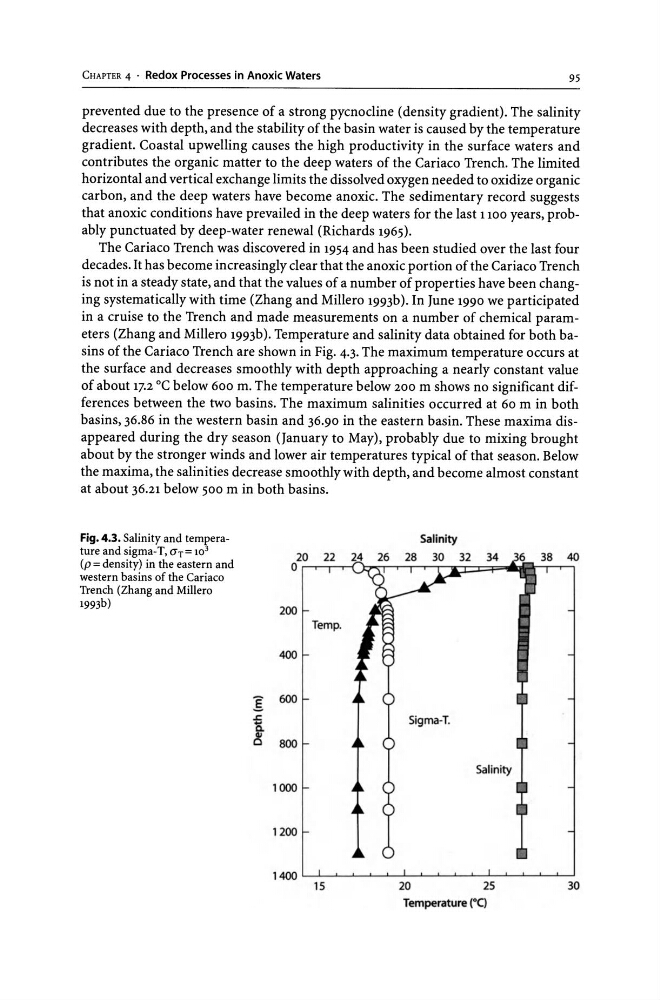
in a cruise to the Trench and made measurements on a number of chemical parameters (Zhang and Millero 1993b). Temperature and salinity data obtained for both basins of the Cariaco Trench are shown in Fig. 4.3. The maximum temperature occurs at
the surface and decreases smoothly with depth approaching a nearly constant value
of about 17.2 °C below 600 m. The temperature below 200 m shows no significant differences between the two basins. The maximum salinities occurred at 60 m in both
basins, 36.86 in the western basin and 36.90 in the eastern basin. These maxima disappeared during the dry season (January to May), probably due to mixing brought
about by the stronger winds and lower air temperatures typical of that season. Below
the maxima, the salinities decrease smoothly with depth, and become almost constant
at about 36.21 below 500 m in both basins.
Fig. 4.3. Salinity and temperature and sigma-T, aT= 10 3
20 22
(p = density) in the eastern and
0
western basins of the Cariaco
Trench (Zhang and Millero
1993b)
200
Temp.
400
:[ 600
L
0.
~ 800
1000
1200
1400 15
20
25
30
Temperature (oq
95
prevented due to the presence of a strong pycnocline (density gradient). The salinity
decreases with depth, and the stability of the basin water is caused by the temperature
gradient. Coastal upwelling causes the high productivity in the surface waters and
contributes the organic matter to the deep waters of the Cariaco Trench. The limited
horizontal and vertical exchange limits the dissolved oxygen needed to oxidize organic
carbon, and the deep waters have become anoxic. The sedimentary record suggests
that anoxic conditions have prevailed in the deep waters for the last 1100 years, probably punctuated by deep-water renewal (Richards 1965).
The Cariaco Trench was discovered in 1954 and has been studied over the last four
decades. It has become increasingly clear that the anoxic portion of the Cariaco Trench
is not in a steady state, and that the values of a number of properties have been changing systematically with time (Zhang and Millero 1993b). In June 1990 we participated
in a cruise to the Trench and made measurements on a number of chemical parameters (Zhang and Millero 1993b). Temperature and salinity data obtained for both basins of the Cariaco Trench are shown in Fig. 4.3. The maximum temperature occurs at
the surface and decreases smoothly with depth approaching a nearly constant value
of about 17.2 °C below 600 m. The temperature below 200 m shows no significant differences between the two basins. The maximum salinities occurred at 60 m in both
basins, 36.86 in the western basin and 36.90 in the eastern basin. These maxima disappeared during the dry season (January to May), probably due to mixing brought
about by the stronger winds and lower air temperatures typical of that season. Below
the maxima, the salinities decrease smoothly with depth, and become almost constant
at about 36.21 below 500 m in both basins.
Fig. 4.3. Salinity and temperature and sigma-T, aT= 10 3
20 22
(p = density) in the eastern and
0
western basins of the Cariaco
Trench (Zhang and Millero
1993b)
200
Temp.
400
:[ 600
L
0.
~ 800
1000
1200
1400 15
20
25
30
Temperature (oq