

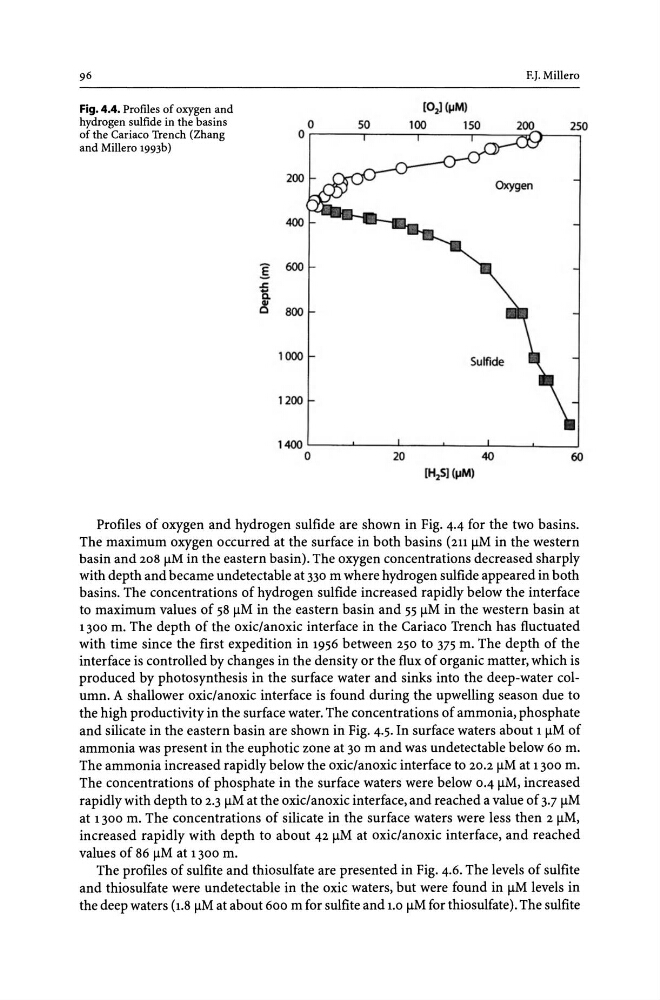
Fig. 4.4. Profiles of oxygen and
hydrogen sulfide in the basins
of the Cariaco Trench (Zhang
and Millero 1993b)
g
~
Q.
c!:
200
400
600
800
1000
1200
1400
F.J. Millero
0
20
40
60
Profiles of oxygen and hydrogen sulfide are shown in Fig. 4.4 for the two basins.
The maximum oxygen occurred at the surface in both basins (211 JlM in the western
basin and 208 JlM in the eastern basin). The oxygen concentrations decreased sharply
with depth and became undetectable at 330 m where hydrogen sulfide appeared in both
basins. The concentrations of hydrogen sulfide increased rapidly below the interface
to maximum values of 58 JlM in the eastern basin and 55 JlM in the western basin at
1300 m. The depth of the oxic/anoxic interface in the Cariaco Trench has fluctuated
with time since the first expedition in 1956 between 250 to 375 m. The depth of the
interface is controlled by changes in the density or the flux of organic matter, which is
produced by photosynthesis in the surface water and sinks into the deep-water column. A shallower oxic/anoxic interface is found during the upwelling season due to
the high productivity in the surface water. The concentrations of ammonia, phosphate
and silicate in the eastern basin are shown in Fig. 4.5. In surface waters about 1 JlM of
ammonia was present in the euphotic zone at 30 m and was undetectable below 60 m.
The ammonia increased rapidly below the oxic/anoxic interface to 20.2 JlM at 1300 m.
The concentrations of phosphate in the surface waters were below 0.4 JlM, increased
rapidly with depth to 2.3 JlM at the oxic/anoxic interface, and reached a value of 3.7 JlM
at 1300 m. The concentrations of silicate in the surface waters were less then 2 JlM,
increased rapidly with depth to about 42 JlM at oxic/anoxic interface, and reached
values of 86 JlM at 1300 m.
The profiles of sulfite and thiosulfate are presented in Fig. 4.6. The levels of sulfite
and thiosulfate were undetectable in the oxic waters, but were found in JlM levels in
the deep waters (1.8 JlM at about 600 m for sulfite and 1.0 JlM for thiosulfate). The sulfite
hydrogen sulfide in the basins
of the Cariaco Trench (Zhang
and Millero 1993b)
g
~
Q.
c!:
200
400
600
800
1000
1200
1400
F.J. Millero
0
20
40
60
Profiles of oxygen and hydrogen sulfide are shown in Fig. 4.4 for the two basins.
The maximum oxygen occurred at the surface in both basins (211 JlM in the western
basin and 208 JlM in the eastern basin). The oxygen concentrations decreased sharply
with depth and became undetectable at 330 m where hydrogen sulfide appeared in both
basins. The concentrations of hydrogen sulfide increased rapidly below the interface
to maximum values of 58 JlM in the eastern basin and 55 JlM in the western basin at
1300 m. The depth of the oxic/anoxic interface in the Cariaco Trench has fluctuated
with time since the first expedition in 1956 between 250 to 375 m. The depth of the
interface is controlled by changes in the density or the flux of organic matter, which is
produced by photosynthesis in the surface water and sinks into the deep-water column. A shallower oxic/anoxic interface is found during the upwelling season due to
the high productivity in the surface water. The concentrations of ammonia, phosphate
and silicate in the eastern basin are shown in Fig. 4.5. In surface waters about 1 JlM of
ammonia was present in the euphotic zone at 30 m and was undetectable below 60 m.
The ammonia increased rapidly below the oxic/anoxic interface to 20.2 JlM at 1300 m.
The concentrations of phosphate in the surface waters were below 0.4 JlM, increased
rapidly with depth to 2.3 JlM at the oxic/anoxic interface, and reached a value of 3.7 JlM
at 1300 m. The concentrations of silicate in the surface waters were less then 2 JlM,
increased rapidly with depth to about 42 JlM at oxic/anoxic interface, and reached
values of 86 JlM at 1300 m.
The profiles of sulfite and thiosulfate are presented in Fig. 4.6. The levels of sulfite
and thiosulfate were undetectable in the oxic waters, but were found in JlM levels in
the deep waters (1.8 JlM at about 600 m for sulfite and 1.0 JlM for thiosulfate). The sulfite