

94
EJ. Millero
cording to the model, the carbon, nitrogen and phosphate are released in the atomic
ratio of 106/16/1. There are a number of processes that can alter this ratio. Under aerobic conditions, the regenerated phosphate can be absorbed on iron and manganese
(hydr)oxides. Denitrification, occurring at oxic/anoxic interfaces, can alter the ratio
of combined nitrogen (nitrate + nitrite + ammonium) to carbon dioxide and phosphate by producing N20 and N2• It is also possible that the organic matter has a C/N/P
ratio different than 106/16/1 when lipids rather than carbohydrates are formed or degraded. Phytoplankton can also incorporate C/N/P in ratios different than 106/16/1
depending on the availability of these elements. For example, the ratios of C/N/P for
the production of diatoms during the IRONEX-II study (Steinberg et al. 1998) lead to
a stoichiometry of [(C90H31090)(NH3)14(H3P04)] for plant material, which gives the
ratio for C/N/P of 90/14/1.
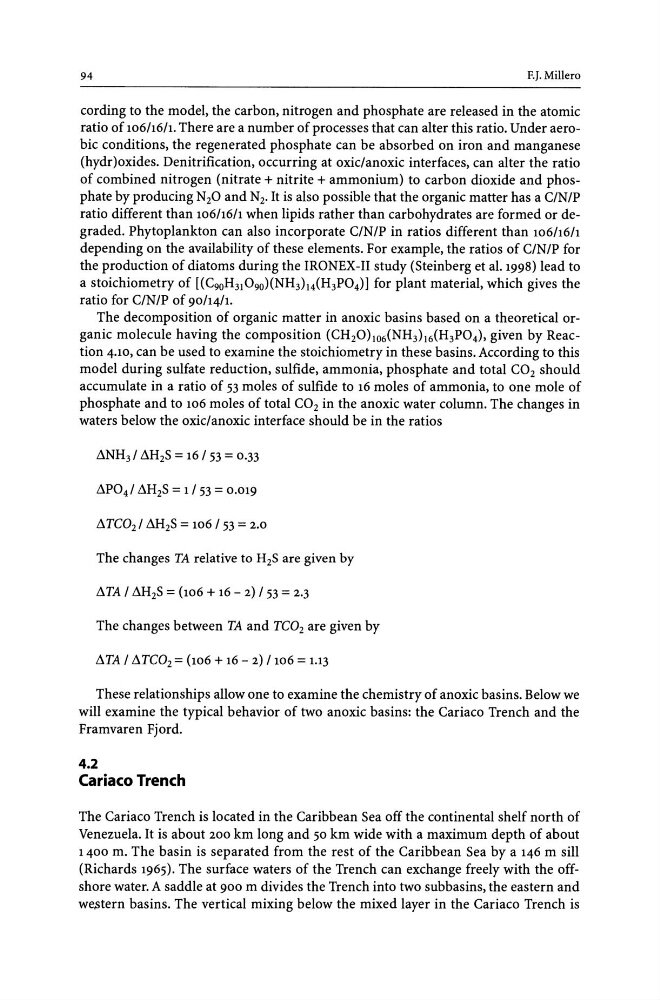
The decomposition of organic matter in anoxic basins based on a theoretical organic molecule having the composition (CH20ho6(NH3)16(H 3 P04), given by Reaction 4.10, can be used to examine the stoichiometry in these basins. According to this
model during sulfate reduction, sulfide, ammonia, phosphate and total CO 2 should
accumulate in a ratio of 53 moles of sulfide to 16 moles of ammonia, to one mole of
phosphate and to 106 moles of total CO2 in the anoxic water column. The changes in
waters below the oxic/anoxic interface should be in the ratios
The changes TA relative to HzS are given by
~TA / ~H2S = (106 + 16 - 2) / 53 = 2.3
The changes between TA and TC02 are given by
~TA / ~TC02 = (106 + 16 - 2) / 106 = 1.13
These relationships allow one to examine the chemistry of anoxic basins. Below we
will examine the typical behavior of two anoxic basins: the Cariaco Trench and the
Framvaren Fjord.
4.2
Cariaco Trench
The Cariaco Trench is located in the Caribbean Sea off the continental shelf north of
Venezuela. It is about 200 km long and 50 km wide with a maximum depth of about
1400 m. The basin is separated from the rest of the Caribbean Sea by a 146 m sill
(Richards 1965). The surface waters of the Trench can exchange freely with the offshore water. A saddle at 900 m divides the Trench into two subbasins, the eastern and
we,stern basins. The vertical mixing below the mixed layer in the Cariaco Trench is
EJ. Millero
cording to the model, the carbon, nitrogen and phosphate are released in the atomic
ratio of 106/16/1. There are a number of processes that can alter this ratio. Under aerobic conditions, the regenerated phosphate can be absorbed on iron and manganese
(hydr)oxides. Denitrification, occurring at oxic/anoxic interfaces, can alter the ratio
of combined nitrogen (nitrate + nitrite + ammonium) to carbon dioxide and phosphate by producing N20 and N2• It is also possible that the organic matter has a C/N/P
ratio different than 106/16/1 when lipids rather than carbohydrates are formed or degraded. Phytoplankton can also incorporate C/N/P in ratios different than 106/16/1
depending on the availability of these elements. For example, the ratios of C/N/P for
the production of diatoms during the IRONEX-II study (Steinberg et al. 1998) lead to
a stoichiometry of [(C90H31090)(NH3)14(H3P04)] for plant material, which gives the
ratio for C/N/P of 90/14/1.
The decomposition of organic matter in anoxic basins based on a theoretical organic molecule having the composition (CH20ho6(NH3)16(H 3 P04), given by Reaction 4.10, can be used to examine the stoichiometry in these basins. According to this
model during sulfate reduction, sulfide, ammonia, phosphate and total CO 2 should
accumulate in a ratio of 53 moles of sulfide to 16 moles of ammonia, to one mole of
phosphate and to 106 moles of total CO2 in the anoxic water column. The changes in
waters below the oxic/anoxic interface should be in the ratios
The changes TA relative to HzS are given by
~TA / ~H2S = (106 + 16 - 2) / 53 = 2.3
The changes between TA and TC02 are given by
~TA / ~TC02 = (106 + 16 - 2) / 106 = 1.13
These relationships allow one to examine the chemistry of anoxic basins. Below we
will examine the typical behavior of two anoxic basins: the Cariaco Trench and the
Framvaren Fjord.
4.2
Cariaco Trench
The Cariaco Trench is located in the Caribbean Sea off the continental shelf north of
Venezuela. It is about 200 km long and 50 km wide with a maximum depth of about
1400 m. The basin is separated from the rest of the Caribbean Sea by a 146 m sill
(Richards 1965). The surface waters of the Trench can exchange freely with the offshore water. A saddle at 900 m divides the Trench into two subbasins, the eastern and
we,stern basins. The vertical mixing below the mixed layer in the Cariaco Trench is