

CHAPTER 4 . Redox Processes in Anoxic Waters
93
After the oxygen is depleted, denitrification occurs with NO}" being the electron
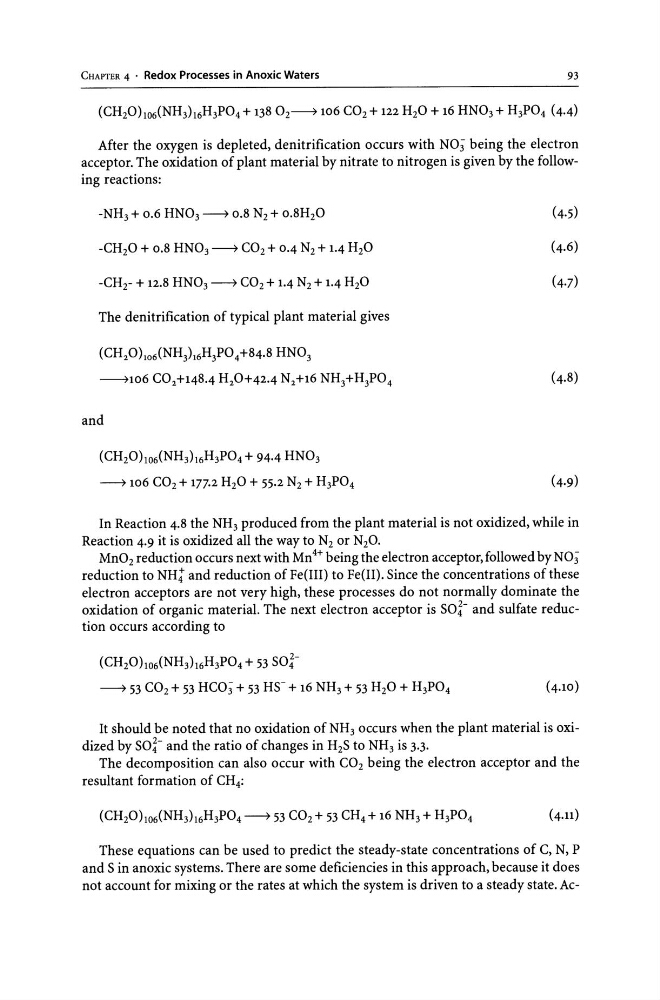
acceptor. The oxidation of plant material by nitrate to nitrogen is given by the following reactions:
-NH3 + 0.6 HN03 ~ 0.8 N z + 0.8HzO
The denitrification of typical plant material gives
(CH20)106(NH3)16H3P04+84.8 HN0 3
--H06 CO2+!48.4 H20+42.4 N2+!6 NH 3 +H 3 P0 4
and
(CHzOho6(NH3)16H3P04 + 94.4 HN03
~ 106 COZ + 177-2 HzO + 55.2 Nz + H3P04
In Reaction 4.8 the NH3 produced from the plant material is not oxidized, while in
Reaction 4.9 it is oxidized all the way to Nz or NzO.
MnOz reduction occurs next with Mn 4+ being the electron acceptor, followed by NO}"
reduction to NH: and reduction of Fe(III) to Fe(II). Since the concentrations of these
electron acceptors are not very high, these processes do not normally dominate the
oxidation of organic material. The next electron acceptor is SO~- and sulfate reduction occurs according to
(CHzOho6(NH3)16H3P04 + 53 SO~~ 53 COz + 53 HCO}" + 53 HS- + 16 NH3 + 53 HzO + H3P04
It should be noted that no oxidation of NH3 occurs when the plant material is oxidized by SO~- and the ratio of changes in HzS to NH3 is 3.3.
The decomposition can also occur with COz being the electron acceptor and the
resultant formation of CH 4 :
These equations can be used to predict the steady-state concentrations of C, N, P
and S in anoxic systems. There are some deficiencies in this approach, because it does
not account for mixing or the rates at which the system is driven to a steady state. Ac-
93
After the oxygen is depleted, denitrification occurs with NO}" being the electron
acceptor. The oxidation of plant material by nitrate to nitrogen is given by the following reactions:
-NH3 + 0.6 HN03 ~ 0.8 N z + 0.8HzO
The denitrification of typical plant material gives
(CH20)106(NH3)16H3P04+84.8 HN0 3
--H06 CO2+!48.4 H20+42.4 N2+!6 NH 3 +H 3 P0 4
and
(CHzOho6(NH3)16H3P04 + 94.4 HN03
~ 106 COZ + 177-2 HzO + 55.2 Nz + H3P04
In Reaction 4.8 the NH3 produced from the plant material is not oxidized, while in
Reaction 4.9 it is oxidized all the way to Nz or NzO.
MnOz reduction occurs next with Mn 4+ being the electron acceptor, followed by NO}"
reduction to NH: and reduction of Fe(III) to Fe(II). Since the concentrations of these
electron acceptors are not very high, these processes do not normally dominate the
oxidation of organic material. The next electron acceptor is SO~- and sulfate reduction occurs according to
(CHzOho6(NH3)16H3P04 + 53 SO~~ 53 COz + 53 HCO}" + 53 HS- + 16 NH3 + 53 HzO + H3P04
It should be noted that no oxidation of NH3 occurs when the plant material is oxidized by SO~- and the ratio of changes in HzS to NH3 is 3.3.
The decomposition can also occur with COz being the electron acceptor and the
resultant formation of CH 4 :
These equations can be used to predict the steady-state concentrations of C, N, P
and S in anoxic systems. There are some deficiencies in this approach, because it does
not account for mixing or the rates at which the system is driven to a steady state. Ac-