

4.
Fish bone
wastes
Treatment
with enzymes
L and K
originated
from Bacillus
species
Organic
matter, fat
content, protein content
molecular
weight,
water retention capacity,
water vaporozation
potential,
extract
odor, skin
patch test,
peptidee
molecular
weight,
amino acid
composition,
physiological activities
Pre-treated (fat
removal, deshing),
treated enzymatically, agitated
(200rpm, 60min,
60°C, Ph8.0),
centrifuged
(800xg,10min)
1. Organic matter the amount of a sample:
vaporized during incineration at
600°Cfor 30 min
2. Fat content: by Soxhlet extrector
3. Protein content: by Lowry-Folin
method (Lowry et al., 1951)
4. Molecular weight: by Laemmli method
(Laemmli,,1970)
5. Water retention capacity: by direct
application of human skin and using
hygrometer
6. Water vaporozation potential: by direct
application of human skin and using
Tewameter
7. Extract odor: sample dilution with pH
adjustments
8. Skin patch test: by the Association
of Industrial Information’s method
(Hayakawa et al., 1975)
9. Peptide molicular weight: mean degree
of polymerization and amino acid
composition
10. Amino acid composition: hydrolysis
of a sample under both acidic and
alkiline conditions
11. Physiological activities: antioxidant
activity (by luminol-enhanced chemiluminescence). ACE inhibitory activity
(by a modifi ed method of Cushman
and Cheung,1971)
1. Protein recovery, <53%
2. High collagen degradation
effi ciency by enzyme L
(85.5%) compared to enzyme
K (69.2%)
Morimura
et al., 2002
5.
Shrimp
ponds and
hatchery
tanks waters
Antagonism
between Bacillus and Vibrio
speceis
-
Addition of probiotic strains of
Bacillus species
-
1. No disease was experienced
2. High survival (80-100%) of
shrimps even in the presence
of Vibrio species
Moriarty,
1999
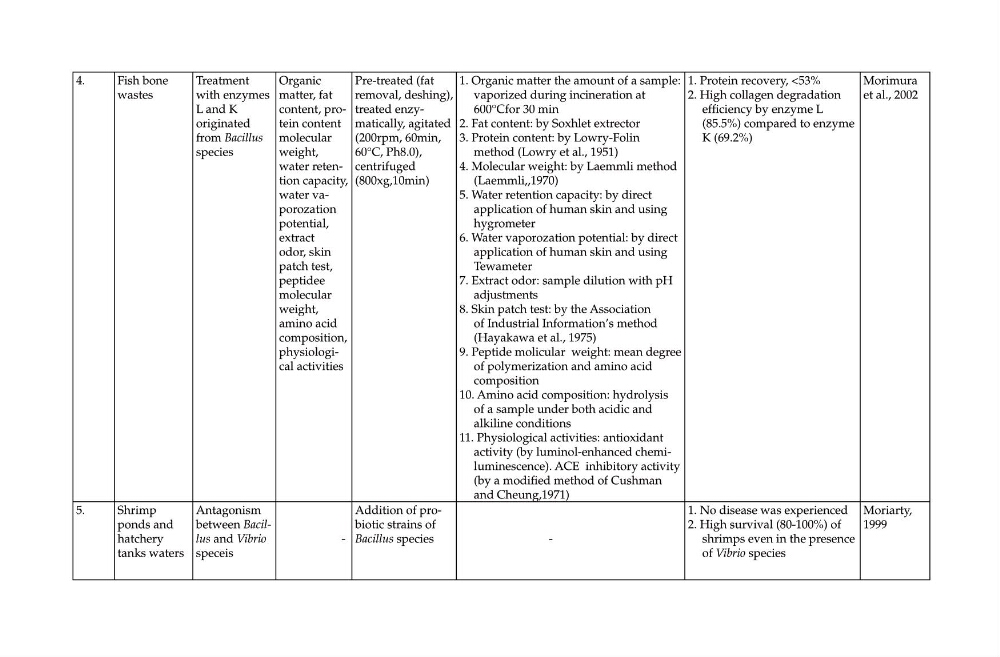
Fish bone
wastes
Treatment
with enzymes
L and K
originated
from Bacillus
species
Organic
matter, fat
content, protein content
molecular
weight,
water retention capacity,
water vaporozation
potential,
extract
odor, skin
patch test,
peptidee
molecular
weight,
amino acid
composition,
physiological activities
Pre-treated (fat
removal, deshing),
treated enzymatically, agitated
(200rpm, 60min,
60°C, Ph8.0),
centrifuged
(800xg,10min)
1. Organic matter the amount of a sample:
vaporized during incineration at
600°Cfor 30 min
2. Fat content: by Soxhlet extrector
3. Protein content: by Lowry-Folin
method (Lowry et al., 1951)
4. Molecular weight: by Laemmli method
(Laemmli,,1970)
5. Water retention capacity: by direct
application of human skin and using
hygrometer
6. Water vaporozation potential: by direct
application of human skin and using
Tewameter
7. Extract odor: sample dilution with pH
adjustments
8. Skin patch test: by the Association
of Industrial Information’s method
(Hayakawa et al., 1975)
9. Peptide molicular weight: mean degree
of polymerization and amino acid
composition
10. Amino acid composition: hydrolysis
of a sample under both acidic and
alkiline conditions
11. Physiological activities: antioxidant
activity (by luminol-enhanced chemiluminescence). ACE inhibitory activity
(by a modifi ed method of Cushman
and Cheung,1971)
1. Protein recovery, <53%
2. High collagen degradation
effi ciency by enzyme L
(85.5%) compared to enzyme
K (69.2%)
Morimura
et al., 2002
5.
Shrimp
ponds and
hatchery
tanks waters
Antagonism
between Bacillus and Vibrio
speceis
-
Addition of probiotic strains of
Bacillus species
-
1. No disease was experienced
2. High survival (80-100%) of
shrimps even in the presence
of Vibrio species
Moriarty,
1999