

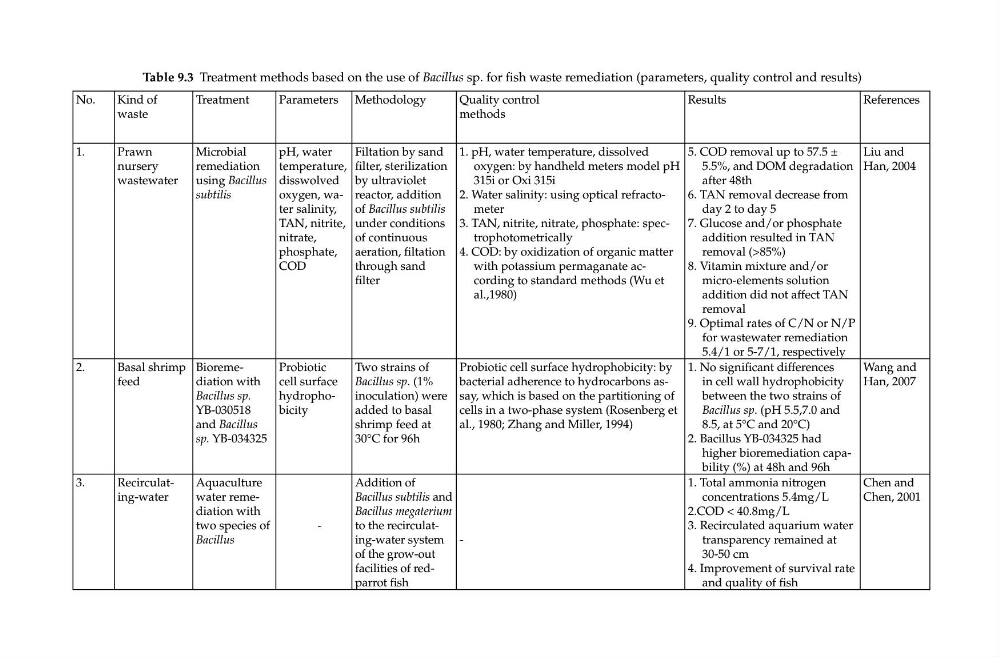
Table 9.3 Treatment methods based on the use of Bacillus sp. for fi sh waste remediation (parameters, quality control and results)
No.
Kind of
waste
Treatment
Parameters Methodology
Quality control
methods
Results
References
1.
Prawn
nursery
wastewater
Microbial
remediation
using Bacillus
subtilis
pH, water
temperature,
disswolved
oxygen, water salinity,
TAN, nitrite,
nitrate,
phosphate,
COD
Filtation by sand
fi lter, sterilization
by ultraviolet
reactor, addition
of Bacillus subtilis
under conditions
of continuous
aeration, fi ltation
through sand
fi lter
1. pH, water temperature, dissolved
oxygen: by handheld meters model pH
315i or Oxi 315i
2. Water salinity: using optical refractometer
3. TAN, nitrite, nitrate, phosphate: spectrophotometrically
4. COD: by oxidization of organic matter
with potassium permaganate according to standard methods (Wu et
al.,1980)
5. COD removal up to 57.5 ±
5.5%, and DOM degradation
after 48th
6. TAN removal decrease from
day 2 to day 5
7. Glucose and/or phosphate
addition resulted in TAN
removal (>85%)
8. Vitamin mixture and/or
micro-elements solution
addition did not affect TAN
removal
9. Optimal rates of C/N or N/P
for wastewater remediation
5.4/1 or 5-7/1, respectively
Liu and
Han, 2004
2.
Basal shrimp
feed
Bioremediation with
Bacillus sp.
YB-030518
and Bacillus
sp. YB-034325
Probiotic
cell surface
hydrophobicity
Two strains of
Bacillus sp. (1%
inoculation) were
added to basal
shrimp feed at
30°C for 96h
Probiotic cell surface hydrophobicity: by
bacterial adherence to hydrocarbons assay, which is based on the partitioning of
cells in a two-phase system (Rosenberg et
al., 1980; Zhang and Miller, 1994)
1. No signifi cant differences
in cell wall hydrophobicity
between the two strains of
Bacillus sp. (pH 5.5,7.0 and
8.5, at 5°C and 20°C)
2. Bacillus YB-034325 had
higher bioremediation capability (%) at 48h and 96h
Wang and
Han, 2007
3.
Recirculating-water
Aquaculture
water remediation with
two species of
Bacillus
-
Addition of
Bacillus subtilis and
Bacillus megaterium
to the recirculating-water system
of the grow-out
facilities of redparrot fi sh
-
1. Total ammonia nitrogen
concentrations 5.4mg/L
2.COD < 40.8mg/L
3. Recirculated aquarium water
transparency remained at
30-50 cm
4. Improvement of survival rate
and quality of fi sh
Chen and
Chen, 2001
No.
Kind of
waste
Treatment
Parameters Methodology
Quality control
methods
Results
References
1.
Prawn
nursery
wastewater
Microbial
remediation
using Bacillus
subtilis
pH, water
temperature,
disswolved
oxygen, water salinity,
TAN, nitrite,
nitrate,
phosphate,
COD
Filtation by sand
fi lter, sterilization
by ultraviolet
reactor, addition
of Bacillus subtilis
under conditions
of continuous
aeration, fi ltation
through sand
fi lter
1. pH, water temperature, dissolved
oxygen: by handheld meters model pH
315i or Oxi 315i
2. Water salinity: using optical refractometer
3. TAN, nitrite, nitrate, phosphate: spectrophotometrically
4. COD: by oxidization of organic matter
with potassium permaganate according to standard methods (Wu et
al.,1980)
5. COD removal up to 57.5 ±
5.5%, and DOM degradation
after 48th
6. TAN removal decrease from
day 2 to day 5
7. Glucose and/or phosphate
addition resulted in TAN
removal (>85%)
8. Vitamin mixture and/or
micro-elements solution
addition did not affect TAN
removal
9. Optimal rates of C/N or N/P
for wastewater remediation
5.4/1 or 5-7/1, respectively
Liu and
Han, 2004
2.
Basal shrimp
feed
Bioremediation with
Bacillus sp.
YB-030518
and Bacillus
sp. YB-034325
Probiotic
cell surface
hydrophobicity
Two strains of
Bacillus sp. (1%
inoculation) were
added to basal
shrimp feed at
30°C for 96h
Probiotic cell surface hydrophobicity: by
bacterial adherence to hydrocarbons assay, which is based on the partitioning of
cells in a two-phase system (Rosenberg et
al., 1980; Zhang and Miller, 1994)
1. No signifi cant differences
in cell wall hydrophobicity
between the two strains of
Bacillus sp. (pH 5.5,7.0 and
8.5, at 5°C and 20°C)
2. Bacillus YB-034325 had
higher bioremediation capability (%) at 48h and 96h
Wang and
Han, 2007
3.
Recirculating-water
Aquaculture
water remediation with
two species of
Bacillus
-
Addition of
Bacillus subtilis and
Bacillus megaterium
to the recirculating-water system
of the grow-out
facilities of redparrot fi sh
-
1. Total ammonia nitrogen
concentrations 5.4mg/L
2.COD < 40.8mg/L
3. Recirculated aquarium water
transparency remained at
30-50 cm
4. Improvement of survival rate
and quality of fi sh
Chen and
Chen, 2001