

Fish Waste Management Methods Based on Microorganisms 229
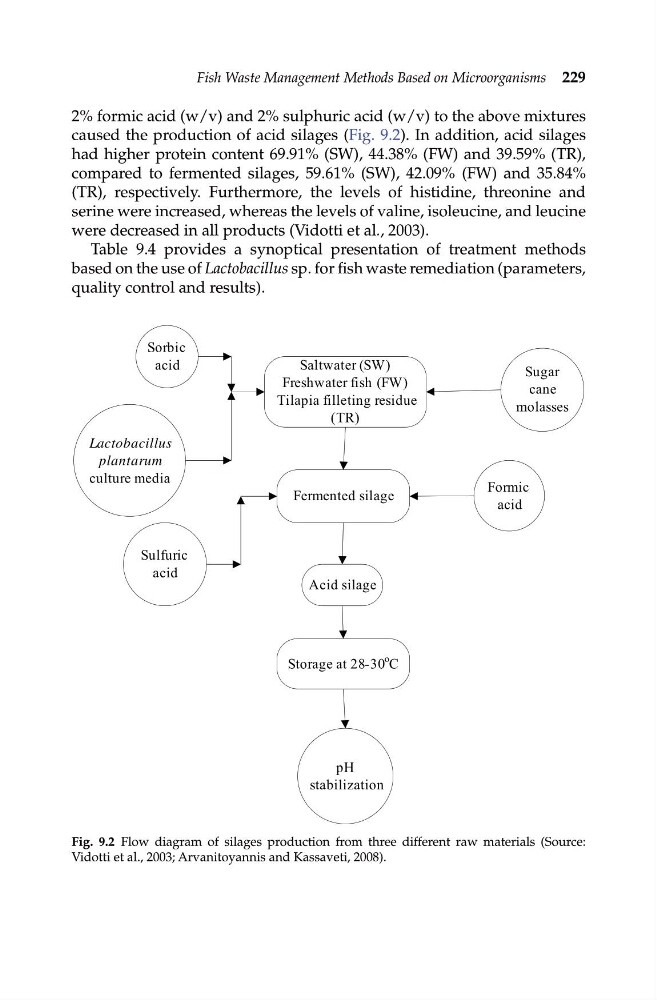
2% formic acid (w/v) and 2% sulphuric acid (w/v) to the above mixtures
caused the production of acid silages (Fig. 9.2). In addition, acid silages
had higher protein content 69.91% (SW), 44.38% (FW) and 39.59% (TR),
compared to fermented silages, 59.61% (SW), 42.09% (FW) and 35.84%
(TR), respectively. Furthermore, the levels of histidine, threonine and
serine were increased, whereas the levels of valine, isoleucine, and leucine
were decreased in all products (Vidotti et al., 2003).
Table 9.4 provides a synoptical presentation of treatment methods
based on the use of Lactobacillus sp. for fi sh waste remediation (parameters,
quality control and results).
Sorbic
acid
Lactobacillus
plantarum
culture media
Saltwater (SW)
Freshwater fish (FW)
Tilapia filleting residue
(TR)
Sugar
cane
molasses
Sulfuric
acid
Fermented silage
Formic
acid
Acid silage
Storage at 28-30
o
C
pH
stabilization
Fig. 9.2 Flow diagram of silages production from three different raw materials (Source:
Vidotti et al., 2003; Arvanitoyannis and Kassaveti, 2008).
2% formic acid (w/v) and 2% sulphuric acid (w/v) to the above mixtures
caused the production of acid silages (Fig. 9.2). In addition, acid silages
had higher protein content 69.91% (SW), 44.38% (FW) and 39.59% (TR),
compared to fermented silages, 59.61% (SW), 42.09% (FW) and 35.84%
(TR), respectively. Furthermore, the levels of histidine, threonine and
serine were increased, whereas the levels of valine, isoleucine, and leucine
were decreased in all products (Vidotti et al., 2003).
Table 9.4 provides a synoptical presentation of treatment methods
based on the use of Lactobacillus sp. for fi sh waste remediation (parameters,
quality control and results).
Sorbic
acid
Lactobacillus
plantarum
culture media
Saltwater (SW)
Freshwater fish (FW)
Tilapia filleting residue
(TR)
Sugar
cane
molasses
Sulfuric
acid
Fermented silage
Formic
acid
Acid silage
Storage at 28-30
o
C
pH
stabilization
Fig. 9.2 Flow diagram of silages production from three different raw materials (Source:
Vidotti et al., 2003; Arvanitoyannis and Kassaveti, 2008).