

480
M. Pettine . L. Patrolecco . S. Capri
compared to June 1996. This was confirmed by the use of the remote observing vehicle (ROV) during the cruises. The scavenging effect exerted in the water column by
mucous macroaggregates may partially explain an inverse relationship between macroaggregates and dissolved DOC concentrations. However, these findings point out that
high DOC levels, as in the case of June 1996, do not necessarily produce macroaggregates, strengthening the importance of the qualitative characteristics of the DOC pool
in the mass transfer between DOC, COC and the mucous fraction.
The conclusion by Passow (2000) that TEP-precursors, which consist of strongly
sulphated polysaccharides actively involved in aggregation processes, appear to be a
distinct group of polysaccharides, whose production and standing stocks are uncoupled from bulk carbohydrates, further remarks the importance of the qualitative
characteristics of DOM in the formation of aggregates. The higher sulphur level found
in macroaggregates in our previous investigations (Pettine et a1.199S) is consistent with
a large role played by TEP in the formation of macroaggregate.
22.6
Composition of DOM
Dissolved organic matter in the northern Adriatic system is characterized by the presence of a high colloidal fraction with a shift in the molecular weight distribution toward the large size fraction and a high contribution of carbohydrates to dissolved organic matter (Pettine et al. 1999 and 2001).
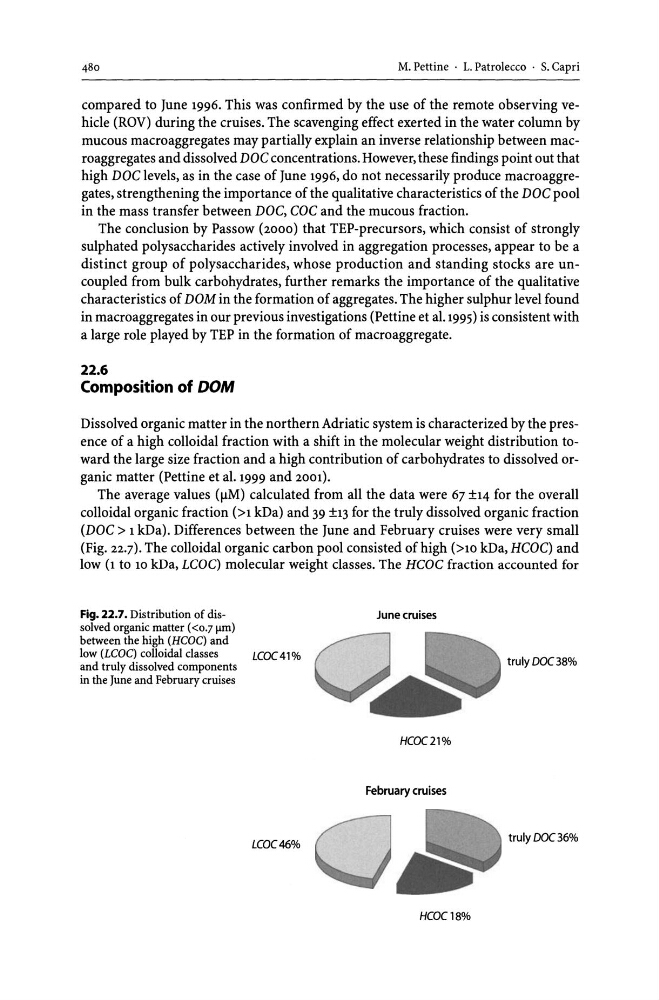
The average values (11M) calculated from all the data were 67 ±14 for the overall
colloidal organic fraction (>1 kDa) and 39 ±13 for the truly dissolved organic fraction
(DOC> 1 kDa). Differences between the June and February cruises were very small
(Fig. 22.7). The colloidal organic carbon pool consisted of high (>10 kDa, HCOC) and
low (1 to 10 kDa, LCGC) molecular weight classes. The HCGC fraction accounted for
Fig. 22.7. Distribution of dissolved organic matter «0.7 flIll)
between the high (HCaC) and
low (LCaC) colloidal classes
LCaC 41 %
and truly dissolved components
in the June and February cruises
LCOC46%
June cruises
truly DOC 38%
HCOC21%
February cruises
truly DOC 36%
HCOC18%
M. Pettine . L. Patrolecco . S. Capri
compared to June 1996. This was confirmed by the use of the remote observing vehicle (ROV) during the cruises. The scavenging effect exerted in the water column by
mucous macroaggregates may partially explain an inverse relationship between macroaggregates and dissolved DOC concentrations. However, these findings point out that
high DOC levels, as in the case of June 1996, do not necessarily produce macroaggregates, strengthening the importance of the qualitative characteristics of the DOC pool
in the mass transfer between DOC, COC and the mucous fraction.
The conclusion by Passow (2000) that TEP-precursors, which consist of strongly
sulphated polysaccharides actively involved in aggregation processes, appear to be a
distinct group of polysaccharides, whose production and standing stocks are uncoupled from bulk carbohydrates, further remarks the importance of the qualitative
characteristics of DOM in the formation of aggregates. The higher sulphur level found
in macroaggregates in our previous investigations (Pettine et a1.199S) is consistent with
a large role played by TEP in the formation of macroaggregate.
22.6
Composition of DOM
Dissolved organic matter in the northern Adriatic system is characterized by the presence of a high colloidal fraction with a shift in the molecular weight distribution toward the large size fraction and a high contribution of carbohydrates to dissolved organic matter (Pettine et al. 1999 and 2001).
The average values (11M) calculated from all the data were 67 ±14 for the overall
colloidal organic fraction (>1 kDa) and 39 ±13 for the truly dissolved organic fraction
(DOC> 1 kDa). Differences between the June and February cruises were very small
(Fig. 22.7). The colloidal organic carbon pool consisted of high (>10 kDa, HCOC) and
low (1 to 10 kDa, LCGC) molecular weight classes. The HCGC fraction accounted for
Fig. 22.7. Distribution of dissolved organic matter «0.7 flIll)
between the high (HCaC) and
low (LCaC) colloidal classes
LCaC 41 %
and truly dissolved components
in the June and February cruises
LCOC46%
June cruises
truly DOC 38%
HCOC21%
February cruises
truly DOC 36%
HCOC18%