

460
C. Ianni· N. Ruggieri
a
18
Z 45.00
. ~.
~G
L
15
12
12.30
12.60
12.90
13.20
Longitude (0 El
9
b
8.0
Z 45.00
°
6.0
.,
"
~
'f
~ 44.80
4.0
I ~(
1I-L904 4
103
7
12.30
12.60
12.90
13.20
2.0
Longitude (0 El
0.0
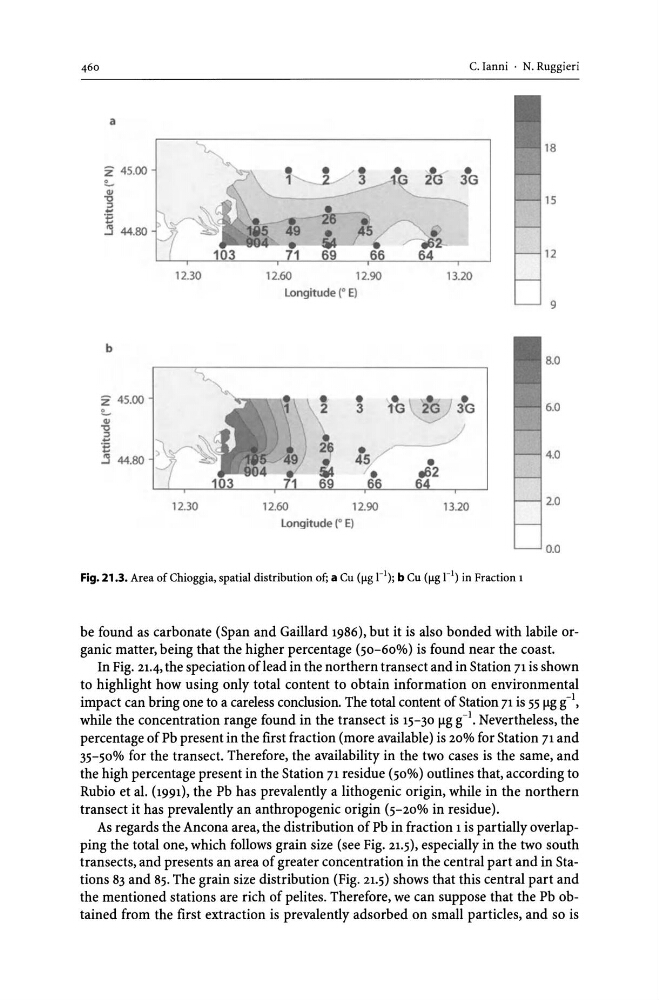
Fig. 21.3. Area of Chioggia, spatial distribution of; a Cu (fig rl); b Cu (fig rl) in Fraction 1
be found as carbonate (Span and Gaillard 1986), but it is also bonded with labile organic matter, being that the higher percentage (so-60%) is found near the coast.
In Fig. 21.4, the speciation oflead in the northern transect and in Station 71 is shown
to highlight how using only total content to obtain information on environmental
impact can bring one to a careless conclusion. The total content of Station 71 is SSjlg g-I,
while the concentration range found in the transect is IS-30 jlg g -I. Nevertheless, the
percentage of Pb present in the first fraction (more available) is 20% for Station 71 and
3S-S0% for the transect. Therefore, the availability in the two cases is the same, and
the high percentage present in the Station 71 residue (so%) outlines that, according to
Rubio et al. (1991), the Pb has prevalently a lithogenic origin, while in the northern
transect it has prevalently an anthropogenic origin (S-20% in residue).
As regards the Ancona area, the distribution of Pb in fraction 1 is partially overlapping the total one, which follows grain size (see Fig. 21.S), especially in the two south
transects, and presents an area of greater concentration in the central part and in Stations 83 and 8S. The grain size distribution (Fig. 21.S) shows that this central part and
the mentioned stations are rich of pelites. Therefore, we can suppose that the Pb obtained from the first extraction is prevalently adsorbed on small particles, and so is
C. Ianni· N. Ruggieri
a
18
Z 45.00
. ~.
~G
L
15
12
12.30
12.60
12.90
13.20
Longitude (0 El
9
b
8.0
Z 45.00
°
6.0
.,
"
~
'f
~ 44.80
4.0
I ~(
1I-L904 4
103
7
12.30
12.60
12.90
13.20
2.0
Longitude (0 El
0.0
Fig. 21.3. Area of Chioggia, spatial distribution of; a Cu (fig rl); b Cu (fig rl) in Fraction 1
be found as carbonate (Span and Gaillard 1986), but it is also bonded with labile organic matter, being that the higher percentage (so-60%) is found near the coast.
In Fig. 21.4, the speciation oflead in the northern transect and in Station 71 is shown
to highlight how using only total content to obtain information on environmental
impact can bring one to a careless conclusion. The total content of Station 71 is SSjlg g-I,
while the concentration range found in the transect is IS-30 jlg g -I. Nevertheless, the
percentage of Pb present in the first fraction (more available) is 20% for Station 71 and
3S-S0% for the transect. Therefore, the availability in the two cases is the same, and
the high percentage present in the Station 71 residue (so%) outlines that, according to
Rubio et al. (1991), the Pb has prevalently a lithogenic origin, while in the northern
transect it has prevalently an anthropogenic origin (S-20% in residue).
As regards the Ancona area, the distribution of Pb in fraction 1 is partially overlapping the total one, which follows grain size (see Fig. 21.S), especially in the two south
transects, and presents an area of greater concentration in the central part and in Stations 83 and 8S. The grain size distribution (Fig. 21.S) shows that this central part and
the mentioned stations are rich of pelites. Therefore, we can suppose that the Pb obtained from the first extraction is prevalently adsorbed on small particles, and so is