

CHAPTER 21 • Solid Speciation and Selective Extraction Procedures
461
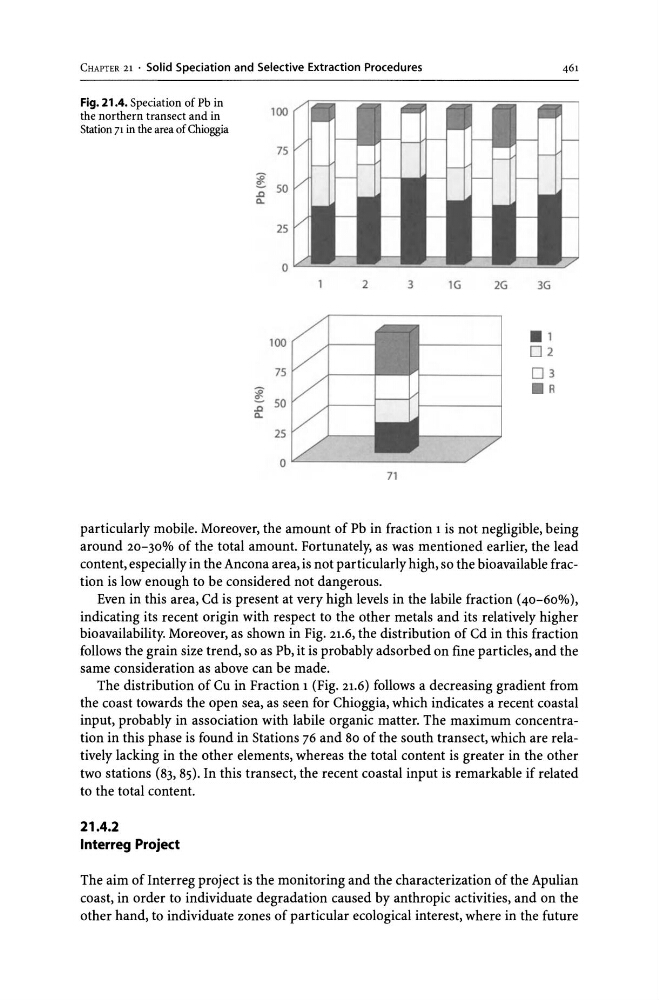
Fig. 21.4. Speciation of Pb in
the northern transect and in
100
Station 71 in the area of Chioggia
75
i
:c 50
0..
25
o ... I<:.....:=~---..!
2
3
lG
2G
3G
100 (
.1
02
i 75 r /i
iJ
03
.R
:c 50
0..
25
0
71
particularly mobile. Moreover, the amount of Pb in fraction 1 is not negligible, being
around 20-30% of the total amount. Fortunately, as was mentioned earlier, the lead
content, especially in the Ancona area, is not particularly high, so the bioavailable fraction is low enough to be considered not dangerous.
Even in this area, Cd is present at very high levels in the labile fraction (40-60%),
indicating its recent origin with respect to the other metals and its relatively higher
bioavailability. Moreover, as shown in Fig. 21.6, the distribution of Cd in this fraction
follows the grain size trend, so as Pb, it is probably adsorbed on fine particles, and the
same consideration as above can be made.
The distribution of Cu in Fraction 1 (Fig. 21.6) follows a decreasing gradient from
the coast towards the open sea, as seen for Chioggia, which indicates a recent coastal
input, probably in association with labile organic matter. The maximum concentration in this phase is found in Stations 76 and 80 of the south transect, which are relatively lacking in the other elements, whereas the total content is greater in the other
two stations (83,85). In this transect, the recent coastal input is remarkable if related
to the total content.
21.4.2
Interreg Project
The aim of Interreg project is the monitoring and the characterization of the Apulian
coast, in order to individuate degradation caused by anthropic activities, and on the
other hand, to individuate zones of particular ecological interest, where in the future
461
Fig. 21.4. Speciation of Pb in
the northern transect and in
100
Station 71 in the area of Chioggia
75
i
:c 50
0..
25
o ... I<:.....:=~---..!
2
3
lG
2G
3G
100 (
.1
02
i 75 r /i
iJ
03
.R
:c 50
0..
25
0
71
particularly mobile. Moreover, the amount of Pb in fraction 1 is not negligible, being
around 20-30% of the total amount. Fortunately, as was mentioned earlier, the lead
content, especially in the Ancona area, is not particularly high, so the bioavailable fraction is low enough to be considered not dangerous.
Even in this area, Cd is present at very high levels in the labile fraction (40-60%),
indicating its recent origin with respect to the other metals and its relatively higher
bioavailability. Moreover, as shown in Fig. 21.6, the distribution of Cd in this fraction
follows the grain size trend, so as Pb, it is probably adsorbed on fine particles, and the
same consideration as above can be made.
The distribution of Cu in Fraction 1 (Fig. 21.6) follows a decreasing gradient from
the coast towards the open sea, as seen for Chioggia, which indicates a recent coastal
input, probably in association with labile organic matter. The maximum concentration in this phase is found in Stations 76 and 80 of the south transect, which are relatively lacking in the other elements, whereas the total content is greater in the other
two stations (83,85). In this transect, the recent coastal input is remarkable if related
to the total content.
21.4.2
Interreg Project
The aim of Interreg project is the monitoring and the characterization of the Apulian
coast, in order to individuate degradation caused by anthropic activities, and on the
other hand, to individuate zones of particular ecological interest, where in the future