

CHAPTER 21 • Solid Speciation and Selective Extraction Procedures
a
Z 45.00
L
QI
" :::>
'f
~ 44.80
b
Z 45.00
L
QI
"
:::>
'f
~ 44.80
12.30
12.30
12.60
12.90
13.20
Longitude (" E)
: G
12.60
12.90
13.20
longitude (0 E)
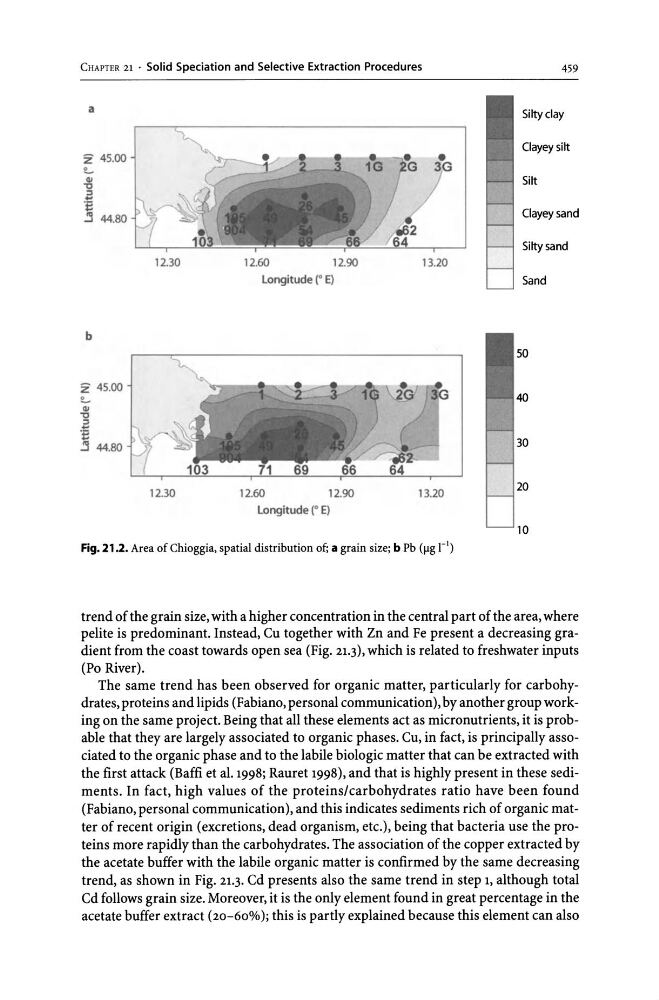
Fig. 21.2. Area of Chioggia, spatial distribution of; a grain size; b Pb (Ilg t')
459
Silty clay
Clayey silt
Silt
Clayey sand
Silty sand
Sand
50
40
30
20
10
trend of the grain size, with a higher concentration in the central part of the area, where
pelite is predominant. Instead, Cu together with Zn and Fe present a decreasing gradient from the coast towards open sea (Fig. 21.3), which is related to freshwater inputs
(Po River).
The same trend has been observed for organic matter, particularly for carbohydrates, proteins and lipids (Fabiano, personal communication), by another group working on the same project. Being that all these elements act as micronutrients, it is probable that they are largely associated to organic phases. Cu, in fact, is principally associated to the organic phase and to the labile biologic matter that can be extracted with
the first attack (Baffi et al. 1998; Rauret 1998), and that is highly present in these sediments. In fact, high values of the proteins/carbohydrates ratio have been found
(Fabiano, personal communication), and this indicates sediments rich of organic matter of recent origin (excretions, dead organism, etc.), being that bacteria use the proteins more rapidly than the carbohydrates. The association of the copper extracted by
the acetate buffer with the labile organic matter is confirmed by the same decreasing
trend, as shown in Fig. 21.3. Cd presents also the same trend in step 1, although total
Cd follows grain size. Moreover, it is the only element found in great percentage in the
acetate buffer extract (20-60%); this is partly explained because this element can also
a
Z 45.00
L
QI
" :::>
'f
~ 44.80
b
Z 45.00
L
QI
"
:::>
'f
~ 44.80
12.30
12.30
12.60
12.90
13.20
Longitude (" E)
: G
12.60
12.90
13.20
longitude (0 E)
Fig. 21.2. Area of Chioggia, spatial distribution of; a grain size; b Pb (Ilg t')
459
Silty clay
Clayey silt
Silt
Clayey sand
Silty sand
Sand
50
40
30
20
10
trend of the grain size, with a higher concentration in the central part of the area, where
pelite is predominant. Instead, Cu together with Zn and Fe present a decreasing gradient from the coast towards open sea (Fig. 21.3), which is related to freshwater inputs
(Po River).
The same trend has been observed for organic matter, particularly for carbohydrates, proteins and lipids (Fabiano, personal communication), by another group working on the same project. Being that all these elements act as micronutrients, it is probable that they are largely associated to organic phases. Cu, in fact, is principally associated to the organic phase and to the labile biologic matter that can be extracted with
the first attack (Baffi et al. 1998; Rauret 1998), and that is highly present in these sediments. In fact, high values of the proteins/carbohydrates ratio have been found
(Fabiano, personal communication), and this indicates sediments rich of organic matter of recent origin (excretions, dead organism, etc.), being that bacteria use the proteins more rapidly than the carbohydrates. The association of the copper extracted by
the acetate buffer with the labile organic matter is confirmed by the same decreasing
trend, as shown in Fig. 21.3. Cd presents also the same trend in step 1, although total
Cd follows grain size. Moreover, it is the only element found in great percentage in the
acetate buffer extract (20-60%); this is partly explained because this element can also