

CHAPTER 19 . Palaeoenvironmental Reconstructions
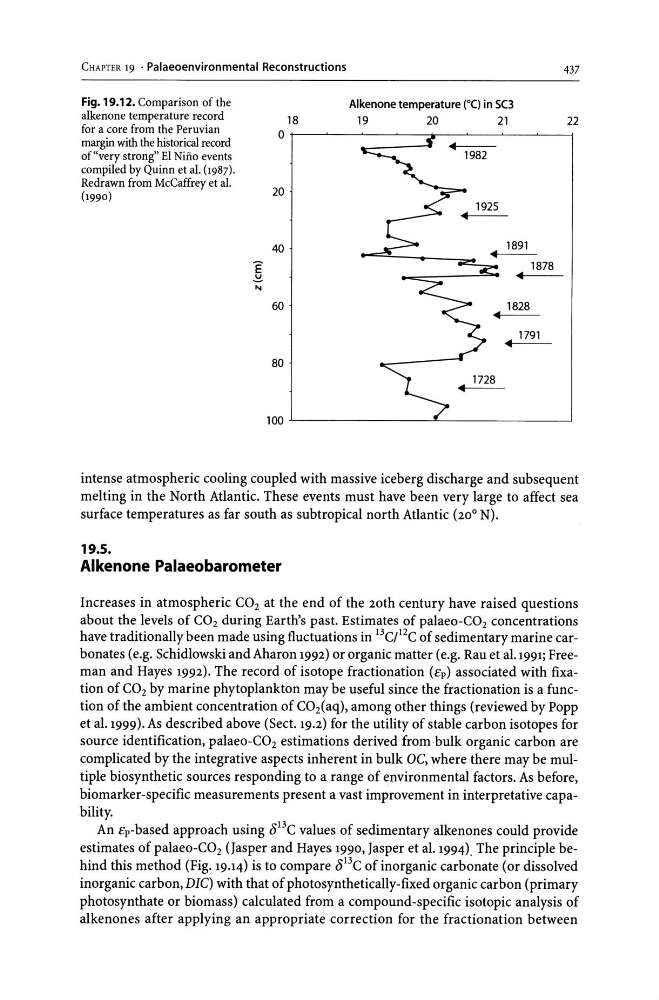
Fig. 19.12. Comparison of the
alkenone temperature record
for a core from the Peruvian
margin with the historical record
of "very strong" El Nino events
compiled by Quinn et al. (1987).
Redrawn from McCaffrey et aI.
(1990)
E
~
' "
Alkenone temperature (DC) in SC3
18
19
20
21
o I
...
... 1982
20
1925
...
40
60
1828
..--...
1791
I
.80
100
•
437
22
intense atmospheric cooling coupled with massive iceberg discharge and subsequent
melting in the North Atlantic. These events must have been very large to affect sea
surface temperatures as far south as subtropical north Atlantic (20 0 N).
19.5.
Alkenone Palaeobarometer
Increases in atmospheric CO2 at the end of the 20th century have raised questions
about the levels of CO2 during Earth's past. Estimates of palaeo-C02 concentrations
have traditionally been made using fluctuations in 13CJ12C of sedimentary marine carbonates (e.g. Schidlowski and Aharon 1992) or organic matter (e.g. Rau et al.1991; Freeman and Hayes 1992). The record of isotope fractionation (£p) associated with fixation of CO2 by marine phytoplankton may be useful since the fractionation is a function of the ambient concentration of CO2(aq), among other things (reviewed by Popp
et al.1999). As described above (Sect. 19.2) for the utility of stable carbon isotopes for
source identification, palaeo-C02 estimations derived from bulk organic carbon are
complicated by the integrative aspects inherent in bulk OC, where there may be multiple biosynthetic sources responding to a range of environmental factors. As before,
biomarker-specific measurements present a vast improvement in interpretative capability.
An £p-based approach using 8 13 C values of sedimentary alkenones could provide
estimates of palaeo-C02 (Jasper and Hayes 1990, Jasper et al. 1994). The principle behind this method (Fig. 19.14) is to compare 813c of inorganic carbonate (or dissolved
inorganic carbon, DIC) with that of photosynthetically-fixed organic carbon (primary
photosynthate or biomass) calculated from a compound-specific isotopic analysis of
alkenones after applying an appropriate correction for the fractionation between
Fig. 19.12. Comparison of the
alkenone temperature record
for a core from the Peruvian
margin with the historical record
of "very strong" El Nino events
compiled by Quinn et al. (1987).
Redrawn from McCaffrey et aI.
(1990)
E
~
' "
Alkenone temperature (DC) in SC3
18
19
20
21
o I
...
... 1982
20
1925
...
40
60
1828
..--...
1791
I
.80
100
•
437
22
intense atmospheric cooling coupled with massive iceberg discharge and subsequent
melting in the North Atlantic. These events must have been very large to affect sea
surface temperatures as far south as subtropical north Atlantic (20 0 N).
19.5.
Alkenone Palaeobarometer
Increases in atmospheric CO2 at the end of the 20th century have raised questions
about the levels of CO2 during Earth's past. Estimates of palaeo-C02 concentrations
have traditionally been made using fluctuations in 13CJ12C of sedimentary marine carbonates (e.g. Schidlowski and Aharon 1992) or organic matter (e.g. Rau et al.1991; Freeman and Hayes 1992). The record of isotope fractionation (£p) associated with fixation of CO2 by marine phytoplankton may be useful since the fractionation is a function of the ambient concentration of CO2(aq), among other things (reviewed by Popp
et al.1999). As described above (Sect. 19.2) for the utility of stable carbon isotopes for
source identification, palaeo-C02 estimations derived from bulk organic carbon are
complicated by the integrative aspects inherent in bulk OC, where there may be multiple biosynthetic sources responding to a range of environmental factors. As before,
biomarker-specific measurements present a vast improvement in interpretative capability.
An £p-based approach using 8 13 C values of sedimentary alkenones could provide
estimates of palaeo-C02 (Jasper and Hayes 1990, Jasper et al. 1994). The principle behind this method (Fig. 19.14) is to compare 813c of inorganic carbonate (or dissolved
inorganic carbon, DIC) with that of photosynthetically-fixed organic carbon (primary
photosynthate or biomass) calculated from a compound-specific isotopic analysis of
alkenones after applying an appropriate correction for the fractionation between