

398
P. J. Worsfold . E. P. Achterberg· A. R. Bowie· R. Sandford· V. Cannizzaro· P. Gardolinski
16.5
FI-SPEC Determination of Nitrate in Sea Water
16.5.1
Marine Chemistry of Nitrate
The elemental gas (N2) is the most abundant form of nitrogen in estuarine and coastal
waters. For biogeochemical processes, however, the most important species are the
dissolved inorganic forms (nitrate, nitrite and ammonia) and organic nitrogen compounds (in dissolved and particulate forms), of which the predominant species in oxic
waters is nitrate.
Nitrate plays an important role in primary production in euphotic surface waters,
and as a growth-limiting nutrient, it can directly affect the quality of freshwater and
marine environments. Therefore, an accurate and reliable technique for determining
nutrient concentrations is essential, and a field deployable instrument is desirable to
minimize sample degradation and provide high temporal and spatial resolution monitoring.A submersible FI monitor incorporating spectrophotometric (SPEC) detection
is therefore a potentially attractive approach.
16.5.2
Submersible FI Monitor
A prototype instrument has been described (David et al. 1998, 1999). The current design is contained within a pressure housing engineered from a single block of PVC in
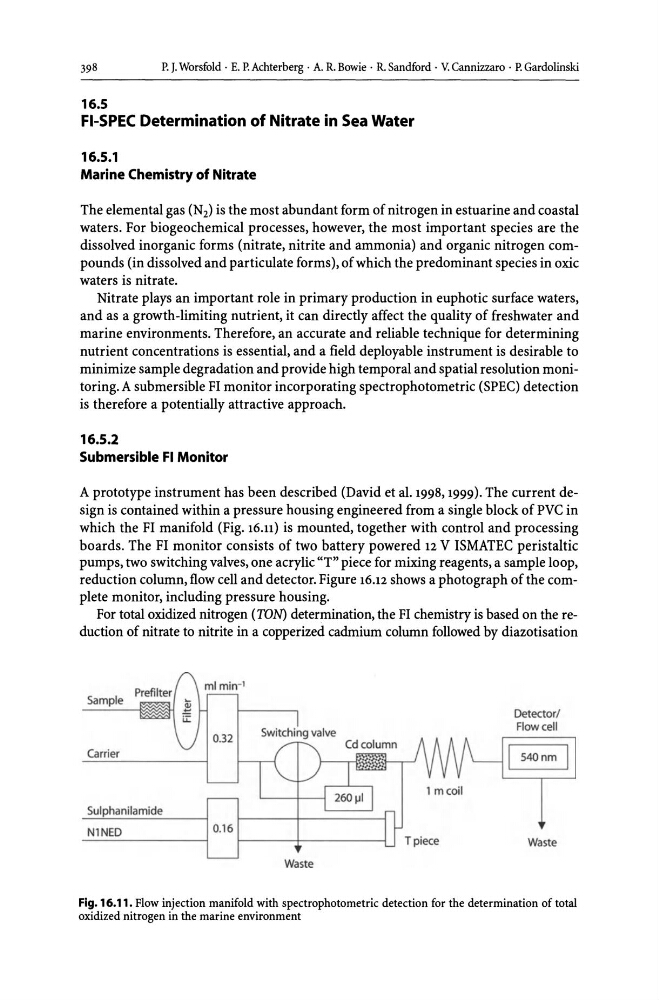
which the FI manifold (Fig. 16.11) is mounted, together with control and processing
boards. The FI monitor consists of two battery powered 12 V ISMATEC peristaltic
pumps, two switching valves, one acrylic "T" piece for mixing reagents, a sample loop,
reduction column, flow cell and detector. Figure 16.12 shows a photograph of the complete monitor, including pressure housing.
For total oxidized nitrogen (TON) determination, the FI chemistry is based on the reduction of nitrate to nitrite in a copperized cadmium column followed by diazotisation
Carrier
Sulphanilamide
N1NED
0.16
Waste
Detector/
Flow cell
Fig. 16.11. Flow injection manifold with spectrophotometric detection for the determination of total
oxidized nitrogen in the marine environment
P. J. Worsfold . E. P. Achterberg· A. R. Bowie· R. Sandford· V. Cannizzaro· P. Gardolinski
16.5
FI-SPEC Determination of Nitrate in Sea Water
16.5.1
Marine Chemistry of Nitrate
The elemental gas (N2) is the most abundant form of nitrogen in estuarine and coastal
waters. For biogeochemical processes, however, the most important species are the
dissolved inorganic forms (nitrate, nitrite and ammonia) and organic nitrogen compounds (in dissolved and particulate forms), of which the predominant species in oxic
waters is nitrate.
Nitrate plays an important role in primary production in euphotic surface waters,
and as a growth-limiting nutrient, it can directly affect the quality of freshwater and
marine environments. Therefore, an accurate and reliable technique for determining
nutrient concentrations is essential, and a field deployable instrument is desirable to
minimize sample degradation and provide high temporal and spatial resolution monitoring.A submersible FI monitor incorporating spectrophotometric (SPEC) detection
is therefore a potentially attractive approach.
16.5.2
Submersible FI Monitor
A prototype instrument has been described (David et al. 1998, 1999). The current design is contained within a pressure housing engineered from a single block of PVC in
which the FI manifold (Fig. 16.11) is mounted, together with control and processing
boards. The FI monitor consists of two battery powered 12 V ISMATEC peristaltic
pumps, two switching valves, one acrylic "T" piece for mixing reagents, a sample loop,
reduction column, flow cell and detector. Figure 16.12 shows a photograph of the complete monitor, including pressure housing.
For total oxidized nitrogen (TON) determination, the FI chemistry is based on the reduction of nitrate to nitrite in a copperized cadmium column followed by diazotisation
Carrier
Sulphanilamide
N1NED
0.16
Waste
Detector/
Flow cell
Fig. 16.11. Flow injection manifold with spectrophotometric detection for the determination of total
oxidized nitrogen in the marine environment