

396
P. J. Worsfold . E. P. Achterberg· A. R. Bowie . R. Sandford· V. Cannizzaro . P. Gardolinski
Pump
MQW
Waste
8-HQcolumn
Buffer
Sample
1.2
I § ' I Injection valve
4-way
valve
Hel
•
I 1.2
NaOH, Methanol
1.2
Pyrogallol,
1.2
HlOl, GAB
Flow cell
PMT
mlmin- 1
Waste
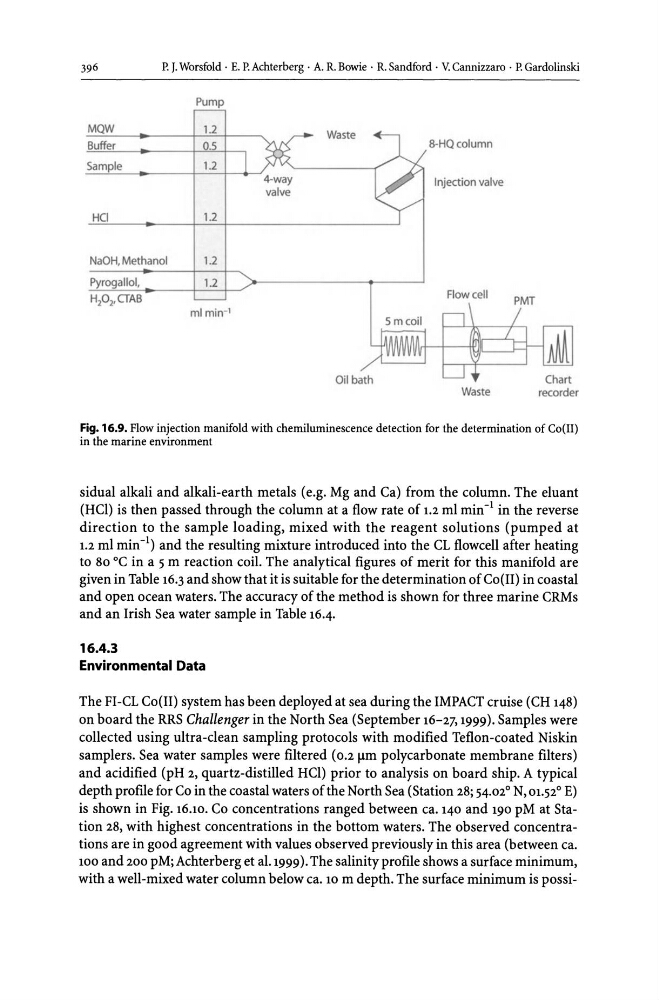
Fig. 16.9. Flow injection manifold with chemiluminescence detection for the determination of Co(Il)
in the marine environment
sidual alkali and alkali-earth metals (e.g. Mg and Ca) from the column. The eluant
(HCI) is then passed through the column at a flow rate of 1.2 ml min- l in the reverse
direction to the sample loading, mixed with the reagent solutions (pumped at
1.2 ml min-I) and the resulting mixture introduced into the CL flowcell after heating
to 80°C in a 5 m reaction coil. The analytical figures of merit for this manifold are
given in Table 16.3 and show that it is suitable for the determination of Co(II) in coastal
and open ocean waters. The accuracy of the method is shown for three marine CRMs
and an Irish Sea water sample in Table 16.4.
16.4.3
Environmental Data
The FI-CL Co(II) system has been deployed at sea during the IMPACT cruise (CH 148)
on board the RRS Challenger in the North Sea (September 16-27, 1999). Samples were
collected using ultra-clean sampling protocols with modified Teflon-coated Niskin
samplers. Sea water samples were filtered (0.2 11m polycarbonate membrane filters)
and acidified (pH 2, quartz-distilled HCI) prior to analysis on board ship. A typical
depth profile for Co in the coastal waters of the North Sea (Station 28; 54.02° N,01.52° E)
is shown in Fig. 16.10. Co concentrations ranged between ca. 140 and 190 pM at Station 28, with highest concentrations in the bottom waters. The observed concentrations are in good agreement with values observed previously in this area (between ca.
100 and 200 pM; Achterberg et al.1999). The salinity profile shows a surface minimum,
with a well-mixed water column below ca. 10 m depth. The surface minimum is possi-
P. J. Worsfold . E. P. Achterberg· A. R. Bowie . R. Sandford· V. Cannizzaro . P. Gardolinski
Pump
MQW
Waste
8-HQcolumn
Buffer
Sample
1.2
I § ' I Injection valve
4-way
valve
Hel
•
I 1.2
NaOH, Methanol
1.2
Pyrogallol,
1.2
HlOl, GAB
Flow cell
PMT
mlmin- 1
Waste
Fig. 16.9. Flow injection manifold with chemiluminescence detection for the determination of Co(Il)
in the marine environment
sidual alkali and alkali-earth metals (e.g. Mg and Ca) from the column. The eluant
(HCI) is then passed through the column at a flow rate of 1.2 ml min- l in the reverse
direction to the sample loading, mixed with the reagent solutions (pumped at
1.2 ml min-I) and the resulting mixture introduced into the CL flowcell after heating
to 80°C in a 5 m reaction coil. The analytical figures of merit for this manifold are
given in Table 16.3 and show that it is suitable for the determination of Co(II) in coastal
and open ocean waters. The accuracy of the method is shown for three marine CRMs
and an Irish Sea water sample in Table 16.4.
16.4.3
Environmental Data
The FI-CL Co(II) system has been deployed at sea during the IMPACT cruise (CH 148)
on board the RRS Challenger in the North Sea (September 16-27, 1999). Samples were
collected using ultra-clean sampling protocols with modified Teflon-coated Niskin
samplers. Sea water samples were filtered (0.2 11m polycarbonate membrane filters)
and acidified (pH 2, quartz-distilled HCI) prior to analysis on board ship. A typical
depth profile for Co in the coastal waters of the North Sea (Station 28; 54.02° N,01.52° E)
is shown in Fig. 16.10. Co concentrations ranged between ca. 140 and 190 pM at Station 28, with highest concentrations in the bottom waters. The observed concentrations are in good agreement with values observed previously in this area (between ca.
100 and 200 pM; Achterberg et al.1999). The salinity profile shows a surface minimum,
with a well-mixed water column below ca. 10 m depth. The surface minimum is possi-