

CHAPTER 16 . Flow Injection Techniques for the in situ Monitoring of Marine Processes
395
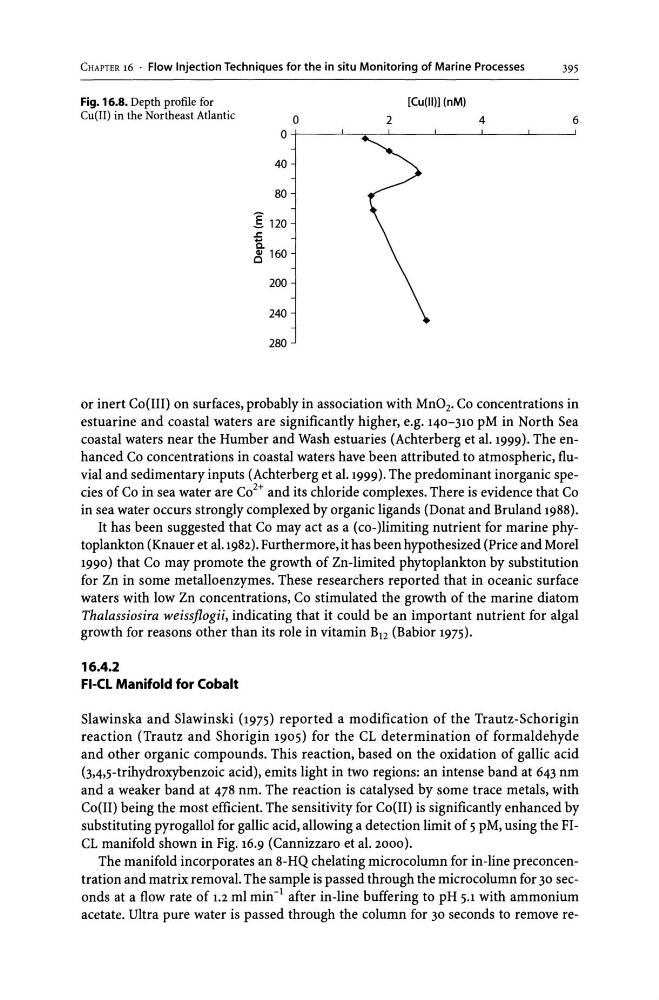
Fig. 16.8. Depth profile for
Cu(II) in the Northeast Atlantic
0
40
80
]: 120
a
~ 160
200
240
280
[Cu(lI)] (nM)
0
2
4
6
or inert Co(IlI) on surfaces, probably in association with MnOz. Co concentrations in
estuarine and coastal waters are significantly higher, e.g. 140-310 pM in North Sea
coastal waters near the Humber and Wash estuaries (Achterberg et al. 1999). The enhanced Co concentrations in coastal waters have been attributed to atmospheric, fluvial and sedimentary inputs (Achterberg et aI. 1999). The predominant inorganic species of Co in sea water are Co z + and its chloride complexes. There is evidence that Co
in sea water occurs strongly complexed by organic ligands (Donat and Bruland 1988).
It has been suggested that Co may act as a (co-)limiting nutrient for marine phytoplankton (Knauer et aI.1982). Furthermore, it has been hypothesized (Price and Morel
1990) that Co may promote the growth of Zn-limited phytoplankton by substitution
for Zn in some metalloenzymes. These researchers reported that in oceanic surface
waters with low Zn concentrations, Co stimulated the growth of the marine diatom
Thalassiosira weissflogii, indicating that it could be an important nutrient for algal
growth for reasons other than its role in vitamin Bl2 (Babior 1975).
16.4.2
FI-CL Manifold for Cobalt
Slawinska and Slawinski (1975) reported a modification of the Trautz-Schorigin
reaction (Trautz and Shorigin 1905) for the CL determination of formaldehyde
and other organic compounds. This reaction, based on the oxidation of gallic acid
(3,4,5-trihydroxybenzoic acid), emits light in two regions: an intense band at 643 nm
and a weaker band at 478 nm. The reaction is catalysed by some trace metals, with
Co(II) being the most efficient. The sensitivity for Co(II) is significantly enhanced by
substituting pyrogallol for gallic acid, allowing a detection limit of 5 pM, using the FICL manifold shown in Fig. 16.9 (Cannizzaro et al. 2000).
The manifold incorporates an 8-HQ chelating micro column for in-line preconcentration and matrix removal. The sample is passed through the microcolumn for 30 seconds at a flow rate of 1.2 ml min- 1 after in-line buffering to pH 5.1 with ammonium
acetate. Ultra pure water is passed through the column for 30 seconds to remove re-
395
Fig. 16.8. Depth profile for
Cu(II) in the Northeast Atlantic
0
40
80
]: 120
a
~ 160
200
240
280
[Cu(lI)] (nM)
0
2
4
6
or inert Co(IlI) on surfaces, probably in association with MnOz. Co concentrations in
estuarine and coastal waters are significantly higher, e.g. 140-310 pM in North Sea
coastal waters near the Humber and Wash estuaries (Achterberg et al. 1999). The enhanced Co concentrations in coastal waters have been attributed to atmospheric, fluvial and sedimentary inputs (Achterberg et aI. 1999). The predominant inorganic species of Co in sea water are Co z + and its chloride complexes. There is evidence that Co
in sea water occurs strongly complexed by organic ligands (Donat and Bruland 1988).
It has been suggested that Co may act as a (co-)limiting nutrient for marine phytoplankton (Knauer et aI.1982). Furthermore, it has been hypothesized (Price and Morel
1990) that Co may promote the growth of Zn-limited phytoplankton by substitution
for Zn in some metalloenzymes. These researchers reported that in oceanic surface
waters with low Zn concentrations, Co stimulated the growth of the marine diatom
Thalassiosira weissflogii, indicating that it could be an important nutrient for algal
growth for reasons other than its role in vitamin Bl2 (Babior 1975).
16.4.2
FI-CL Manifold for Cobalt
Slawinska and Slawinski (1975) reported a modification of the Trautz-Schorigin
reaction (Trautz and Shorigin 1905) for the CL determination of formaldehyde
and other organic compounds. This reaction, based on the oxidation of gallic acid
(3,4,5-trihydroxybenzoic acid), emits light in two regions: an intense band at 643 nm
and a weaker band at 478 nm. The reaction is catalysed by some trace metals, with
Co(II) being the most efficient. The sensitivity for Co(II) is significantly enhanced by
substituting pyrogallol for gallic acid, allowing a detection limit of 5 pM, using the FICL manifold shown in Fig. 16.9 (Cannizzaro et al. 2000).
The manifold incorporates an 8-HQ chelating micro column for in-line preconcentration and matrix removal. The sample is passed through the microcolumn for 30 seconds at a flow rate of 1.2 ml min- 1 after in-line buffering to pH 5.1 with ammonium
acetate. Ultra pure water is passed through the column for 30 seconds to remove re-