

394
P. J. Worsfold . E. P. Achterberg· A. R. Bowie· R. Sandford· V. Cannizzaro· P. Gardolinski
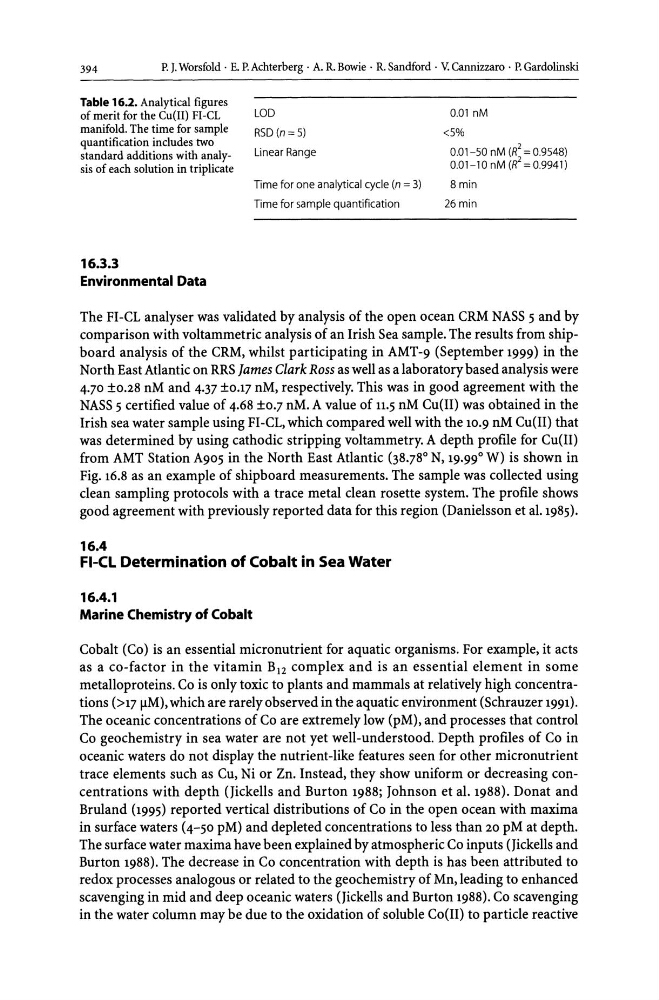
Table 16.2. Analytical figures
of merit for the Cu(II) PI -CL
manifold. The time for sample
quantification includes two
standard additions with analysis of each solution in triplicate
16.3.3
Environmental Data
LOD
RSD (n = 5)
Linear Range
Time for one analytical cycle (n = 3)
Time for sample quantification
0.01 nM
<5%
0.01-50 nM (R 2 = 0.9548)
0.01-10 nM (R 2 = 0.9941)
8min
26min
The FI-CL analyser was validated by analysis of the open ocean CRM NASS 5 and by
comparison with voltammetric analysis of an Irish Sea sample. The results from shipboard analysis of the CRM, whilst participating in AMT-9 (September 1999) in the
North East Atlantic on RRS James Clark Ross as well as a laboratory based analysis were
4.70 ±0.28 nM and 4.37 ±0.17 nM, respectively. This was in good agreement with the
NASS 5 certified value of 4.68 ±0.7 nM. A value of 11.5 nM Cu(lI) was obtained in the
Irish sea water sample using FI-CL, which compared well with the 10.9 nM Cu(II) that
was determined by using cathodic stripping voltammetry. A depth profile for Cu(lI)
from AMT Station A905 in the North East Atlantic (38.78° N, 19.99° W) is shown in
Fig. 16.8 as an example of shipboard measurements. The sample was collected using
clean sampling protocols with a trace metal clean rosette system. The profile shows
good agreement with previously reported data for this region (Danielsson et al. 1985).
16.4
FI-CL Determination of Cobalt in Sea Water
16.4.1
Marine Chemistry of Cobalt
Cobalt (Co) is an essential micronutrient for aquatic organisms. For example, it acts
as a co-factor in the vitamin B12 complex and is an essential element in some
metalloproteins. Co is only toxic to plants and mammals at relatively high concentrations (>17 flM), which are rarely observed in the aquatic environment (Schrauzer 1991).
The oceanic concentrations of Co are extremely low (pM), and processes that control
Co geochemistry in sea water are not yet well-understood. Depth profiles of Co in
oceanic waters do not display the nutrient-like features seen for other micronutrient
trace elements such as Cu, Ni or Zn. Instead, they show uniform or decreasing concentrations with depth (Jickells and Burton 1988; Johnson et al. 1988). Donat and
Bruland (1995) reported vertical distributions of Co in the open ocean with maxima
in surface waters (4-50 pM) and depleted concentrations to less than 20 pM at depth.
The surface water maxima have been explained by atmospheric Co inputs (Jickells and
Burton 1988). The decrease in Co concentration with depth is has been attributed to
redox processes analogous or related to the geochemistry of Mn, leading to enhanced
scavenging in mid and deep oceanic waters (Jickells and Burton 1988). Co scavenging
in the water column may be due to the oxidation of soluble Co(II) to particle reactive
P. J. Worsfold . E. P. Achterberg· A. R. Bowie· R. Sandford· V. Cannizzaro· P. Gardolinski
Table 16.2. Analytical figures
of merit for the Cu(II) PI -CL
manifold. The time for sample
quantification includes two
standard additions with analysis of each solution in triplicate
16.3.3
Environmental Data
LOD
RSD (n = 5)
Linear Range
Time for one analytical cycle (n = 3)
Time for sample quantification
0.01 nM
<5%
0.01-50 nM (R 2 = 0.9548)
0.01-10 nM (R 2 = 0.9941)
8min
26min
The FI-CL analyser was validated by analysis of the open ocean CRM NASS 5 and by
comparison with voltammetric analysis of an Irish Sea sample. The results from shipboard analysis of the CRM, whilst participating in AMT-9 (September 1999) in the
North East Atlantic on RRS James Clark Ross as well as a laboratory based analysis were
4.70 ±0.28 nM and 4.37 ±0.17 nM, respectively. This was in good agreement with the
NASS 5 certified value of 4.68 ±0.7 nM. A value of 11.5 nM Cu(lI) was obtained in the
Irish sea water sample using FI-CL, which compared well with the 10.9 nM Cu(II) that
was determined by using cathodic stripping voltammetry. A depth profile for Cu(lI)
from AMT Station A905 in the North East Atlantic (38.78° N, 19.99° W) is shown in
Fig. 16.8 as an example of shipboard measurements. The sample was collected using
clean sampling protocols with a trace metal clean rosette system. The profile shows
good agreement with previously reported data for this region (Danielsson et al. 1985).
16.4
FI-CL Determination of Cobalt in Sea Water
16.4.1
Marine Chemistry of Cobalt
Cobalt (Co) is an essential micronutrient for aquatic organisms. For example, it acts
as a co-factor in the vitamin B12 complex and is an essential element in some
metalloproteins. Co is only toxic to plants and mammals at relatively high concentrations (>17 flM), which are rarely observed in the aquatic environment (Schrauzer 1991).
The oceanic concentrations of Co are extremely low (pM), and processes that control
Co geochemistry in sea water are not yet well-understood. Depth profiles of Co in
oceanic waters do not display the nutrient-like features seen for other micronutrient
trace elements such as Cu, Ni or Zn. Instead, they show uniform or decreasing concentrations with depth (Jickells and Burton 1988; Johnson et al. 1988). Donat and
Bruland (1995) reported vertical distributions of Co in the open ocean with maxima
in surface waters (4-50 pM) and depleted concentrations to less than 20 pM at depth.
The surface water maxima have been explained by atmospheric Co inputs (Jickells and
Burton 1988). The decrease in Co concentration with depth is has been attributed to
redox processes analogous or related to the geochemistry of Mn, leading to enhanced
scavenging in mid and deep oceanic waters (Jickells and Burton 1988). Co scavenging
in the water column may be due to the oxidation of soluble Co(II) to particle reactive