

CHAPTER 16 . Flow Injection Techniques for the in situ Monitoring of Marine Processes
393
superoxide radicals, which oxidize the 1,10-phenanthroline to the excited intermediate state 3,3' -diformyl-2,2 dipyridyl (the primary CL emitter) and eventually to
2' -dipyridyl-3,3' -dicarboxylic acid (Federova et al. 1982). A cationic surfactant,
cetyldimethylethylenediamine bromide (CEDAB), creates a less polar micellar environment than the aqueous phase for the uncharged 1,IO-phenanthroline, and a positively charged surface for the anionic superoxide radical to migrate to. Thus, a microenvironment is created that allows a higher excitation efficiency and aids decomposition of the excited 1,2-dioxetane so formed. Tetraethylenepentamine (TEPA) is used
to reduce the interference (noise) generated from trace metal contamination of the
reagents. TEPA is a strong complexing agent for Cu but with slower kinetics than the
main CL reaction and thus does not inhibit the primary CL emission.
Many CL reactions are unselective with respect to the metal ions that catalyse them
and interfering species alter the quantitative relationship between the CL yield and
the analyte concentration in the sample. Significant quenching of the CL signal for
Cu(ll) from the 1,IO-phenanthroline reaction has been observed with some species,
e.g. Na(I) (51%), Cr(Ill) (78%), Mn(ll) (83%), and bicarbonate (12.2%) and significant
enhancement with others, e.g. K(I) (271%), Mg(ll) (143%) and chloride (131%) (all data
normalized to 100% for the response for 10 nM Cu). These observations highlight the
need for matrix separation when analysing sea water (Coale et al. 1992). A chelating
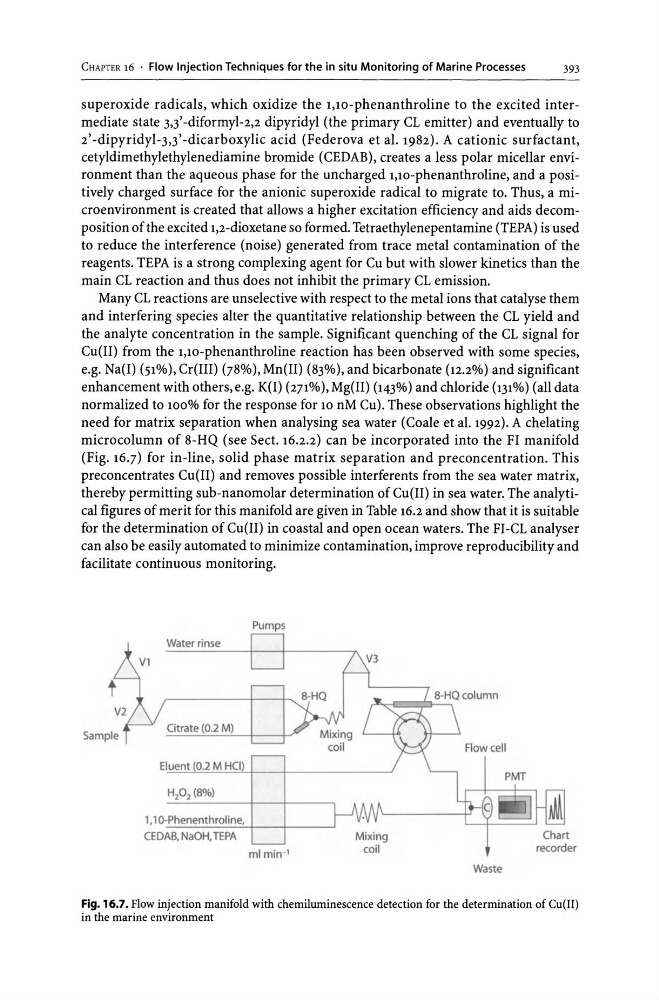
microcolumn of 8-HQ (see Sect. 16.2.2) can be incorporated into the FI manifold
(Fig. 16.7) for in-line, solid phase matrix separation and preconcentration. This
pre concentrates Cu(II) and removes possible interferents from the sea water matrix,
thereby permitting sub-nanomolar determination of Cu(II) in sea water. The analytical figures of merit for this manifold are given in Table 16.2 and show that it is suitable
for the determination of Cu(II) in coastal and open ocean waters. The FI-CL analyser
can also be easily automated to minimize contamination, improve reproducibility and
facilitate continuous monitoring.
Water rinse
Citrate (0.2 M)
Eluent (0.2 M Hel)
H 2 0 2 (8%)
1,10-Phenenthroline,
CEDAB, NaOH, TEPA
Pumps
Waste
Fig. 16.7. Flow injection manifold with chemiluminescence detection for the determination of Cu(II)
in the marine environment
393
superoxide radicals, which oxidize the 1,10-phenanthroline to the excited intermediate state 3,3' -diformyl-2,2 dipyridyl (the primary CL emitter) and eventually to
2' -dipyridyl-3,3' -dicarboxylic acid (Federova et al. 1982). A cationic surfactant,
cetyldimethylethylenediamine bromide (CEDAB), creates a less polar micellar environment than the aqueous phase for the uncharged 1,IO-phenanthroline, and a positively charged surface for the anionic superoxide radical to migrate to. Thus, a microenvironment is created that allows a higher excitation efficiency and aids decomposition of the excited 1,2-dioxetane so formed. Tetraethylenepentamine (TEPA) is used
to reduce the interference (noise) generated from trace metal contamination of the
reagents. TEPA is a strong complexing agent for Cu but with slower kinetics than the
main CL reaction and thus does not inhibit the primary CL emission.
Many CL reactions are unselective with respect to the metal ions that catalyse them
and interfering species alter the quantitative relationship between the CL yield and
the analyte concentration in the sample. Significant quenching of the CL signal for
Cu(ll) from the 1,IO-phenanthroline reaction has been observed with some species,
e.g. Na(I) (51%), Cr(Ill) (78%), Mn(ll) (83%), and bicarbonate (12.2%) and significant
enhancement with others, e.g. K(I) (271%), Mg(ll) (143%) and chloride (131%) (all data
normalized to 100% for the response for 10 nM Cu). These observations highlight the
need for matrix separation when analysing sea water (Coale et al. 1992). A chelating
microcolumn of 8-HQ (see Sect. 16.2.2) can be incorporated into the FI manifold
(Fig. 16.7) for in-line, solid phase matrix separation and preconcentration. This
pre concentrates Cu(II) and removes possible interferents from the sea water matrix,
thereby permitting sub-nanomolar determination of Cu(II) in sea water. The analytical figures of merit for this manifold are given in Table 16.2 and show that it is suitable
for the determination of Cu(II) in coastal and open ocean waters. The FI-CL analyser
can also be easily automated to minimize contamination, improve reproducibility and
facilitate continuous monitoring.
Water rinse
Citrate (0.2 M)
Eluent (0.2 M Hel)
H 2 0 2 (8%)
1,10-Phenenthroline,
CEDAB, NaOH, TEPA
Pumps
Waste
Fig. 16.7. Flow injection manifold with chemiluminescence detection for the determination of Cu(II)
in the marine environment