

392
P. J. Worsfold . E. P. Achterberg· A. R. Bowie· R. Sandford· V. Cannizzaro· P. Gardolinski
0
40
:§:
80
..r:
a. CLI
o 120
160
200
0
[Total Fe] (nM)
1
2
36.4
Salinity / Fluorescence
36.8
37.2
..........
Salinity'
..... \
,
\ Fluorescence
" / "
,
,
\.....
"
\.
I
..
....
"
L~l~D'~
;1,
•... /
/1
. . . . . . . . . . . . >/
( ................... ~//
I Temperature
....
I I
o
10
20
Temperature rC)
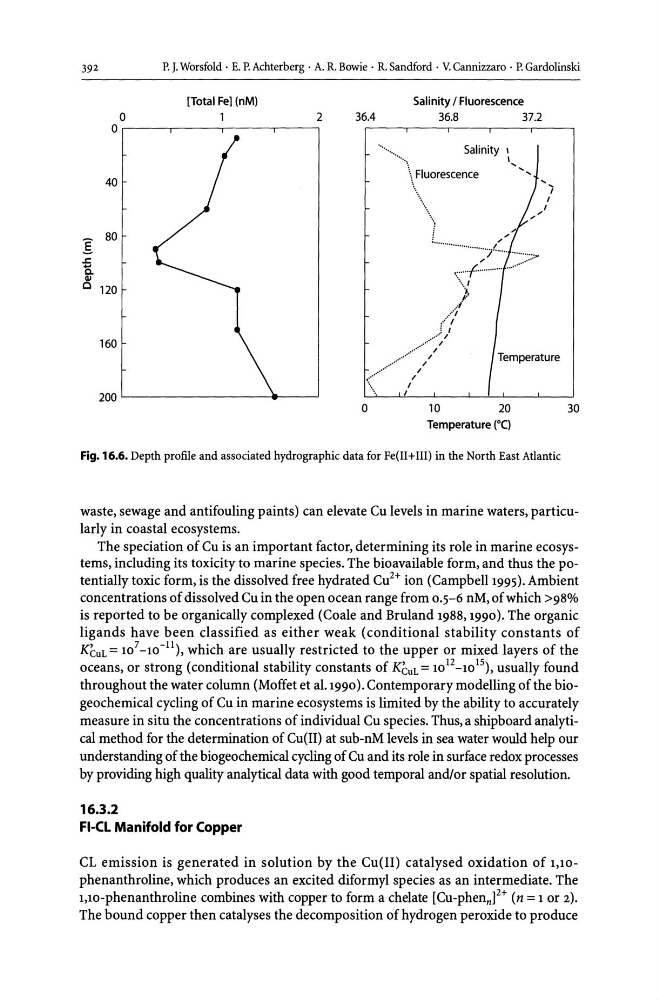
Fig. 16.6. Depth profile and associated hydrographic data for Fe(II + III) in the North East Atlantic
30
waste, sewage and antifouling paints) can elevate Cu levels in marine waters, particularly in coastal ecosystems.
The speciation of Cu is an important factor, determining its role in marine ecosystems, including its toxicity to marine species. The bioavailable form, and thus the potentially toxic form, is the dissolved free hydrated Cu 2 + ion (Campbell 1995). Ambient
concentrations of dissolved Cu in the open ocean range from 0.5-6 nM, of which >98%
is reported to be organically complexed (Coale and Bruland 1988, 1990). The organic
ligands have been classified as either weak (conditional stability constants of
KCuL = 10 7 -10 -11), which are usually restricted to the upper or mixed layers of the
oceans, or strong (conditional stability constants of KCuL = 10 12 -10 15), usually found
throughout the water column (Moffet et a1.1990). Contemporary modelling of the biogeochemical cycling of Cu in marine ecosystems is limited by the ability to accurately
measure in situ the concentrations of individual Cu species. Thus, a shipboard analytical method for the determination of Cu(II) at sub-nM levels in sea water would help our
understanding of the biogeochemical cycling of Cu and its role in surface redox processes
by providing high quality analytical data with good temporal and/or spatial resolution.
16.3.2
FI-CL Manifold for Copper
CL emission is generated in solution by the Cu(II) catalysed oxidation of 1,10phenanthroline, which produces an excited diformyl species as an intermediate. The
1,lO-phenanthroline combines with copper to form a chelate [Cu-phennf+ (n = 1 or 2).
The bound copper then catalyses the decomposition of hydrogen peroxide to produce
P. J. Worsfold . E. P. Achterberg· A. R. Bowie· R. Sandford· V. Cannizzaro· P. Gardolinski
0
40
:§:
80
..r:
a. CLI
o 120
160
200
0
[Total Fe] (nM)
1
2
36.4
Salinity / Fluorescence
36.8
37.2
..........
Salinity'
..... \
,
\ Fluorescence
" / "
,
,
\.....
"
\.
I
..
....
"
L~l~D'~
;1,
•... /
/1
. . . . . . . . . . . . >/
( ................... ~//
I Temperature
....
I I
o
10
20
Temperature rC)
Fig. 16.6. Depth profile and associated hydrographic data for Fe(II + III) in the North East Atlantic
30
waste, sewage and antifouling paints) can elevate Cu levels in marine waters, particularly in coastal ecosystems.
The speciation of Cu is an important factor, determining its role in marine ecosystems, including its toxicity to marine species. The bioavailable form, and thus the potentially toxic form, is the dissolved free hydrated Cu 2 + ion (Campbell 1995). Ambient
concentrations of dissolved Cu in the open ocean range from 0.5-6 nM, of which >98%
is reported to be organically complexed (Coale and Bruland 1988, 1990). The organic
ligands have been classified as either weak (conditional stability constants of
KCuL = 10 7 -10 -11), which are usually restricted to the upper or mixed layers of the
oceans, or strong (conditional stability constants of KCuL = 10 12 -10 15), usually found
throughout the water column (Moffet et a1.1990). Contemporary modelling of the biogeochemical cycling of Cu in marine ecosystems is limited by the ability to accurately
measure in situ the concentrations of individual Cu species. Thus, a shipboard analytical method for the determination of Cu(II) at sub-nM levels in sea water would help our
understanding of the biogeochemical cycling of Cu and its role in surface redox processes
by providing high quality analytical data with good temporal and/or spatial resolution.
16.3.2
FI-CL Manifold for Copper
CL emission is generated in solution by the Cu(II) catalysed oxidation of 1,10phenanthroline, which produces an excited diformyl species as an intermediate. The
1,lO-phenanthroline combines with copper to form a chelate [Cu-phennf+ (n = 1 or 2).
The bound copper then catalyses the decomposition of hydrogen peroxide to produce