

CHAPTER 16 . Flow Injection Techniques for the in situ Monitoring of Marine Processes
391
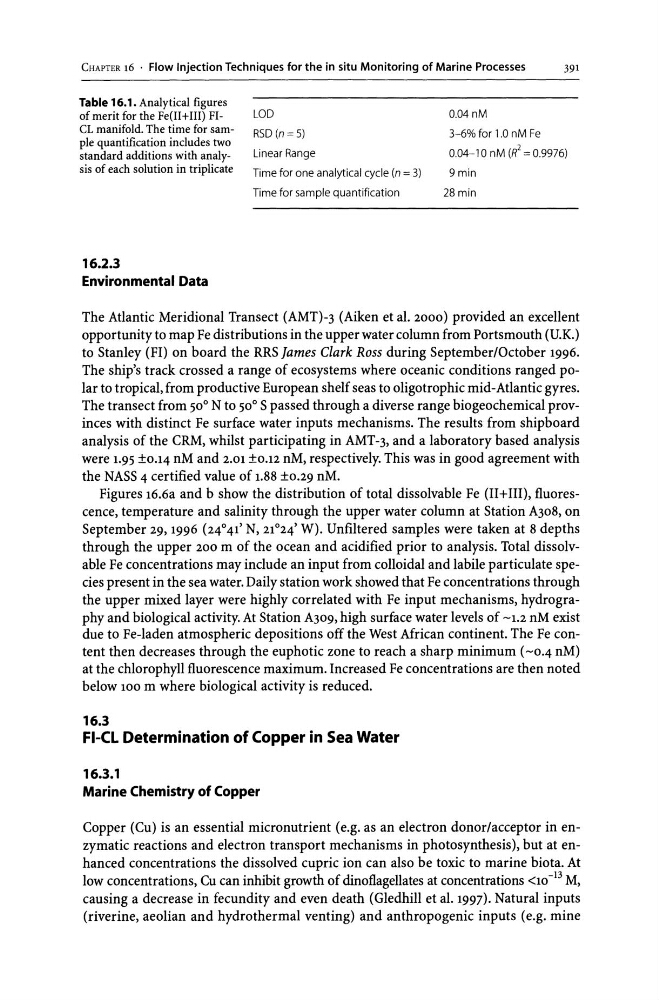
Table 16.1. Analytical figures
of merit for the Fe(II + III) FICL manifold. The time for sample quantification includes two
standard additions with analysis of each solution in triplicate
16.2.3
Environmental Data
LOD
RSD (n=5)
Linear Range
Time for one analytical cycle (n = 3)
Time for sample quantification
0.04 nM
3-6% for 1.0 nM Fe
0.04-10 nM (R 2 = 0.9976)
9min
28min
The Atlantic Meridional Transect (AMT)-3 (Aiken et al. 2000) provided an excellent
opportunity to map Fe distributions in the upper water column from Portsmouth (U.K.)
to Stanley (FI) on board the RRS James Clark Ross during September/October 1996.
The ship's track crossed a range of ecosystems where oceanic conditions ranged polar to tropical, from productive European shelf seas to oligotrophic mid-Atlantic gyres.
The transect from 50° N to 50° S passed through a diverse range biogeochemical provinces with distinct Fe surface water inputs mechanisms. The results from shipboard
analysis of the CRM, whilst participating in AMT-3, and a laboratory based analysis
were 1.95 ±0.14 nM and 2.01 ±0.12 nM, respectively. This was in good agreement with
the NASS 4 certified value of 1.88 ±0.29 nM.
Figures 16.6a and b show the distribution of total dissolvable Fe (II+III), fluorescence, temperature and salinity through the upper water column at Station A308, on
September 29,1996 (24°41' N, 21°24' W). Unfiltered samples were taken at 8 depths
through the upper 200 m of the ocean and acidified prior to analysis. Total dissolvable Fe concentrations may include an input from colloidal and labile particulate species present in the sea water. Daily station work showed iliat Fe concentrations through
the upper mixed layer were highly correlated with Fe input mechanisms, hydrography and biological activity. At Station A309, high surface water levels of -1.2 nM exist
due to Fe-laden atmospheric depositions off the West African continent. The Fe content then decreases through the euphotic zone to reach a sharp minimum (-0.4 nM)
at the chlorophyll fluorescence maximum. Increased Fe concentrations are then noted
below 100 m where biological activity is reduced.
16.3
FI-CL Determination of Copper in Sea Water
16.3.1
Marine Chemistry of Copper
Copper (Cu) is an essential micronutrient (e.g. as an electron donor/acceptor in enzymatic reactions and electron transport mechanisms in photosynthesis), but at enhanced concentrations the dissolved cupric ion can also be toxic to marine biota. At
low concentrations, Cu can inhibit growili of dinoflagellates at concentrations <10- 13 M,
causing a decrease in fecundity and even death (Gledhill et al. 1997). Natural inputs
(riverine, aeolian and hydrothermal venting) and anthropogenic inputs (e.g. mine
391
Table 16.1. Analytical figures
of merit for the Fe(II + III) FICL manifold. The time for sample quantification includes two
standard additions with analysis of each solution in triplicate
16.2.3
Environmental Data
LOD
RSD (n=5)
Linear Range
Time for one analytical cycle (n = 3)
Time for sample quantification
0.04 nM
3-6% for 1.0 nM Fe
0.04-10 nM (R 2 = 0.9976)
9min
28min
The Atlantic Meridional Transect (AMT)-3 (Aiken et al. 2000) provided an excellent
opportunity to map Fe distributions in the upper water column from Portsmouth (U.K.)
to Stanley (FI) on board the RRS James Clark Ross during September/October 1996.
The ship's track crossed a range of ecosystems where oceanic conditions ranged polar to tropical, from productive European shelf seas to oligotrophic mid-Atlantic gyres.
The transect from 50° N to 50° S passed through a diverse range biogeochemical provinces with distinct Fe surface water inputs mechanisms. The results from shipboard
analysis of the CRM, whilst participating in AMT-3, and a laboratory based analysis
were 1.95 ±0.14 nM and 2.01 ±0.12 nM, respectively. This was in good agreement with
the NASS 4 certified value of 1.88 ±0.29 nM.
Figures 16.6a and b show the distribution of total dissolvable Fe (II+III), fluorescence, temperature and salinity through the upper water column at Station A308, on
September 29,1996 (24°41' N, 21°24' W). Unfiltered samples were taken at 8 depths
through the upper 200 m of the ocean and acidified prior to analysis. Total dissolvable Fe concentrations may include an input from colloidal and labile particulate species present in the sea water. Daily station work showed iliat Fe concentrations through
the upper mixed layer were highly correlated with Fe input mechanisms, hydrography and biological activity. At Station A309, high surface water levels of -1.2 nM exist
due to Fe-laden atmospheric depositions off the West African continent. The Fe content then decreases through the euphotic zone to reach a sharp minimum (-0.4 nM)
at the chlorophyll fluorescence maximum. Increased Fe concentrations are then noted
below 100 m where biological activity is reduced.
16.3
FI-CL Determination of Copper in Sea Water
16.3.1
Marine Chemistry of Copper
Copper (Cu) is an essential micronutrient (e.g. as an electron donor/acceptor in enzymatic reactions and electron transport mechanisms in photosynthesis), but at enhanced concentrations the dissolved cupric ion can also be toxic to marine biota. At
low concentrations, Cu can inhibit growili of dinoflagellates at concentrations <10- 13 M,
causing a decrease in fecundity and even death (Gledhill et al. 1997). Natural inputs
(riverine, aeolian and hydrothermal venting) and anthropogenic inputs (e.g. mine