

CHAPTER 15 • Toxic Effects of Organometallic Compounds towards Marine Biota
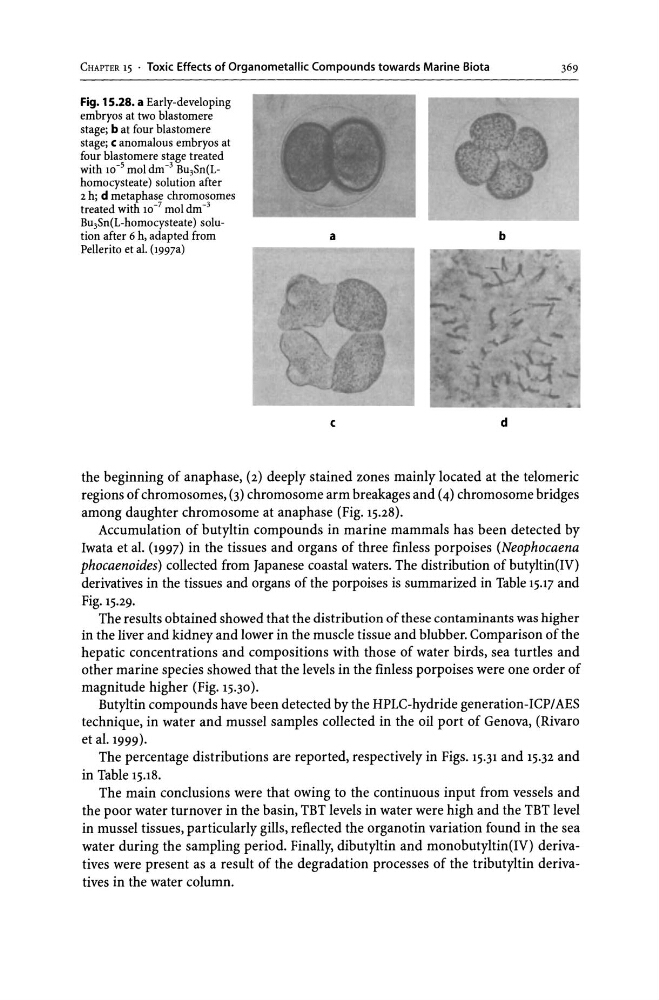
Fig. 1 S.28. a Early-developing
embryos at two blastomere
stage; b at four blastomere
stage; c anomalous embryos at
four blastomere stage treated
with 10- 5 mol dm -3 Bu 3 Sn (Lhomocysteate) solution after
2 h; d metaphase chromosomes
treated with 10- 7 mol dm- 3
BU3Sn(L-homocysteate) solution after 6 h, adapted from
Pellerito et al. (1997a)
a
c
369
b
d
the beginning of anaphase, (2) deeply stained zones mainly located at the telomeric
regions of chromosomes, (3) chromosome arm breakages and (4) chromosome bridges
among daughter chromosome at anaphase (Fig. 15.28).
Accumulation of butyltin compounds in marine mammals has been detected by
Iwata et al. (1997) in the tissues and organs of three finless porpoises (Neophocaena
phocaenoides) collected from Japanese coastal waters. The distribution of butyltin(IV)
derivatives in the tissues and organs of the porpoises is summarized in Table 15.17 and
Fig. 15.29.
The results obtained showed that the distribution of these contaminants was higher
in the liver and kidney and lower in the muscle tissue and blubber. Comparison of the
hepatic concentrations and compositions with those of water birds, sea turtles and
other marine species showed that the levels in the finless porpoises were one order of
magnitude higher (Fig. 15.30).
Butyltin compounds have been detected by the HPLC-hydride generation-ICP/AES
technique, in water and mussel samples collected in the oil port of Genova, (Rivaro
et al. 1999).
The percentage distributions are reported, respectively in Figs. 15.31 and 15.32 and
in Table 15.18.
The main conclusions were that owing to the continuous input from vessels and
the poor water turnover in the basin, TBT levels in water were high and the TBT level
in mussel tissues, particularly gills, reflected the organotin variation found in the sea
water during the sampling period. Finally, dibutyltin and monobutyltin(IV) derivatives were present as a result of the degradation processes of the tributyltin derivatives in the water column.
Fig. 1 S.28. a Early-developing
embryos at two blastomere
stage; b at four blastomere
stage; c anomalous embryos at
four blastomere stage treated
with 10- 5 mol dm -3 Bu 3 Sn (Lhomocysteate) solution after
2 h; d metaphase chromosomes
treated with 10- 7 mol dm- 3
BU3Sn(L-homocysteate) solution after 6 h, adapted from
Pellerito et al. (1997a)
a
c
369
b
d
the beginning of anaphase, (2) deeply stained zones mainly located at the telomeric
regions of chromosomes, (3) chromosome arm breakages and (4) chromosome bridges
among daughter chromosome at anaphase (Fig. 15.28).
Accumulation of butyltin compounds in marine mammals has been detected by
Iwata et al. (1997) in the tissues and organs of three finless porpoises (Neophocaena
phocaenoides) collected from Japanese coastal waters. The distribution of butyltin(IV)
derivatives in the tissues and organs of the porpoises is summarized in Table 15.17 and
Fig. 15.29.
The results obtained showed that the distribution of these contaminants was higher
in the liver and kidney and lower in the muscle tissue and blubber. Comparison of the
hepatic concentrations and compositions with those of water birds, sea turtles and
other marine species showed that the levels in the finless porpoises were one order of
magnitude higher (Fig. 15.30).
Butyltin compounds have been detected by the HPLC-hydride generation-ICP/AES
technique, in water and mussel samples collected in the oil port of Genova, (Rivaro
et al. 1999).
The percentage distributions are reported, respectively in Figs. 15.31 and 15.32 and
in Table 15.18.
The main conclusions were that owing to the continuous input from vessels and
the poor water turnover in the basin, TBT levels in water were high and the TBT level
in mussel tissues, particularly gills, reflected the organotin variation found in the sea
water during the sampling period. Finally, dibutyltin and monobutyltin(IV) derivatives were present as a result of the degradation processes of the tributyltin derivatives in the water column.