

CHAPTER 15 . Toxic Effects of Organometallic Compounds towards Marine Biota
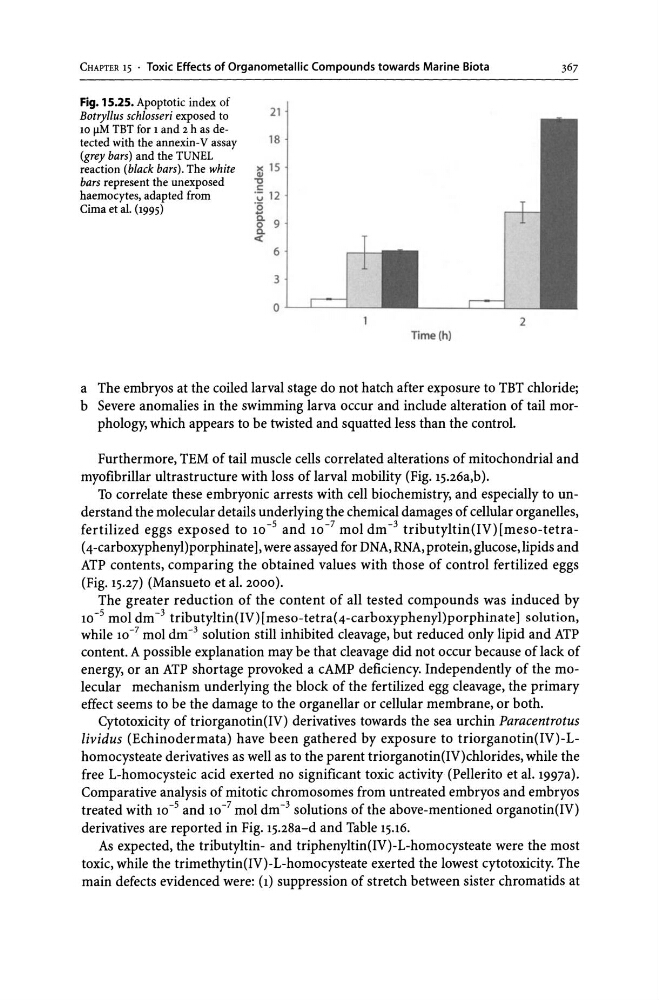
Fig. 15.25. Apoptotic index of
Botryllus schlosseri exposed to
10 f!M TBT for 1 and 2 h as detected with the annexin-V assay
(grey bars) and the TUNEL
reaction (black bars). The white
bars represent the unexposed
haemocytes, adapted from
Cima et al. (1995)
21
18
~ 15
-c
c
'u 12
' 15
g. 9
a.
0{
6
3
o -'--'---'------'
Time (h)
367
2
a The embryos at the coiled larval stage do not hatch after exposure to TBT chloride;
b Severe anomalies in the swimming larva occur and include alteration of tail morphology, which appears to be twisted and squatted less than the control.
Furthermore, TEM of tail muscle cells correlated alterations of mitochondrial and
myofibrillar ultrastructure with loss of larval mobility (Fig. 1p6a,b).
To correlate these embryonic arrests with cell biochemistry, and especially to understand the molecular details underlying the chemical damages of cellular organelles,
fertilized eggs exposed to 10- 5 and 10- 7 mol dm -3 tributyltin(IV)[meso-tetra(4-carboxyphenyl)porphinate], were assayed for DNA, RNA, protein, glucose, lipids and
ATP contents, comparing the obtained values with those of control fertilized eggs
(Fig. 15.27) (Mansueto et a!. 2000).
The greater reduction of the content of all tested compounds was induced by
10 -5 mol dm -3 tributyltin(IV)[meso-tetra{4-carboxyphenyl)porphinatel solution,
while 10- 7 mol dm- 3 solution still inhibited cleavage, but reduced only lipid and ATP
content. A possible explanation may be that cleavage did not occur because of lack of
energy, or an ATP shortage provoked a cAMP deficiency. Independently of the molecular mechanism underlying the block of the fertilized egg cleavage, the primary
effect seems to be the damage to the organellar or cellular membrane, or both.
Cytotoxicity of triorganotin{IV) derivatives towards the sea urchin Paracentrotus
lividus (Echinodermata) have been gathered by exposure to triorganotin(IV)-Lhomocysteate derivatives as well as to the parent triorganotin{IV)chlorides, while the
free L-homocysteic acid exerted no significant toxic activity (Pellerito et al. 1997a).
Comparative analysis of mitotic chromosomes from untreated embryos and embryos
treated with 10- 5 and 10- 7 mol dm -3 solutions of the above-mentioned organotin(IV)
derivatives are reported in Fig. 15.28a-d and Table 15.16.
As expected, the tributyltin- and triphenyltin{IV)-L-homocysteate were the most
toxic, while the trimethytin(IV)-L-homocysteate exerted the lowest cytotoxicity. The
main defects evidenced were: (1) suppression of stretch between sister chromatids at
Fig. 15.25. Apoptotic index of
Botryllus schlosseri exposed to
10 f!M TBT for 1 and 2 h as detected with the annexin-V assay
(grey bars) and the TUNEL
reaction (black bars). The white
bars represent the unexposed
haemocytes, adapted from
Cima et al. (1995)
21
18
~ 15
-c
c
'u 12
' 15
g. 9
a.
0{
6
3
o -'--'---'------'
Time (h)
367
2
a The embryos at the coiled larval stage do not hatch after exposure to TBT chloride;
b Severe anomalies in the swimming larva occur and include alteration of tail morphology, which appears to be twisted and squatted less than the control.
Furthermore, TEM of tail muscle cells correlated alterations of mitochondrial and
myofibrillar ultrastructure with loss of larval mobility (Fig. 1p6a,b).
To correlate these embryonic arrests with cell biochemistry, and especially to understand the molecular details underlying the chemical damages of cellular organelles,
fertilized eggs exposed to 10- 5 and 10- 7 mol dm -3 tributyltin(IV)[meso-tetra(4-carboxyphenyl)porphinate], were assayed for DNA, RNA, protein, glucose, lipids and
ATP contents, comparing the obtained values with those of control fertilized eggs
(Fig. 15.27) (Mansueto et a!. 2000).
The greater reduction of the content of all tested compounds was induced by
10 -5 mol dm -3 tributyltin(IV)[meso-tetra{4-carboxyphenyl)porphinatel solution,
while 10- 7 mol dm- 3 solution still inhibited cleavage, but reduced only lipid and ATP
content. A possible explanation may be that cleavage did not occur because of lack of
energy, or an ATP shortage provoked a cAMP deficiency. Independently of the molecular mechanism underlying the block of the fertilized egg cleavage, the primary
effect seems to be the damage to the organellar or cellular membrane, or both.
Cytotoxicity of triorganotin{IV) derivatives towards the sea urchin Paracentrotus
lividus (Echinodermata) have been gathered by exposure to triorganotin(IV)-Lhomocysteate derivatives as well as to the parent triorganotin{IV)chlorides, while the
free L-homocysteic acid exerted no significant toxic activity (Pellerito et al. 1997a).
Comparative analysis of mitotic chromosomes from untreated embryos and embryos
treated with 10- 5 and 10- 7 mol dm -3 solutions of the above-mentioned organotin(IV)
derivatives are reported in Fig. 15.28a-d and Table 15.16.
As expected, the tributyltin- and triphenyltin{IV)-L-homocysteate were the most
toxic, while the trimethytin(IV)-L-homocysteate exerted the lowest cytotoxicity. The
main defects evidenced were: (1) suppression of stretch between sister chromatids at