

302
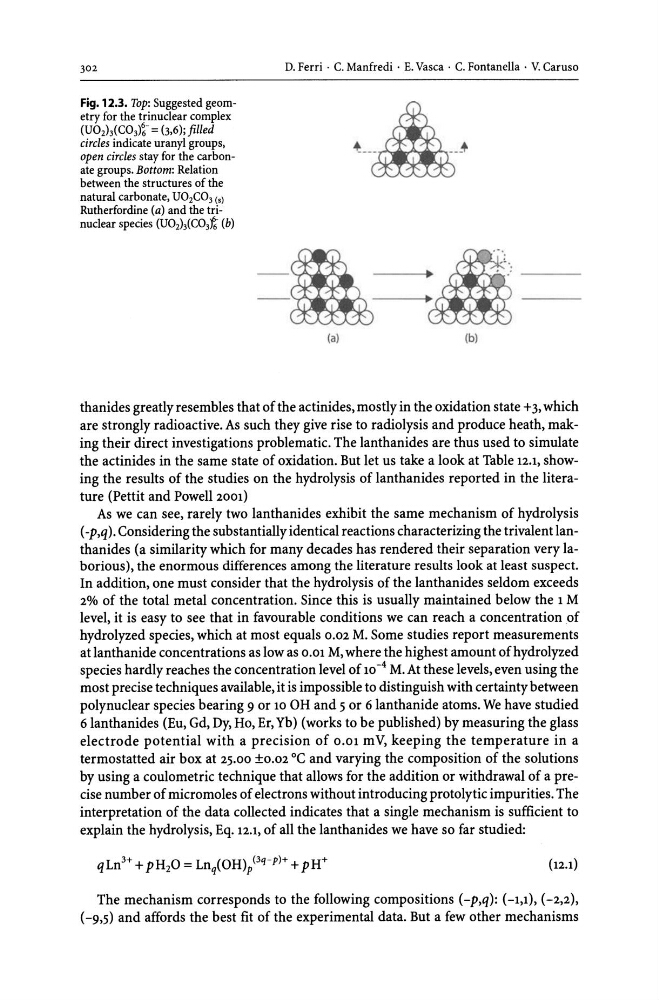
Fig. 12.3. Top: Suggested geometry for the trinuclear complex
(U02h(C03)~- = (3,6); filled
circles indicate uranyl groups,
open circles stay for the carbonate groups. Bottom: Relation
between the structures of the
natural carbonate, U02C03 (,)
Rutherfordine (a) and the trinuclear species (U02h(C03lt (b)
D. Ferri . C. Manfredi . E. Vasca . C. Fontanella . V. Caruso
~- - A~
• •
-.
-
. :'.':
-
~
(a)
(b)
thanides greatly resembles that of the actinides, mostly in the oxidation state +3, which
are strongly radioactive. As such they give rise to radiolysis and produce heath, making their direct investigations problematic. The lanthanides are thus used to simulate
the actinides in the same state of oxidation. But let us take a look at Table 12.1, showing the results of the studies on the hydrolysis of lanthanides reported in the literature (Pettit and Powell 2001)
As we can see, rarely two lanthanides exhibit the same mechanism of hydrolysis
(-p,q). Considering the substantially identical reactions characterizing the trivalent lanthanides (a similarity which for many decades has rendered their separation very laborious), the enormous differences among the literature results look at least suspect.
In addition, one must consider that the hydrolysis of the lanthanides seldom exceeds
2% of the total metal concentration. Since this is usually maintained below the 1 M
level, it is easy to see that in favourable conditions we can reach a concentration of
hydrolyzed species, which at most equals 0 .02 M. Some studies report measurements
at lanthanide concentrations as low as 0.01 M, where the highest amount of hydrolyzed
species hardly reaches the concentration level of 10 -4 M. At these levels, even using the
most precise techniques available, it is impossible to distinguish with certainty between
polynuclear species bearing 9 or 10 OH and 5 or 6 lanthanide atoms. We have studied
6 lanthanides (Eu, Gd, Dy, Ho, Er, Yb) (works to be published) by measuring the glass
electrode potential with a precision of 0.01 m V, keeping the temperature in a
termostatted air box at 25.00 ±0.02 °C and varying the composition of the solutions
by using a coulometric technique that allows for the addition or withdrawal of a precise number of micromoles of electrons without introducing protolytic impurities. The
interpretation of the data collected indicates that a single mechanism is sufficient to
explain the hydrolysis, Eq. 12.1, of all the lanthanides we have so far studied:
qLn 3 + + pH 2 0 = Ln q (OH)/3 q -P)+ + pH+
(12.1)
The mechanism corresponds to the following compositions (-p,q): (-1,1), (-2,2),
(-9,5) and affords the best fit of the experimental data. But a few other mechanisms
Fig. 12.3. Top: Suggested geometry for the trinuclear complex
(U02h(C03)~- = (3,6); filled
circles indicate uranyl groups,
open circles stay for the carbonate groups. Bottom: Relation
between the structures of the
natural carbonate, U02C03 (,)
Rutherfordine (a) and the trinuclear species (U02h(C03lt (b)
D. Ferri . C. Manfredi . E. Vasca . C. Fontanella . V. Caruso
~- - A~
• •
-.
-
. :'.':
-
~
(a)
(b)
thanides greatly resembles that of the actinides, mostly in the oxidation state +3, which
are strongly radioactive. As such they give rise to radiolysis and produce heath, making their direct investigations problematic. The lanthanides are thus used to simulate
the actinides in the same state of oxidation. But let us take a look at Table 12.1, showing the results of the studies on the hydrolysis of lanthanides reported in the literature (Pettit and Powell 2001)
As we can see, rarely two lanthanides exhibit the same mechanism of hydrolysis
(-p,q). Considering the substantially identical reactions characterizing the trivalent lanthanides (a similarity which for many decades has rendered their separation very laborious), the enormous differences among the literature results look at least suspect.
In addition, one must consider that the hydrolysis of the lanthanides seldom exceeds
2% of the total metal concentration. Since this is usually maintained below the 1 M
level, it is easy to see that in favourable conditions we can reach a concentration of
hydrolyzed species, which at most equals 0 .02 M. Some studies report measurements
at lanthanide concentrations as low as 0.01 M, where the highest amount of hydrolyzed
species hardly reaches the concentration level of 10 -4 M. At these levels, even using the
most precise techniques available, it is impossible to distinguish with certainty between
polynuclear species bearing 9 or 10 OH and 5 or 6 lanthanide atoms. We have studied
6 lanthanides (Eu, Gd, Dy, Ho, Er, Yb) (works to be published) by measuring the glass
electrode potential with a precision of 0.01 m V, keeping the temperature in a
termostatted air box at 25.00 ±0.02 °C and varying the composition of the solutions
by using a coulometric technique that allows for the addition or withdrawal of a precise number of micromoles of electrons without introducing protolytic impurities. The
interpretation of the data collected indicates that a single mechanism is sufficient to
explain the hydrolysis, Eq. 12.1, of all the lanthanides we have so far studied:
qLn 3 + + pH 2 0 = Ln q (OH)/3 q -P)+ + pH+
(12.1)
The mechanism corresponds to the following compositions (-p,q): (-1,1), (-2,2),
(-9,5) and affords the best fit of the experimental data. But a few other mechanisms