

CHAPTER 12 • Modelling of Natural Fluids: Are the Available Databases Adequate for this Purpose?
301
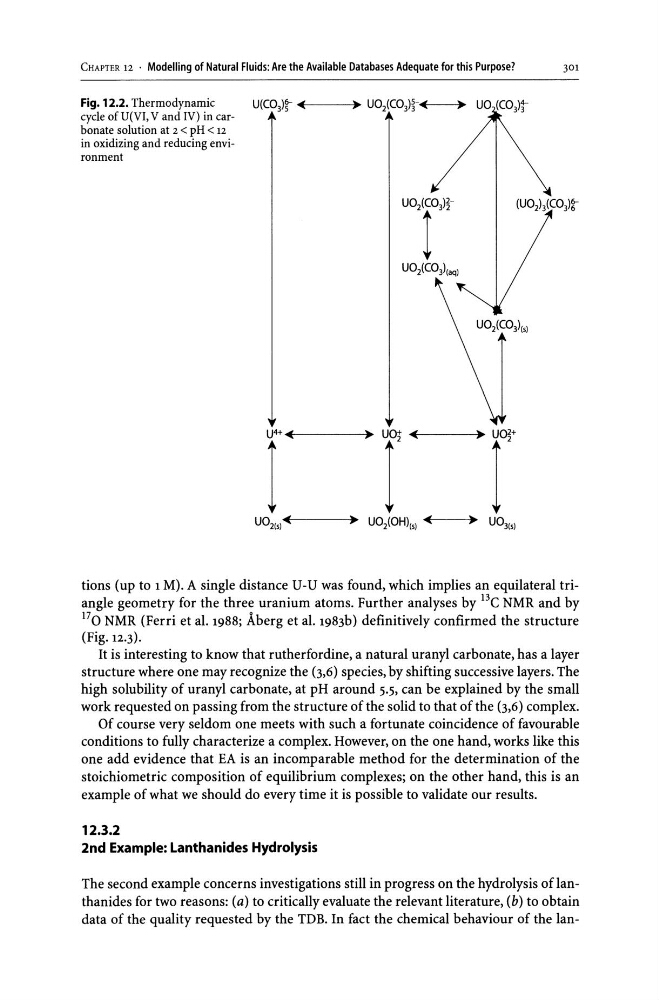
Fig. 12.2. Thermodynamic
U(C0 3 )t 0(
) U02(C03)~ 0(
)
U02.(C0 3 )t
cycle of U(VI, V and IV) in c a r - '
.
bonate solution at 2 < pH < 12
in oxidizing and reducing environment
UO' 1"' )' .
(U02)3(S:°3)t
U02(C03)(aq)
OO' r
r 'Ie 'r
uo2(S) 0(
)
UOiOH)(s) 0(
)
U03(S)
tions (up to 1 M). A single distance U-U was found, which implies an equilateral triangle geometry for the three uranium atoms. Further analyses by l3e NMR and by
17 0 NMR (Ferri et al. 1988; Aberg et al. 1983b) definitively confirmed the structure
(Fig. 12.3).
It is interesting to know that rutherfordine, a natural uranyl carbonate, has a layer
structure where one may recognize the (3,6) species, by shifting successive layers. The
high solubility of uranyl carbonate, at pH around 5.5, can be explained by the small
work requested on passing from the structure of the solid to that of the (3,6) complex.
Of course very seldom one meets with such a fortunate coincidence of favourable
conditions to fully characterize a complex. However, on the one hand, works like this
one add evidence that EA is an incomparable method for the determination of the
stoichiometric composition of equilibrium complexes; on the other hand, this is an
example of what we should do every time it is possible to validate our results.
12.3.2
2nd Example: Lanthanides Hydrolysis
The second example concerns investigations still in progress on the hydrolysis oflanthanides for two reasons: (a) to critically evaluate the relevant literature, (b) to obtain
data of the quality requested by the TDB. In fact the chemical behaviour of the lan-
301
Fig. 12.2. Thermodynamic
U(C0 3 )t 0(
) U02(C03)~ 0(
)
U02.(C0 3 )t
cycle of U(VI, V and IV) in c a r - '
.
bonate solution at 2 < pH < 12
in oxidizing and reducing environment
UO' 1"' )' .
(U02)3(S:°3)t
U02(C03)(aq)
OO' r
r 'Ie 'r
uo2(S) 0(
)
UOiOH)(s) 0(
)
U03(S)
tions (up to 1 M). A single distance U-U was found, which implies an equilateral triangle geometry for the three uranium atoms. Further analyses by l3e NMR and by
17 0 NMR (Ferri et al. 1988; Aberg et al. 1983b) definitively confirmed the structure
(Fig. 12.3).
It is interesting to know that rutherfordine, a natural uranyl carbonate, has a layer
structure where one may recognize the (3,6) species, by shifting successive layers. The
high solubility of uranyl carbonate, at pH around 5.5, can be explained by the small
work requested on passing from the structure of the solid to that of the (3,6) complex.
Of course very seldom one meets with such a fortunate coincidence of favourable
conditions to fully characterize a complex. However, on the one hand, works like this
one add evidence that EA is an incomparable method for the determination of the
stoichiometric composition of equilibrium complexes; on the other hand, this is an
example of what we should do every time it is possible to validate our results.
12.3.2
2nd Example: Lanthanides Hydrolysis
The second example concerns investigations still in progress on the hydrolysis oflanthanides for two reasons: (a) to critically evaluate the relevant literature, (b) to obtain
data of the quality requested by the TDB. In fact the chemical behaviour of the lan-