

CHAPTER 10 • Equilibrium Analysis, the Ionic Medium Method and Activity Factors
267
where B is a constant determined by properties of the solvent (temperature, pressure, density and dielectric constant), and ad is the "effective" distance between anion and cation.
The extended equation is valid up to 1m approx. 0.03 M for single charged 1:1 electrolytes.
In order to extend the range of validity of the Debye-Hiickel model further and to
take experimentally observed individual electrolyte characteristics into account, the
following methods have been used:
• Introduction of non-electrostatic short-range interactions by adding terms proportional to the concentrations of the various ions, or the ionic strength. An example is
the Davies equation, written below for the single activity coefficient of an ion, Yi:
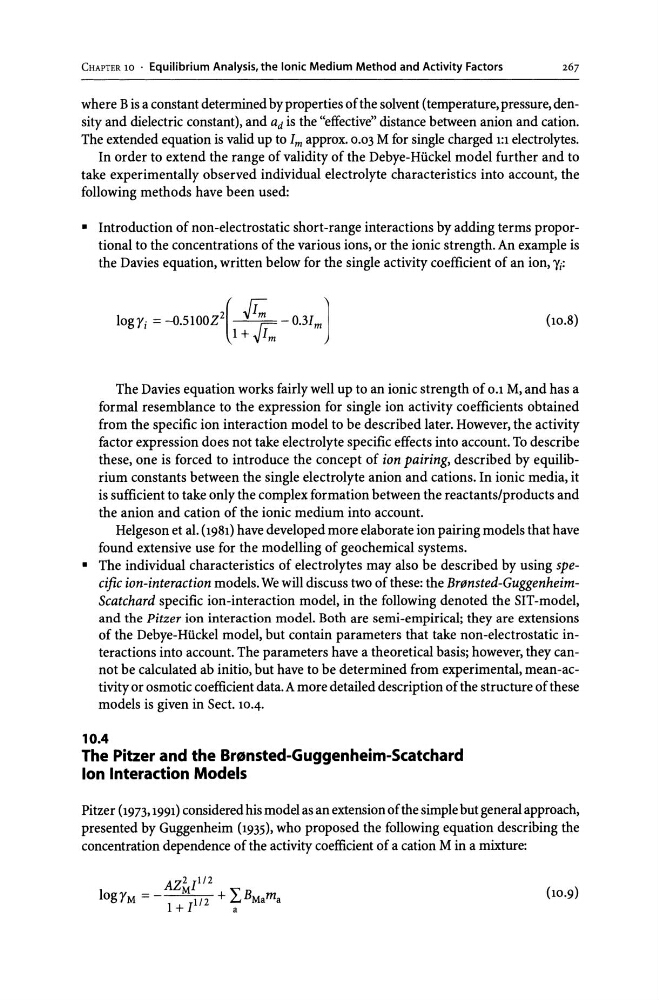
logYi = --o.5100Z 2 ( Fm -0. 31 1
l+Fm m
(10.8)
The Davies equation works fairly well up to an ionic strength of 0.1 M, and has a
formal resemblance to the expression for single ion activity coefficients obtained
from the specific ion interaction model to be described later. However, the activity
factor expression does not take electrolyte specific effects into account. To describe
these, one is forced to introduce the concept of ion pairing, described by equilibrium constants between the single electrolyte anion and cations. In ionic media, it
is sufficient to take only the complex formation between the reactants/products and
the anion and cation of the ionic medium into account.
Helgeson et al. (1981) have developed more elaborate ion pairing models that have
found extensive use for the modelling of geochemical systems.
• The individual characteristics of electrolytes may also be described by using specific ion-interaction models. We will discuss two of these: the Brensted-GuggenheimScatchard specific ion-interaction model, in the following denoted the SIT-model,
and the Pitzer ion interaction model. Both are semi-empirical; they are extensions
of the Debye-Huckel model, but contain parameters that take non-electrostatic interactions into account. The parameters have a theoretical basis; however, they cannot be calculated ab initio, but have to be determined from experimental, mean-activity or osmotic coefficient data. A more detailed description of the structure of these
models is given in Sect. 10-410.4
The Pitzer and the Brensted-Guggenheim-Scatchard
Ion Interaction Models
Pitzer (1973, 1991) considered his model as an extension of the simple but general approach,
presented by Guggenheim (1935), who proposed the following equation describing the
concentration dependence of the activity coefficient of a cation M in a mixture:
AZ211/2
logYM =
M 1/2 + 2,BMama
1 + 1
a
(10.9)
267
where B is a constant determined by properties of the solvent (temperature, pressure, density and dielectric constant), and ad is the "effective" distance between anion and cation.
The extended equation is valid up to 1m approx. 0.03 M for single charged 1:1 electrolytes.
In order to extend the range of validity of the Debye-Hiickel model further and to
take experimentally observed individual electrolyte characteristics into account, the
following methods have been used:
• Introduction of non-electrostatic short-range interactions by adding terms proportional to the concentrations of the various ions, or the ionic strength. An example is
the Davies equation, written below for the single activity coefficient of an ion, Yi:
logYi = --o.5100Z 2 ( Fm -0. 31 1
l+Fm m
(10.8)
The Davies equation works fairly well up to an ionic strength of 0.1 M, and has a
formal resemblance to the expression for single ion activity coefficients obtained
from the specific ion interaction model to be described later. However, the activity
factor expression does not take electrolyte specific effects into account. To describe
these, one is forced to introduce the concept of ion pairing, described by equilibrium constants between the single electrolyte anion and cations. In ionic media, it
is sufficient to take only the complex formation between the reactants/products and
the anion and cation of the ionic medium into account.
Helgeson et al. (1981) have developed more elaborate ion pairing models that have
found extensive use for the modelling of geochemical systems.
• The individual characteristics of electrolytes may also be described by using specific ion-interaction models. We will discuss two of these: the Brensted-GuggenheimScatchard specific ion-interaction model, in the following denoted the SIT-model,
and the Pitzer ion interaction model. Both are semi-empirical; they are extensions
of the Debye-Huckel model, but contain parameters that take non-electrostatic interactions into account. The parameters have a theoretical basis; however, they cannot be calculated ab initio, but have to be determined from experimental, mean-activity or osmotic coefficient data. A more detailed description of the structure of these
models is given in Sect. 10-410.4
The Pitzer and the Brensted-Guggenheim-Scatchard
Ion Interaction Models
Pitzer (1973, 1991) considered his model as an extension of the simple but general approach,
presented by Guggenheim (1935), who proposed the following equation describing the
concentration dependence of the activity coefficient of a cation M in a mixture:
AZ211/2
logYM =
M 1/2 + 2,BMama
1 + 1
a
(10.9)