

266
1. Grenthe
Conclusion: Users of equilibrium analytical data should be aware of the sources
of error present in experiments of this type. The stoichiometric coefficients determined in an equilibrium analysis are not "fitting parameters;' they are related to
the known co-ordination chemistry of the system, and one should therefore always
investigate if the chemical model suggested by an equilibrium analysis is consistent with other types of chemical information or not. The users of tabulated equilibrium data are often faced with a number of different values of equilibrium constants, often determined in ionic media of different composition. In order to compare these data with one another, it is necessary to have a method for calculating
activity coefficients. The same is true if one needs to use existing equilibrium constants for a certain metal complex determined, e.g. in 3 M NaCI04, to describe the
chemistry in another system, e.g. marine waters.
10.3
Activity Factors in Multi-Component Electrolyte Systems
The ionic medium method dates back to the first decades of the last century (Bodlander
and Storbek 1902a,bj Bodlander and Fittig 1902j Bodlander and Eberlin 1904j von Euler
1903a,b,cj Grossman 1905). The early use was based on empirics, which was later given
a theoretical foundation through the work of Debye and Huckel (1923).
Theoretical background. All electrolyte models are based on macroscopic physicochemical descriptions of the interactions between dissolved ions, and sometimes between these and the solvent. However, all models used so far are provisional in the sense
that they contain parameters that have to be determined experimentallyj an exception
is the Debye-Huckellimiting law.
The classical Debye-Huckel model takes only electrostatic interactions between ions
of opposite charge into account. It provides a fairly accurate description of the variation of the mean-activity coefficients of single charged 1:1 electrolytes up to concentrations of 0.01 Mj for higher charged electrolytes the range of validity is much smaller.
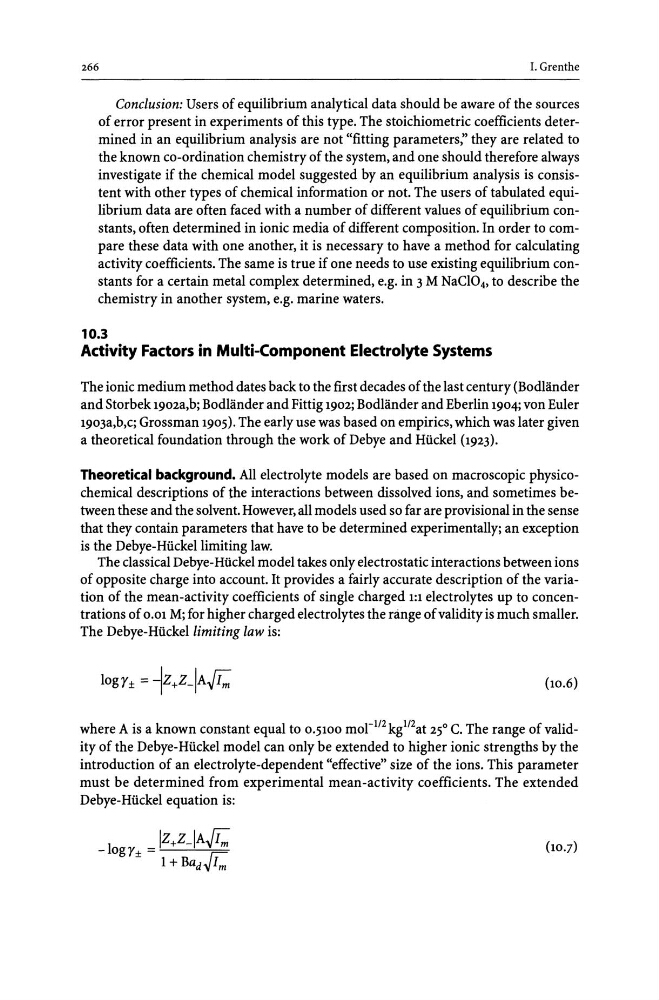
The Debye-Huckellimiting law is:
logy± == -lz+z-IAv'J:
(10.6)
where A is a known constant equal to 0.5100 mor l12 kg 1l2 at 25° C. The range of validity of the Debye-Huckel model can only be extended to higher ionic strengths by the
introduction of an electrolyte-dependent "effective" size of the ions. This parameter
must be determined from experimental mean-activity coefficients. The extended
Debye-Huckel equation is:
Iz+z_IAv' J:
-log Y ± == 1 + Bad v'J:
(10.7)
1. Grenthe
Conclusion: Users of equilibrium analytical data should be aware of the sources
of error present in experiments of this type. The stoichiometric coefficients determined in an equilibrium analysis are not "fitting parameters;' they are related to
the known co-ordination chemistry of the system, and one should therefore always
investigate if the chemical model suggested by an equilibrium analysis is consistent with other types of chemical information or not. The users of tabulated equilibrium data are often faced with a number of different values of equilibrium constants, often determined in ionic media of different composition. In order to compare these data with one another, it is necessary to have a method for calculating
activity coefficients. The same is true if one needs to use existing equilibrium constants for a certain metal complex determined, e.g. in 3 M NaCI04, to describe the
chemistry in another system, e.g. marine waters.
10.3
Activity Factors in Multi-Component Electrolyte Systems
The ionic medium method dates back to the first decades of the last century (Bodlander
and Storbek 1902a,bj Bodlander and Fittig 1902j Bodlander and Eberlin 1904j von Euler
1903a,b,cj Grossman 1905). The early use was based on empirics, which was later given
a theoretical foundation through the work of Debye and Huckel (1923).
Theoretical background. All electrolyte models are based on macroscopic physicochemical descriptions of the interactions between dissolved ions, and sometimes between these and the solvent. However, all models used so far are provisional in the sense
that they contain parameters that have to be determined experimentallyj an exception
is the Debye-Huckellimiting law.
The classical Debye-Huckel model takes only electrostatic interactions between ions
of opposite charge into account. It provides a fairly accurate description of the variation of the mean-activity coefficients of single charged 1:1 electrolytes up to concentrations of 0.01 Mj for higher charged electrolytes the range of validity is much smaller.
The Debye-Huckellimiting law is:
logy± == -lz+z-IAv'J:
(10.6)
where A is a known constant equal to 0.5100 mor l12 kg 1l2 at 25° C. The range of validity of the Debye-Huckel model can only be extended to higher ionic strengths by the
introduction of an electrolyte-dependent "effective" size of the ions. This parameter
must be determined from experimental mean-activity coefficients. The extended
Debye-Huckel equation is:
Iz+z_IAv' J:
-log Y ± == 1 + Bad v'J:
(10.7)