

268
1. Grenthe
where A is the Debye-Hiickel parameter (note that A = 3Acp= 0.5100 mor 1l2 kg 112 at
25°C, where Acp is the corresponding parameter in the Pitzer model). The summation
involves all anions, a, present in solution. BMa is an interaction parameter specific for
each cation-anion pair, Ma. In accordance with the Br0nsted (1922) postulate on specific interaction between ions, the terms for ions of the same charge sign are equal to
zero. The analogous expression for the anion X is obtained by changing the subscripts
M and a for X and c, respectively, where c denotes a cation in general. A detailed discussion of the use of the Guggenheim model for describing the concentration dependence of the osmotic coefficient and the mean activity coefficients in both single and
mixed electrolyte solutions are given in Pitzer and Brewer (1961).
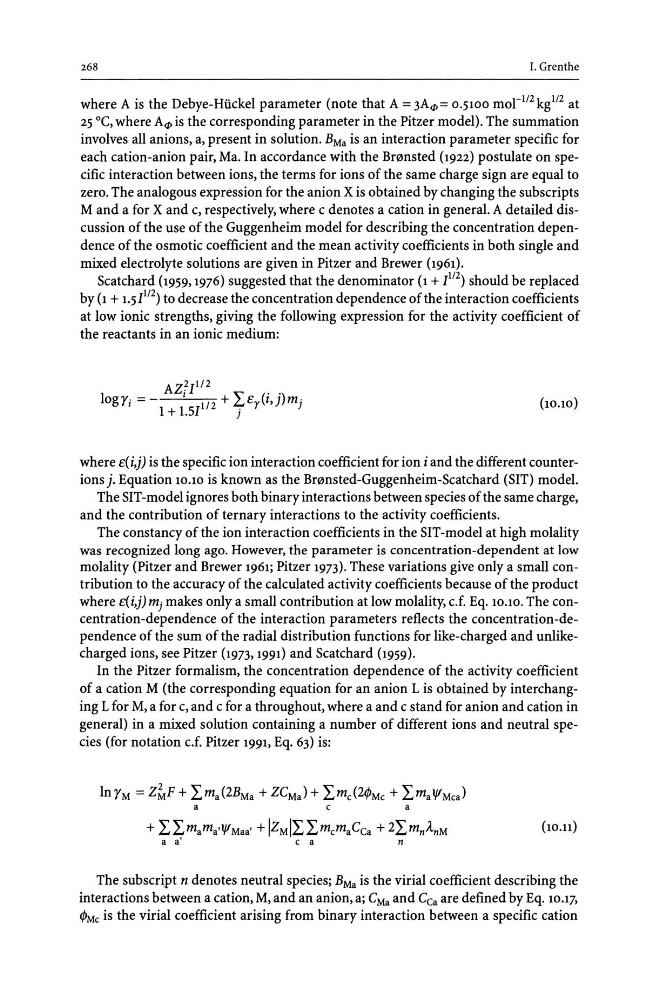
Scatchard (1959,1976) suggested that the denominator (1 + [112) should be replaced
by (1 + 1.5[112) to decrease the concentration dependence of the interaction coefficients
at low ionic strengths, giving the following expression for the activity coefficient of
the reactants in an ionic medium:
AZ2[1I2
10gYi =
!
112 + }>y(i,j)mj
1+ l.S[
j
(10.10)
where £(i,j) is the specific ion interaction coefficient for ion i and the different counterions j. Equation 10.10 is known as the Br0nsted-Guggenheim-Scatchard (SIT) model.
The SIT-model ignores both binary interactions between species of the same charge,
and the contribution of ternary interactions to the activity coefficients.
The constancy of the ion interaction coefficients in the SIT -model at high molality
was recognized long ago. However, the parameter is concentration-dependent at low
molality (Pitzer and Brewer 1961; Pitzer 1973). These variations give only a small contribution to the accuracy of the calculated activity coefficients because of the product
where £(i,j) mj makes only a small contribution at low molality, c.f. Eq. 10.10. The concentration-dependence of the interaction parameters reflects the concentration-dependence of the sum of the radial distribution functions for like-charged and unlikecharged ions, see Pitzer (1973,1991) and Scatchard (1959).
In the Pitzer formalism, the concentration dependence of the activity coefficient
of a cation M (the corresponding equation for an anion L is obtained by interchanging L for M, a for c, and c for a throughout, where a and c stand for anion and cation in
general) in a mixed solution containing a number of different ions and neutral species (for notation c.f. Pitzer 1991, Eq. 63) is:
In YM = Zf.tF + I, ma(2BMa + ZCMa ) + I, me (2
a
+ I, I, mama''I'Maa' + IZMII, I, memaCCa + 2I,mnAnM
a a'
c a n
(lO.n)
The subscript n denotes neutral species; BMa is the virial coefficient describing the
interactions between a cation, M, and an anion, a; CMa and CCa are defined by Eq. 10.17,
1. Grenthe
where A is the Debye-Hiickel parameter (note that A = 3Acp= 0.5100 mor 1l2 kg 112 at
25°C, where Acp is the corresponding parameter in the Pitzer model). The summation
involves all anions, a, present in solution. BMa is an interaction parameter specific for
each cation-anion pair, Ma. In accordance with the Br0nsted (1922) postulate on specific interaction between ions, the terms for ions of the same charge sign are equal to
zero. The analogous expression for the anion X is obtained by changing the subscripts
M and a for X and c, respectively, where c denotes a cation in general. A detailed discussion of the use of the Guggenheim model for describing the concentration dependence of the osmotic coefficient and the mean activity coefficients in both single and
mixed electrolyte solutions are given in Pitzer and Brewer (1961).
Scatchard (1959,1976) suggested that the denominator (1 + [112) should be replaced
by (1 + 1.5[112) to decrease the concentration dependence of the interaction coefficients
at low ionic strengths, giving the following expression for the activity coefficient of
the reactants in an ionic medium:
AZ2[1I2
10gYi =
!
112 + }>y(i,j)mj
1+ l.S[
j
(10.10)
where £(i,j) is the specific ion interaction coefficient for ion i and the different counterions j. Equation 10.10 is known as the Br0nsted-Guggenheim-Scatchard (SIT) model.
The SIT-model ignores both binary interactions between species of the same charge,
and the contribution of ternary interactions to the activity coefficients.
The constancy of the ion interaction coefficients in the SIT -model at high molality
was recognized long ago. However, the parameter is concentration-dependent at low
molality (Pitzer and Brewer 1961; Pitzer 1973). These variations give only a small contribution to the accuracy of the calculated activity coefficients because of the product
where £(i,j) mj makes only a small contribution at low molality, c.f. Eq. 10.10. The concentration-dependence of the interaction parameters reflects the concentration-dependence of the sum of the radial distribution functions for like-charged and unlikecharged ions, see Pitzer (1973,1991) and Scatchard (1959).
In the Pitzer formalism, the concentration dependence of the activity coefficient
of a cation M (the corresponding equation for an anion L is obtained by interchanging L for M, a for c, and c for a throughout, where a and c stand for anion and cation in
general) in a mixed solution containing a number of different ions and neutral species (for notation c.f. Pitzer 1991, Eq. 63) is:
In YM = Zf.tF + I, ma(2BMa + ZCMa ) + I, me (2
a
+ I, I, mama''I'Maa' + IZMII, I, memaCCa + 2I,mnAnM
a a'
c a n
(lO.n)
The subscript n denotes neutral species; BMa is the virial coefficient describing the
interactions between a cation, M, and an anion, a; CMa and CCa are defined by Eq. 10.17,