

CHAPTER 8 . Speciation of Metals in Natural Waters
197
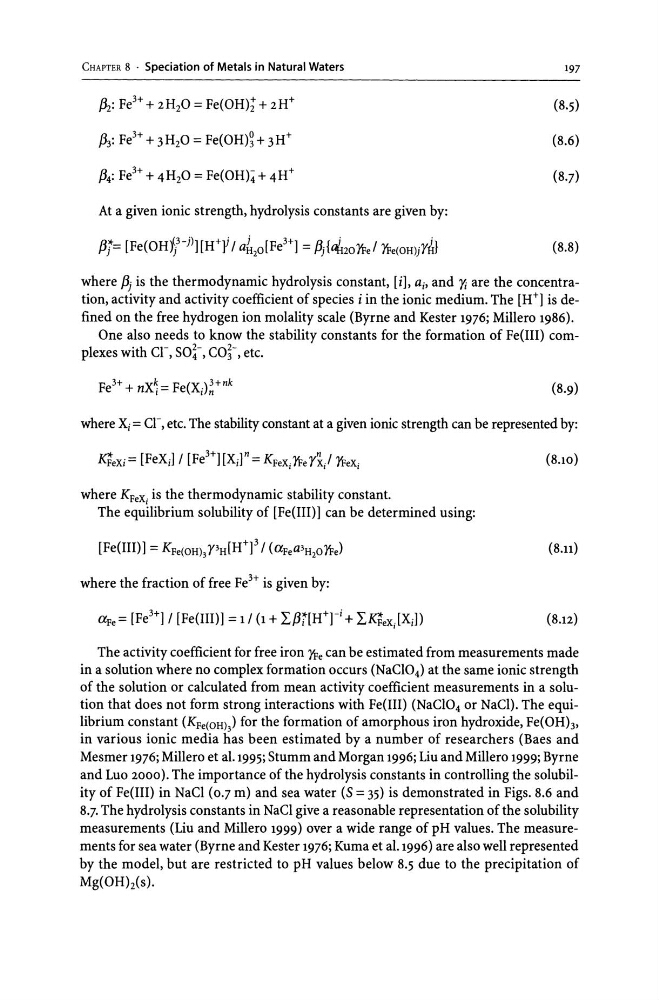
/3z: Fe3+ + 2HzO = Fe(OH)~ + 2H+
(B.S)
133: Fe3+ + 3HzO = Fe(OH)~ + 3H+
(B.6)
134: Fe 3 + + 4HzO = Fe(OH)4 + 4H+
(B.7)
At a given ionic strength, hydrolysis constants are given by:
f3t= [Fe(OH)j3- j ))[H+]j I ah 2 0[Fe 3 +] = f3j{ahzo'YFe l 'YFe(oH)jyh}
(B.B)
where f3j is the thermodynamic hydrolysis constant, [i], ai' and y; are the concentration, activity and activity coefficient of species i in the ionic medium. The [H+] is defined on the free hydrogen ion molality scale (Byrne and Kester 1976; Millero 19B6).
One also needs to know the stability constants for the formation of Fe(III) complexes with cr, SO~-, coL etc.
Fe 3 + + nXk= Fe(X·)3+nk
I
I n
(B·9)
where Xi = cr, etc. The stability constant at a given ionic strength can be represented by:
Ktexi = [FeX;l1 [Fe 3 +] [Xit = KFeXi ' YFe y~/ 'YFeX i
(B.lO)
where K FeXi is the thermodynamic stability constant.
The equilibrium solubility of [Fe(III)] can be determined using:
[Fe(III)] = KFe(OHhY3H [H+]3 1 (aFea3H20'YFe)
(B.n)
where the fraction of free Fe3+ is given by:
aFe = [Fe 3 +] I [Fe(III)] = 11 (1 + I.f3([H+r i + I.Ktex[X;l)
I
(B.12)
The activity coefficient for free iron ' YFe can be estimated from measurements made
in a solution where no complex formation occurs (NaCI04) at the same ionic strength
of the solution or calculated from mean activity coefficient measurements in a solution that does not form strong interactions with Fe(III) (NaCl0 4 or NaCI). The equilibrium constant (KFe(OHh) for the formation of amorphous iron hydroxide, Fe(OHh,
in various ionic media has been estimated by a number of researchers (Baes and
Mesmer 1976; Millero et al.199S; Stumm and Morgan 1996; Liu and Millero 1999; Byrne
and Luo 2000). The importance of the hydrolysis constants in controlling the solubility of Fe(III) in NaCI (0.7 m) and sea water (S = 35) is demonstrated in Figs. B.6 and
B.7. The hydrolysis constants in NaCI give a reasonable representation of the solubility
measurements (Liu and Millero 1999) over a wide range of pH values. The measurements for sea water (Byrne and Kester 1976; Kuma et al.1996) are also well represented
by the model, but are restricted to pH values below B.5 due to the precipitation of
Mg(OH}z(s).
197
/3z: Fe3+ + 2HzO = Fe(OH)~ + 2H+
(B.S)
133: Fe3+ + 3HzO = Fe(OH)~ + 3H+
(B.6)
134: Fe 3 + + 4HzO = Fe(OH)4 + 4H+
(B.7)
At a given ionic strength, hydrolysis constants are given by:
f3t= [Fe(OH)j3- j ))[H+]j I ah 2 0[Fe 3 +] = f3j{ahzo'YFe l 'YFe(oH)jyh}
(B.B)
where f3j is the thermodynamic hydrolysis constant, [i], ai' and y; are the concentration, activity and activity coefficient of species i in the ionic medium. The [H+] is defined on the free hydrogen ion molality scale (Byrne and Kester 1976; Millero 19B6).
One also needs to know the stability constants for the formation of Fe(III) complexes with cr, SO~-, coL etc.
Fe 3 + + nXk= Fe(X·)3+nk
I
I n
(B·9)
where Xi = cr, etc. The stability constant at a given ionic strength can be represented by:
Ktexi = [FeX;l1 [Fe 3 +] [Xit = KFeXi ' YFe y~/ 'YFeX i
(B.lO)
where K FeXi is the thermodynamic stability constant.
The equilibrium solubility of [Fe(III)] can be determined using:
[Fe(III)] = KFe(OHhY3H [H+]3 1 (aFea3H20'YFe)
(B.n)
where the fraction of free Fe3+ is given by:
aFe = [Fe 3 +] I [Fe(III)] = 11 (1 + I.f3([H+r i + I.Ktex[X;l)
I
(B.12)
The activity coefficient for free iron ' YFe can be estimated from measurements made
in a solution where no complex formation occurs (NaCI04) at the same ionic strength
of the solution or calculated from mean activity coefficient measurements in a solution that does not form strong interactions with Fe(III) (NaCl0 4 or NaCI). The equilibrium constant (KFe(OHh) for the formation of amorphous iron hydroxide, Fe(OHh,
in various ionic media has been estimated by a number of researchers (Baes and
Mesmer 1976; Millero et al.199S; Stumm and Morgan 1996; Liu and Millero 1999; Byrne
and Luo 2000). The importance of the hydrolysis constants in controlling the solubility of Fe(III) in NaCI (0.7 m) and sea water (S = 35) is demonstrated in Figs. B.6 and
B.7. The hydrolysis constants in NaCI give a reasonable representation of the solubility
measurements (Liu and Millero 1999) over a wide range of pH values. The measurements for sea water (Byrne and Kester 1976; Kuma et al.1996) are also well represented
by the model, but are restricted to pH values below B.5 due to the precipitation of
Mg(OH}z(s).