

196
F. Millero . D. Pierrot
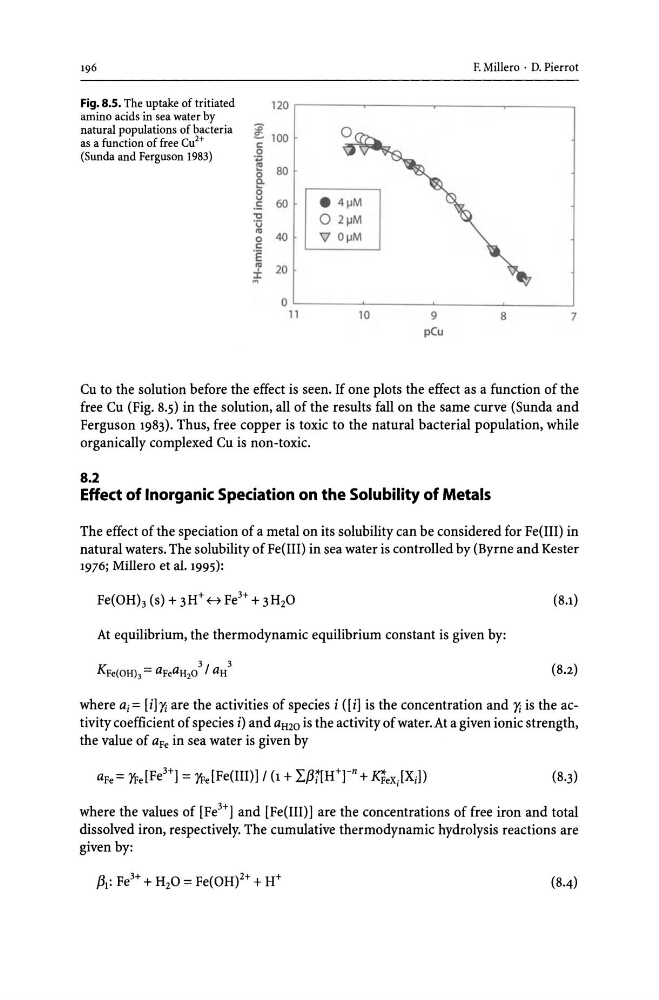
Fig. 8.5. The uptake of tritiated
amino acids in sea water by
natural populations of bacteria
as a function offree Cu 2 +
(Sunda and Ferguson 1983)
120 I,-----~------r---_ _._---_,
ll00
'"
0
''::;
~
80
0
e- o v
:t
.4iJM
.S
""C
o 2iJM
'u
'"
V OiJM
0
' "
'E
'" 20
io ~I --------~------~--______ ~ _ _ _ _ _ _ _ J
11
10
9
8
7
pCu
eu to the solution before the effect is seen. If one plots the effect as a function of the
free eu (Fig. 8.5) in the solution, all of the results fall on the same curve (Sunda and
Ferguson 1983). Thus, free copper is toxic to the natural bacterial population, while
organically complexed eu is non-toxic.
8.2
Effect of Inorganic Speciation on the Solubility of Metals
The effect of the speciation of a metal on its solubility can be considered for Fe(III) in
natural waters. The solubility of Fe(III) in sea water is controlled by (Byrne and Kester
1976; Millero et al. 1995):
Fe(OHh (s) + 3H+ H Fe 3 + + 3H20
(8.1)
At equilibrium, the thermodynamic equilibrium constant is given by:
3/
3
KFe(OH)3 == aFea H 2 0 aH
(8.2)
where ai == [i] Yi are the activities of species i ([ i] is the concentration and Yi is the activity coefficient of species i) and aRlO is the activity of water. At a given ionic strength,
the value of aFe in sea water is given by
aFe == lFe [Fe 3 +] == lFe [Fe(III)] / (1 + I.13i1H+r n + KFex.[Xi])
I
(8·3)
where the values of [Fe 3 +] and [Fe(III)] are the concentrations of free iron and total
dissolved iron, respectively. The cumulative thermodynamic hydrolysis reactions are
given by:
131: Fe 3 + + H 2 0 == Fe(OH)2+ + H+
(8.4)
F. Millero . D. Pierrot
Fig. 8.5. The uptake of tritiated
amino acids in sea water by
natural populations of bacteria
as a function offree Cu 2 +
(Sunda and Ferguson 1983)
120 I,-----~------r---_ _._---_,
ll00
'"
0
''::;
~
80
0
e- o v
:t
.4iJM
.S
""C
o 2iJM
'u
'"
V OiJM
0
' "
'E
'" 20
io ~I --------~------~--______ ~ _ _ _ _ _ _ _ J
11
10
9
8
7
pCu
eu to the solution before the effect is seen. If one plots the effect as a function of the
free eu (Fig. 8.5) in the solution, all of the results fall on the same curve (Sunda and
Ferguson 1983). Thus, free copper is toxic to the natural bacterial population, while
organically complexed eu is non-toxic.
8.2
Effect of Inorganic Speciation on the Solubility of Metals
The effect of the speciation of a metal on its solubility can be considered for Fe(III) in
natural waters. The solubility of Fe(III) in sea water is controlled by (Byrne and Kester
1976; Millero et al. 1995):
Fe(OHh (s) + 3H+ H Fe 3 + + 3H20
(8.1)
At equilibrium, the thermodynamic equilibrium constant is given by:
3/
3
KFe(OH)3 == aFea H 2 0 aH
(8.2)
where ai == [i] Yi are the activities of species i ([ i] is the concentration and Yi is the activity coefficient of species i) and aRlO is the activity of water. At a given ionic strength,
the value of aFe in sea water is given by
aFe == lFe [Fe 3 +] == lFe [Fe(III)] / (1 + I.13i1H+r n + KFex.[Xi])
I
(8·3)
where the values of [Fe 3 +] and [Fe(III)] are the concentrations of free iron and total
dissolved iron, respectively. The cumulative thermodynamic hydrolysis reactions are
given by:
131: Fe 3 + + H 2 0 == Fe(OH)2+ + H+
(8.4)