

198
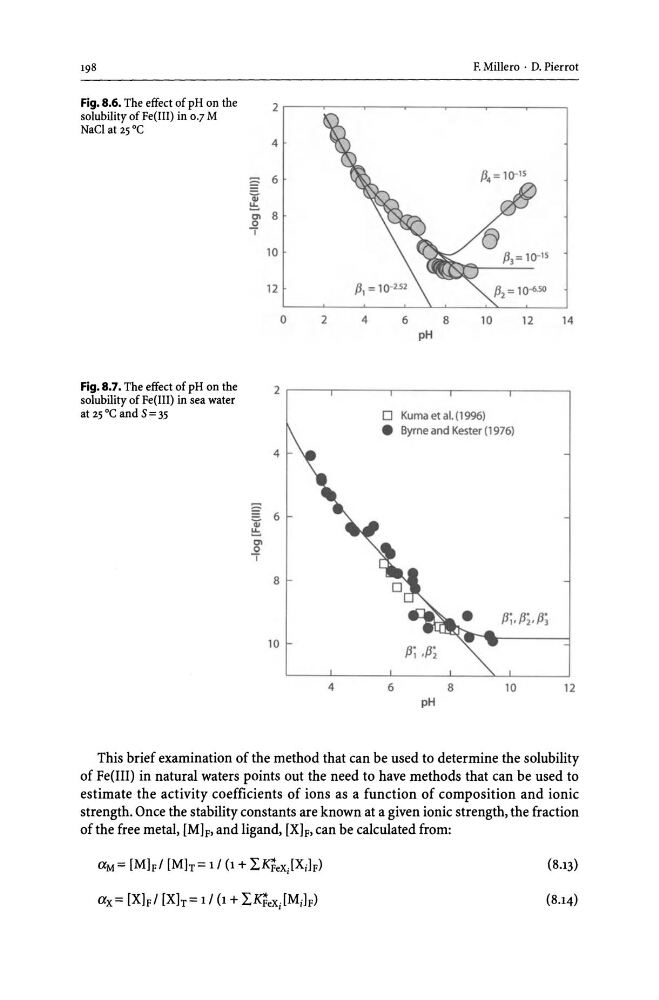
Fig. 8.6. The effect of pH on the
solubility of Fe(III) in 0.7 M
NaCI at 25°C
Fig. 8.7. The effect of pH on the
solubility of Fe(lII) in sea water
at 25°C and s= 35
2
4
6
;¥
';;, 8
0
"j'
10
12
o
2
4
2
1\
4
Qj'
6
~
en
0
"j'
8
I
lO t
4
F. Millero . D. Pierrot
/.1.=10- 15
/.Il= 10- 15
/.I2=1(T6-50
6
8
10
12
14
pH
o Kuma et al. (1996)
• Byrne and Kester (1976)
u~
/.I;. /.I;. /.Ii
.~
/.I; .Pi
6
8
10
12
pH
This brief examination of the method that can be used to determine the solubility
of Fe(III) in natural waters points out the need to have methods that can be used to
estimate the activity coefficients of ions as a function of composition and ionic
strength. Once the stability constants are known at a given ionic strength, the fraction
of the free metal, [Mh, and ligand, [Xh, can be calculated from:
aM= [M]P1 [Mlr= 11 (1 + LKfexj[Xih)
ax = [X]P I [Xlr = 11 (1 + LKfex· [Mi]P)
I
(8.13)
(8.14)
Fig. 8.6. The effect of pH on the
solubility of Fe(III) in 0.7 M
NaCI at 25°C
Fig. 8.7. The effect of pH on the
solubility of Fe(lII) in sea water
at 25°C and s= 35
2
4
6
;¥
';;, 8
0
"j'
10
12
o
2
4
2
1\
4
Qj'
6
~
en
0
"j'
8
I
lO t
4
F. Millero . D. Pierrot
/.1.=10- 15
/.Il= 10- 15
/.I2=1(T6-50
6
8
10
12
14
pH
o Kuma et al. (1996)
• Byrne and Kester (1976)
u~
/.I;. /.I;. /.Ii
.~
/.I; .Pi
6
8
10
12
pH
This brief examination of the method that can be used to determine the solubility
of Fe(III) in natural waters points out the need to have methods that can be used to
estimate the activity coefficients of ions as a function of composition and ionic
strength. Once the stability constants are known at a given ionic strength, the fraction
of the free metal, [Mh, and ligand, [Xh, can be calculated from:
aM= [M]P1 [Mlr= 11 (1 + LKfexj[Xih)
ax = [X]P I [Xlr = 11 (1 + LKfex· [Mi]P)
I
(8.13)
(8.14)