

186
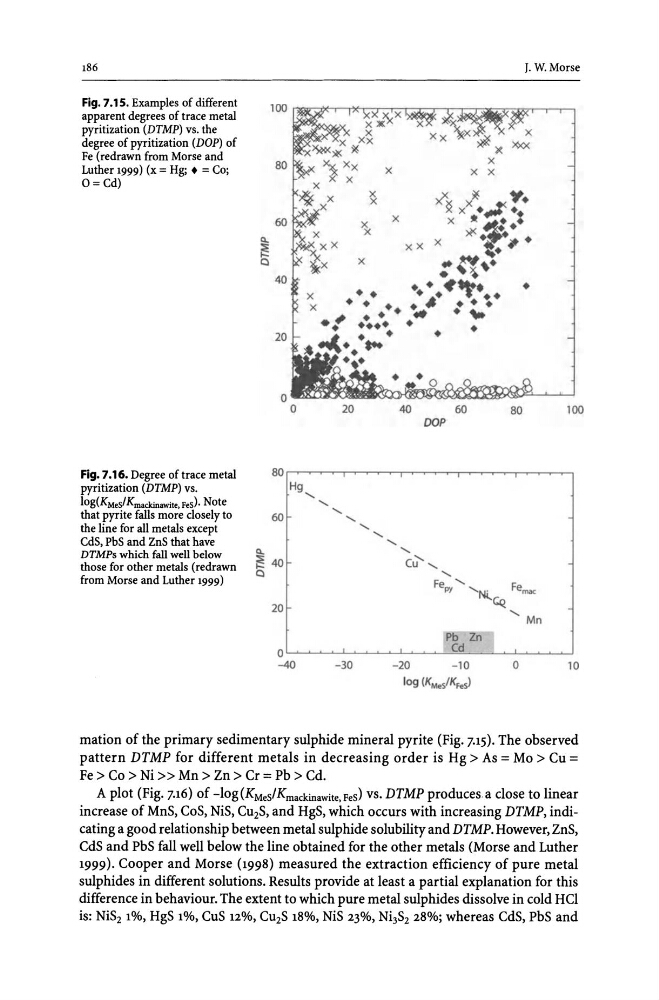
Fig. 7.1 s. Examples of different
apparent degrees of trace metal
pyritization (DTMP) vs. the
degree of pyritization (DOP) of
Fe (redrawn from Morse and
Luther 1999) (x = Hg; • = Co;
O=Cd)
Fig. 7.16. Degree of trace metal
pyritization (DTMP) vs.
log(KMesl Kmackinawite, FeS) ' Note
that pyrite falls more closely to
the line for all metals except
CdS, PbS and ZnS that have
DTMPs which fall well below
those for other metals (redrawn
from Morse and Luther 1999)
J. w. Morse
100~, IX~'>L~x ~JS~. ~ '
]
80 r _ _ v
,lL ' ~A
X
X
~
X X
X. ·
60 R : X >iL/ • ..,r Y.
~ fX
'" ,.S
o
XX X ··
X
X
, .
40
- ~~ •
• ~>+~.
.. . ... ,.
• •
•• • •
. ... . ~ ....
20 I. . . . . - . _.
o o
80 1
Hg,
60
~
~ 40
o
.
~
. .
... . .
20
40
60
80
DOP
'" " "
C' ,
u
,
F '
Femac
e py 'Ni.. CQ
, Mn
20
Pb Zn
0'
Cd
--40
- 30
- 20
-10
o
log (KMeSIK""s)
100
10
mation of the primary sedimentary sulphide mineral pyrite (Fig. 7.15). The observed
pattern DTMP for different metals in decreasing order is Hg> As = Mo > Cu =
Fe > Co > Ni > > Mn > Zn > Cr = Pb > Cd.
A plot (Fig. 7.16) of -log (KMeslKmackinawite, FeS) vs. DTMP produces a close to linear
increase of MnS, CoS, NiS, CU2S, and HgS, which occurs with increasing DTMP, indicating a good relationship between metal sulphide solubility and DTMP. However, ZnS,
CdS and PbS fall well below the line obtained for the other metals (Morse and Luther
1999). Cooper and Morse (1998) measured the extraction efficiency of pure metal
sulphides in different solutions, Results provide at least a partial explanation for this
difference in behaviour. The extent to which pure metal sulphides dissolve in cold HCI
is: NiS2 1%, HgS 1%, CuS 12%, CU2S 18%, NiS 23%, Ni3S2 28%; whereas CdS, PbS and
Fig. 7.1 s. Examples of different
apparent degrees of trace metal
pyritization (DTMP) vs. the
degree of pyritization (DOP) of
Fe (redrawn from Morse and
Luther 1999) (x = Hg; • = Co;
O=Cd)
Fig. 7.16. Degree of trace metal
pyritization (DTMP) vs.
log(KMesl Kmackinawite, FeS) ' Note
that pyrite falls more closely to
the line for all metals except
CdS, PbS and ZnS that have
DTMPs which fall well below
those for other metals (redrawn
from Morse and Luther 1999)
J. w. Morse
100~, IX~'>L~x ~JS~. ~ '
]
80 r _ _ v
,lL ' ~A
X
X
~
X X
X. ·
60 R : X >iL/ • ..,r Y.
~ fX
'" ,.S
o
XX X ··
X
X
, .
40
- ~~ •
• ~>+~.
.. . ... ,.
• •
•• • •
. ... . ~ ....
20 I. . . . . - . _.
o o
80 1
Hg,
60
~
~ 40
o
.
~
. .
... . .
20
40
60
80
DOP
'" " "
C' ,
u
,
F '
Femac
e py 'Ni.. CQ
, Mn
20
Pb Zn
0'
Cd
--40
- 30
- 20
-10
o
log (KMeSIK""s)
100
10
mation of the primary sedimentary sulphide mineral pyrite (Fig. 7.15). The observed
pattern DTMP for different metals in decreasing order is Hg> As = Mo > Cu =
Fe > Co > Ni > > Mn > Zn > Cr = Pb > Cd.
A plot (Fig. 7.16) of -log (KMeslKmackinawite, FeS) vs. DTMP produces a close to linear
increase of MnS, CoS, NiS, CU2S, and HgS, which occurs with increasing DTMP, indicating a good relationship between metal sulphide solubility and DTMP. However, ZnS,
CdS and PbS fall well below the line obtained for the other metals (Morse and Luther
1999). Cooper and Morse (1998) measured the extraction efficiency of pure metal
sulphides in different solutions, Results provide at least a partial explanation for this
difference in behaviour. The extent to which pure metal sulphides dissolve in cold HCI
is: NiS2 1%, HgS 1%, CuS 12%, CU2S 18%, NiS 23%, Ni3S2 28%; whereas CdS, PbS and