

CHAPTER 7 . Sedimentary Geochemistry of the Carbonate and Sulphide Systems
61
71
~4
5
"0
~
:l
~ 2
0" Vl
o
2
a
~
~
~o<:•
~eOV •
~:?>,-e
~~~\l
~
~e~o
••
Sulphide
oxidation
&~~<;
• •
0.0<;
.:.
• Mudbanks
0000
8 oQ 0 00
o~o
4
6
o Burrowed banks
8
10
12
rco; (mM)
14
• •
•
•
• •
.' •
- •
• o 0 0
8 0 0
o 0 00
o 0.5 1.0
b
• Mudbanks
o Burrowed banks
00 000
1.5
2.5
Excess Ca 2 + (mM )
185
2.5
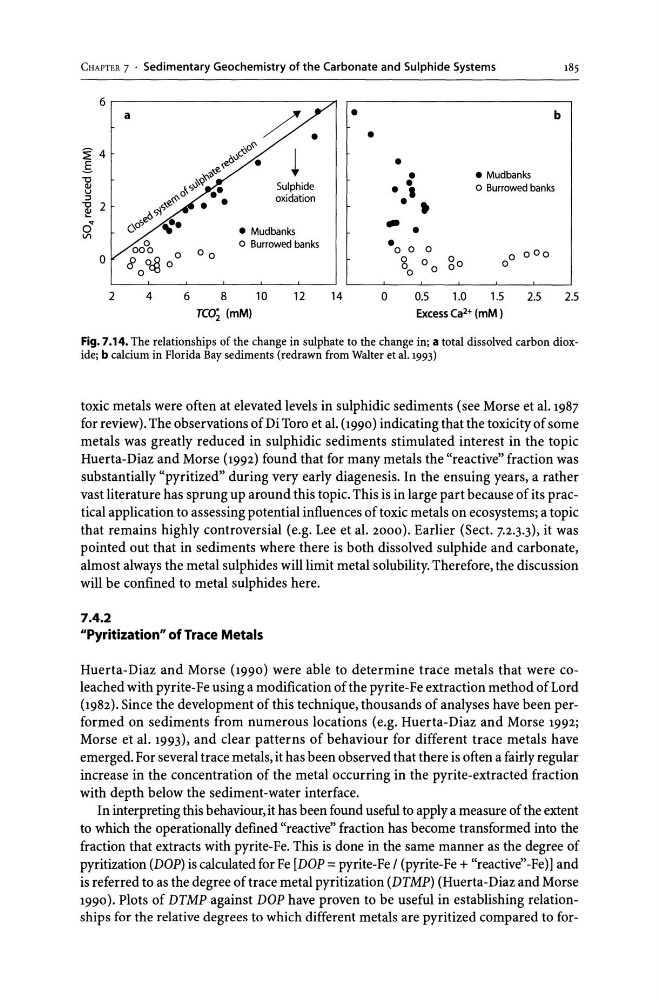
Fig. 7.14. The relationships of the change in sulphate to the change in; a total dissolved carbon dioxide; b calcium in Florida Bay sediments (redrawn from Walter et al. 1993)
toxic metals were often at elevated levels in sulphidic sediments (see Morse et al. 1987
for review). The observations of Di Toro et al. (1990) indicating that the toxicity of some
metals was greatly reduced in sulphidic sediments stimulated interest in the topic
Huerta-Diaz and Morse (1992) found that for many metals the "reactive" fraction was
substantially "pyritized" during very early diagenesis. In the ensuing years, a rather
vast literature has sprung up around this topic. This is in large part because of its practical application to assessing potential influences of toxic metals on ecosystems; a topic
that remains highly controversial (e.g. Lee et al. 2000). Earlier (Sect. 7.2.3.3), it was
pointed out that in sediments where there is both dissolved sulphide and carbonate,
almost always the metal sulphides will limit metal solubility. Therefore, the discussion
will be confined to metal sulphides here.
7.4.2
"Pyritization" of Trace Metals
Huerta-Diaz and Morse (1990) were able to determine trace metals that were coleached with pyrite-Fe using a modification of the pyrite-Fe extraction method of Lord
(1982). Since the development of this technique, thousands of analyses have been performed on sediments from numerous locations (e.g. Huerta-Diaz and Morse 1992;
Morse et al. 1993), and clear patterns of behaviour for different trace metals have
emerged. For several trace metals, it has been observed that there is often a fairly regular
increase in the concentration of the metal occurring in the pyrite-extracted fraction
with depth below the sediment-water interface.
In interpreting this behaviour, it has been found useful to apply a measure of tile extent
to which tile operationally defined "reactive" fraction has become transformed into tile
fraction that extracts with pyrite-Fe. This is done in the same manner as the degree of
pyritization (DOP) is calculated for Fe [DOP = pyrite-Fe I (pyrite-Fe + "reactive"-Fe)] and
is referred to as the degree of trace metal pyritization (DTMP) (Huerta-Diaz and Morse
1990). Plots of DTMP against DOP have proven to be useful in establishing relationships for the relative degrees to which different metals are pyritized compared to for-
61
71
~4
5
"0
~
:l
~ 2
0" Vl
o
2
a
~
~
~o<:•
~eOV •
~:?>,-e
~~~\l
~
~e~o
••
Sulphide
oxidation
&~~<;
• •
0.0<;
.:.
• Mudbanks
0000
8 oQ 0 00
o~o
4
6
o Burrowed banks
8
10
12
rco; (mM)
14
• •
•
•
• •
.' •
- •
• o 0 0
8 0 0
o 0 00
o 0.5 1.0
b
• Mudbanks
o Burrowed banks
00 000
1.5
2.5
Excess Ca 2 + (mM )
185
2.5
Fig. 7.14. The relationships of the change in sulphate to the change in; a total dissolved carbon dioxide; b calcium in Florida Bay sediments (redrawn from Walter et al. 1993)
toxic metals were often at elevated levels in sulphidic sediments (see Morse et al. 1987
for review). The observations of Di Toro et al. (1990) indicating that the toxicity of some
metals was greatly reduced in sulphidic sediments stimulated interest in the topic
Huerta-Diaz and Morse (1992) found that for many metals the "reactive" fraction was
substantially "pyritized" during very early diagenesis. In the ensuing years, a rather
vast literature has sprung up around this topic. This is in large part because of its practical application to assessing potential influences of toxic metals on ecosystems; a topic
that remains highly controversial (e.g. Lee et al. 2000). Earlier (Sect. 7.2.3.3), it was
pointed out that in sediments where there is both dissolved sulphide and carbonate,
almost always the metal sulphides will limit metal solubility. Therefore, the discussion
will be confined to metal sulphides here.
7.4.2
"Pyritization" of Trace Metals
Huerta-Diaz and Morse (1990) were able to determine trace metals that were coleached with pyrite-Fe using a modification of the pyrite-Fe extraction method of Lord
(1982). Since the development of this technique, thousands of analyses have been performed on sediments from numerous locations (e.g. Huerta-Diaz and Morse 1992;
Morse et al. 1993), and clear patterns of behaviour for different trace metals have
emerged. For several trace metals, it has been observed that there is often a fairly regular
increase in the concentration of the metal occurring in the pyrite-extracted fraction
with depth below the sediment-water interface.
In interpreting this behaviour, it has been found useful to apply a measure of tile extent
to which tile operationally defined "reactive" fraction has become transformed into tile
fraction that extracts with pyrite-Fe. This is done in the same manner as the degree of
pyritization (DOP) is calculated for Fe [DOP = pyrite-Fe I (pyrite-Fe + "reactive"-Fe)] and
is referred to as the degree of trace metal pyritization (DTMP) (Huerta-Diaz and Morse
1990). Plots of DTMP against DOP have proven to be useful in establishing relationships for the relative degrees to which different metals are pyritized compared to for-