

170
J. W.Morse
7.2.2.2
Reactions Involving Metals
Although it is possible to also write a large number of potential redox reactions between iron and manganese oxide minerals and assorted sulphur species (e.g. Aller and
Rude 1988), the major reactions in sediments are almost certainly far more complex
than these simple reactions would indicate. This is well-illustrated by the work of Pyzik
and Summer (1981) on the sulphidization of goethite (FeOOH). They pointed out it
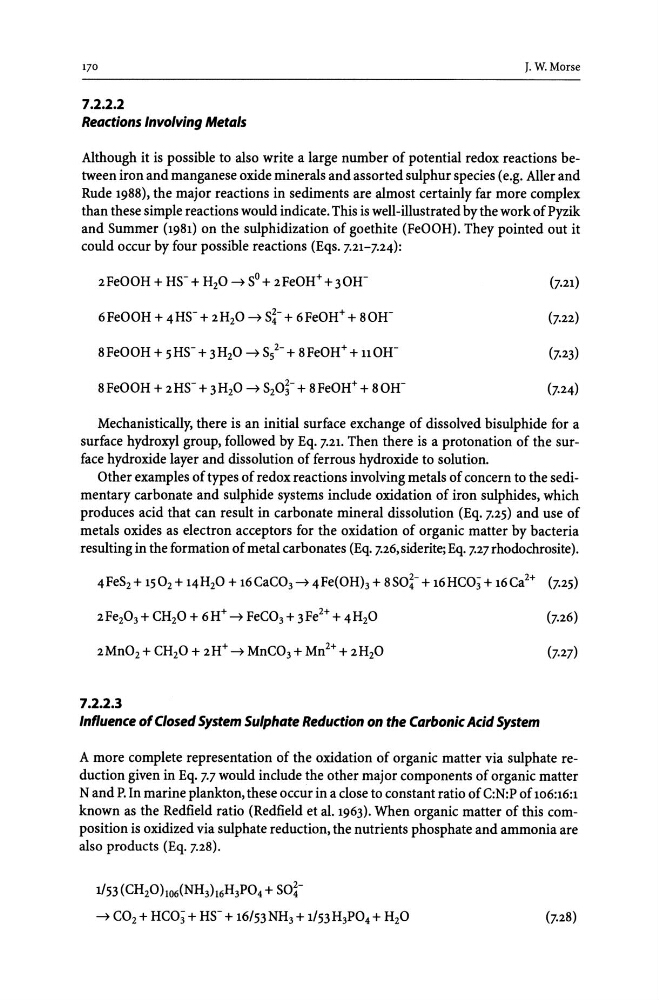
could occur by four possible reactions (Eqs. 7.21-7.24):
2FeOOH + HS- + H 2 0 ~ SO + 2 FeOH+ + 30W
(7.21)
6 FeOOH + 4HS- + 2H 2 0 ~ S~- + 6 FeOH+ + 80H(7.22)
8FeOOH + 5HS- + 3H20 ~ S/- + 8 FeOH+ + 1l0H(7.23)
8FeOOH + 2HS- + 3H20 ~ S20~- + 8 FeOH+ + 80W
(7.24)
Mechanistically, there is an initial surface exchange of dissolved bisulphide for a
surface hydroxyl group, followed by Eq. 7.21. Then there is a protonation of the surface hydroxide layer and dissolution of ferrous hydroxide to solution.
Other examples of types of redox reactions involving metals of concern to the sedimentary carbonate and sulphide systems include oxidation of iron sulphides, which
produces acid that can result in carbonate mineral dissolution (Eq. 7.25) and use of
metals oxides as electron acceptors for the oxidation of organic matter by bacteria
resulting in the formation of metal carbonates (Eq. 7.26, siderite; Eq. 7.27 rhodochrosite).
4FeS2+ 1502+ 14H20 + 16CaC03~4Fe(OHh+ 8S0~- + 16 HCO; + 16Ca 2 + (7.25)
2 Fe203 + CH20 + 6H+ ~ FeC03 + 3 Fe 2 + + 4H20
(7.26)
2Mn02 + CH 2 0 + 2H+ ~ MnC0 3 + Mn2+ + 2H 2 0
(7.27)
7.2.2.3
Influence of Closed System Sulphate Reduction on the Carbonic Acid System
A more complete representation of the oxidation of organic matter via sulphate reduction given in Eq. 7.7 would include the other major components of organic matter
Nand P. In marine plankton, these occur in a close to constant ratio of C:N:P of 106:16:1
known as the Redfield ratio (Redfield et al. 1963). When organic matter of this composition is oxidized via sulphate reduction, the nutrients phosphate and ammonia are
also products (Eq. 7.28).
1/53 (CH20) 106(NH3) 16H3P04 + SO~~ CO2 + HCO; + HS- + 16/53 NH3 + 1/53 H3P04 + H20
(7.28)
J. W.Morse
7.2.2.2
Reactions Involving Metals
Although it is possible to also write a large number of potential redox reactions between iron and manganese oxide minerals and assorted sulphur species (e.g. Aller and
Rude 1988), the major reactions in sediments are almost certainly far more complex
than these simple reactions would indicate. This is well-illustrated by the work of Pyzik
and Summer (1981) on the sulphidization of goethite (FeOOH). They pointed out it
could occur by four possible reactions (Eqs. 7.21-7.24):
2FeOOH + HS- + H 2 0 ~ SO + 2 FeOH+ + 30W
(7.21)
6 FeOOH + 4HS- + 2H 2 0 ~ S~- + 6 FeOH+ + 80H(7.22)
8FeOOH + 5HS- + 3H20 ~ S/- + 8 FeOH+ + 1l0H(7.23)
8FeOOH + 2HS- + 3H20 ~ S20~- + 8 FeOH+ + 80W
(7.24)
Mechanistically, there is an initial surface exchange of dissolved bisulphide for a
surface hydroxyl group, followed by Eq. 7.21. Then there is a protonation of the surface hydroxide layer and dissolution of ferrous hydroxide to solution.
Other examples of types of redox reactions involving metals of concern to the sedimentary carbonate and sulphide systems include oxidation of iron sulphides, which
produces acid that can result in carbonate mineral dissolution (Eq. 7.25) and use of
metals oxides as electron acceptors for the oxidation of organic matter by bacteria
resulting in the formation of metal carbonates (Eq. 7.26, siderite; Eq. 7.27 rhodochrosite).
4FeS2+ 1502+ 14H20 + 16CaC03~4Fe(OHh+ 8S0~- + 16 HCO; + 16Ca 2 + (7.25)
2 Fe203 + CH20 + 6H+ ~ FeC03 + 3 Fe 2 + + 4H20
(7.26)
2Mn02 + CH 2 0 + 2H+ ~ MnC0 3 + Mn2+ + 2H 2 0
(7.27)
7.2.2.3
Influence of Closed System Sulphate Reduction on the Carbonic Acid System
A more complete representation of the oxidation of organic matter via sulphate reduction given in Eq. 7.7 would include the other major components of organic matter
Nand P. In marine plankton, these occur in a close to constant ratio of C:N:P of 106:16:1
known as the Redfield ratio (Redfield et al. 1963). When organic matter of this composition is oxidized via sulphate reduction, the nutrients phosphate and ammonia are
also products (Eq. 7.28).
1/53 (CH20) 106(NH3) 16H3P04 + SO~~ CO2 + HCO; + HS- + 16/53 NH3 + 1/53 H3P04 + H20
(7.28)