

CHAPTER 7 . Sedimentary Geochemistry of the Carbonate and Sulphide Systems
169
plex form in the context of how it influences carbonate mineral dissolution and precipitation, nutrient regeneration and pore water pH.
Although organic-C of zero valence is generally assumed in sulphate reduction reactions, other forms are possible as well. For example, one of the more studied and
still controversial reactions is where methane is used as the electron donor. This reaction can be simply written as in Eq. 7.8. However, it likely does not occur directly, and
a consortium of bacteria, probably
CH 4 + SO~- ~ HS- + HCO; + HzO
(7.8)
causes the above net reaction to occur via two steps as in Eqs. 7.9 and /'.10 (Hoehler et al.1994).
CH4 + 3HzO ~ HCO~- + 4Hz + H+
(7·9)
4Hz + SO~- + H+ ~ HS- + 4HzO
(7.10)
The sulphide that is produced by these reactions can meet a number of different
fates. Generally, only a few percent of the produced sulphide survives to ultimately be
buried, dominantly as pyrite-So The two primary ways in which the sulphide is lost both
involve oxidation. This oxidation can be accomplished by S oxidizing bacteria, with entire
ecosystems using sulphide as an energy source, such as in hydrothermal ridge vents
and in cold "seep" vents. Oxidation can also result from reaction of hydrogen sulphide
with metal oxides, with iron and manganese oxides generally being most important.
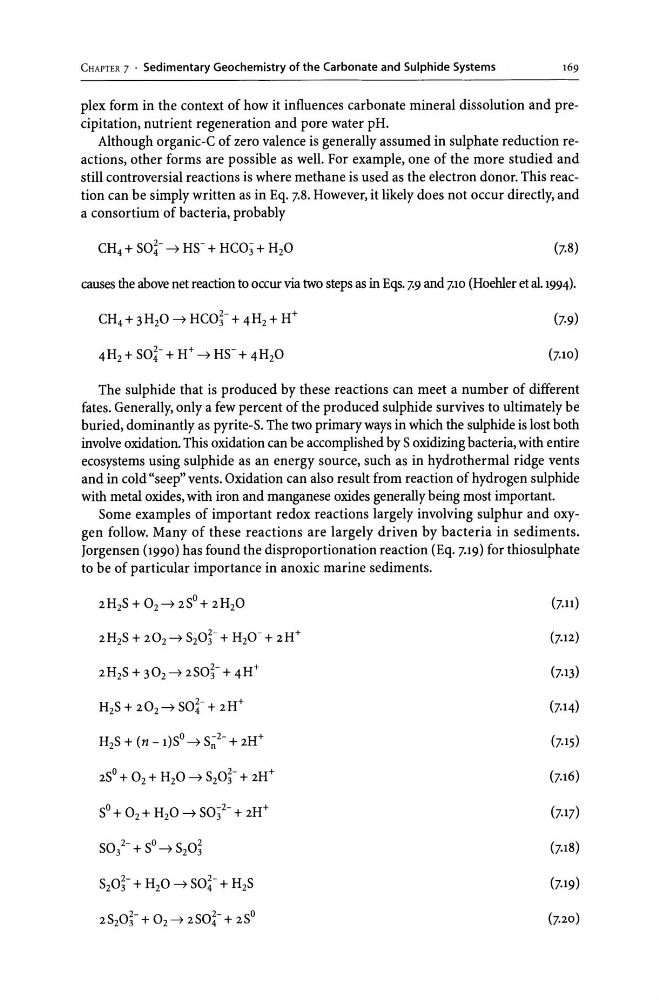
Some examples of important redox reactions largely involving sulphur and oxygen follow. Many of these reactions are largely driven by bacteria in sediments.
Jorgensen (1990) has found the disproportionation reaction (Eq. 7.19) for thiosulphate
to be of particular importance in anoxic marine sediments.
2H z S + Oz ~ 2So + 2H z O
(7·u)
2H z S + 20z ~ SzO;- + HzO- + 2H+
(7.12)
2HzS + 30z~ 2S0~- + 4H+
(7.13)
HzS + 20 2 ~ SO~- + 2H+
(7.14)
HzS + (n - l)SO ~ S~z- + 2H+
(7.15)
2So + O 2 + H 2 0 ~ S20~- + 2H+
(7.16)
SO + O 2 + H 2 0 ~ SO;2- + 2H+
(7.17)
S03 2 - + SO ~ S20~
(7.18)
SzO~- + HzO ~ SO~- + HzS
(7.19 )
2S20~- + O 2 ~ 2S0~- + 2S0
(7.20)
169
plex form in the context of how it influences carbonate mineral dissolution and precipitation, nutrient regeneration and pore water pH.
Although organic-C of zero valence is generally assumed in sulphate reduction reactions, other forms are possible as well. For example, one of the more studied and
still controversial reactions is where methane is used as the electron donor. This reaction can be simply written as in Eq. 7.8. However, it likely does not occur directly, and
a consortium of bacteria, probably
CH 4 + SO~- ~ HS- + HCO; + HzO
(7.8)
causes the above net reaction to occur via two steps as in Eqs. 7.9 and /'.10 (Hoehler et al.1994).
CH4 + 3HzO ~ HCO~- + 4Hz + H+
(7·9)
4Hz + SO~- + H+ ~ HS- + 4HzO
(7.10)
The sulphide that is produced by these reactions can meet a number of different
fates. Generally, only a few percent of the produced sulphide survives to ultimately be
buried, dominantly as pyrite-So The two primary ways in which the sulphide is lost both
involve oxidation. This oxidation can be accomplished by S oxidizing bacteria, with entire
ecosystems using sulphide as an energy source, such as in hydrothermal ridge vents
and in cold "seep" vents. Oxidation can also result from reaction of hydrogen sulphide
with metal oxides, with iron and manganese oxides generally being most important.
Some examples of important redox reactions largely involving sulphur and oxygen follow. Many of these reactions are largely driven by bacteria in sediments.
Jorgensen (1990) has found the disproportionation reaction (Eq. 7.19) for thiosulphate
to be of particular importance in anoxic marine sediments.
2H z S + Oz ~ 2So + 2H z O
(7·u)
2H z S + 20z ~ SzO;- + HzO- + 2H+
(7.12)
2HzS + 30z~ 2S0~- + 4H+
(7.13)
HzS + 20 2 ~ SO~- + 2H+
(7.14)
HzS + (n - l)SO ~ S~z- + 2H+
(7.15)
2So + O 2 + H 2 0 ~ S20~- + 2H+
(7.16)
SO + O 2 + H 2 0 ~ SO;2- + 2H+
(7.17)
S03 2 - + SO ~ S20~
(7.18)
SzO~- + HzO ~ SO~- + HzS
(7.19 )
2S20~- + O 2 ~ 2S0~- + 2S0
(7.20)