

CHAPTER 6 . Diagenesis of Organic Matter at the Water-Sediment Interface
161
~ X~·n
"'0 ~
"'"
" 0
HO
OH
OAe
Fucoxanthin
t
~ X~·n
:;/
"""
"' "
o
~
HO
OH
OH
OAe
+
~x~OO
HO~~ -
~eaxanthin
(Dlatoxanthin)
~
>
(Diadinoxanthin)
(Peridinin)
f
~R
HO~R
~
~
OH X~.~
111110""
M
HO
OH
OAe
Fucoxanthin 5,8-hemiketal
~
HO~II"b
/
~R
Ho~b -
t
~O
Ho~b
~O
HO~II"O
(3S,5R) Loliolide
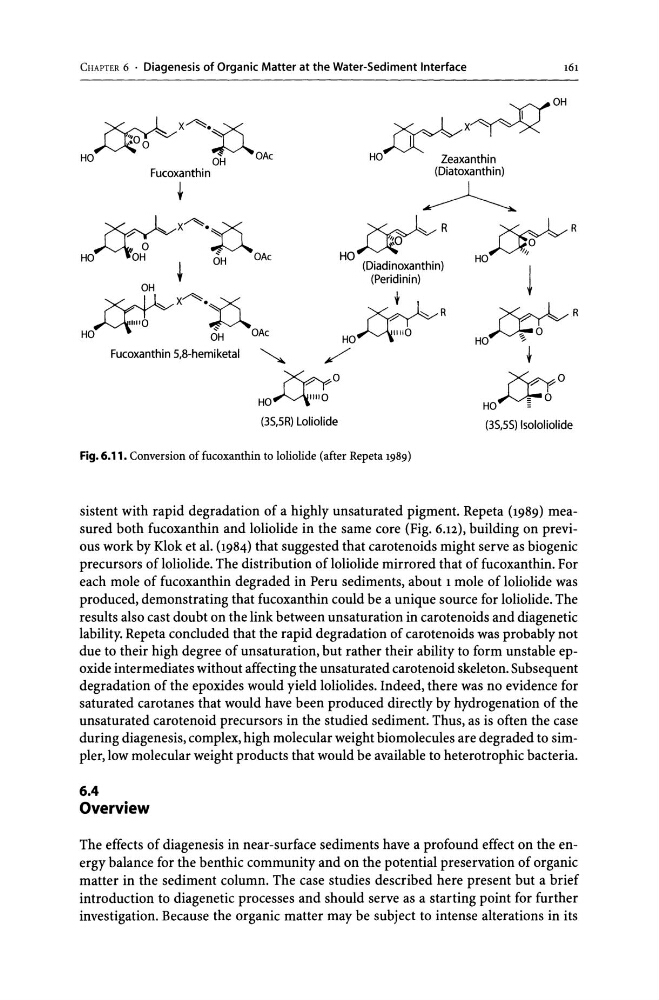
Fig. 6.11. Conversion of fucoxanthin to loliolide (after Repeta 1989)
(35,55) Isololiolide
sistent with rapid degradation of a highly unsaturated pigment. Repeta (1989) measured both fucoxanthin and loliolide in the same core (Fig. 6.12), building on previous work by Klok et al. (1984) that suggested that carotenoids might serve as biogenic
precursors of loliolide. The distribution of loliolide mirrored that of fucoxanthin. For
each mole of fucoxanthin degraded in Peru sediments, about 1 mole of loliolide was
produced, demonstrating that fucoxanthin could be a unique source for loliolide. The
results also cast doubt on the link between unsaturation in carotenoids and diagenetic
lability. Repeta concluded that the rapid degradation of carotenoids was probably not
due to their high degree of unsaturation, but rather their ability to form unstable epoxide intermediates without affecting the unsaturated carotenoid skeleton. Subsequent
degradation of the epoxides would yield loliolides. Indeed, there was no evidence for
saturated carotanes that would have been produced directly by hydrogenation of the
unsaturated carotenoid precursors in the studied sediment. Thus, as is often the case
during diagenesis, complex, high molecular weight biomolecules are degraded to simpler, low molecular weight products that would be available to heterotrophic bacteria.
6.4
Overview
The effects of diagenesis in near-surface sediments have a profound effect on the energy balance for the benthic community and on the potential preservation of organic
matter in the sediment column. The case studies described here present but a brief
introduction to diagenetic processes and should serve as a starting point for further
investigation. Because the organic matter may be subject to intense alterations in its
161
~ X~·n
"'0 ~
"'"
" 0
HO
OH
OAe
Fucoxanthin
t
~ X~·n
:;/
"""
"' "
o
~
HO
OH
OH
OAe
+
~x~OO
HO~~ -
~eaxanthin
(Dlatoxanthin)
~
>
(Diadinoxanthin)
(Peridinin)
f
~R
HO~R
~
~
OH X~.~
111110""
M
HO
OH
OAe
Fucoxanthin 5,8-hemiketal
~
HO~II"b
/
~R
Ho~b -
t
~O
Ho~b
~O
HO~II"O
(3S,5R) Loliolide
Fig. 6.11. Conversion of fucoxanthin to loliolide (after Repeta 1989)
(35,55) Isololiolide
sistent with rapid degradation of a highly unsaturated pigment. Repeta (1989) measured both fucoxanthin and loliolide in the same core (Fig. 6.12), building on previous work by Klok et al. (1984) that suggested that carotenoids might serve as biogenic
precursors of loliolide. The distribution of loliolide mirrored that of fucoxanthin. For
each mole of fucoxanthin degraded in Peru sediments, about 1 mole of loliolide was
produced, demonstrating that fucoxanthin could be a unique source for loliolide. The
results also cast doubt on the link between unsaturation in carotenoids and diagenetic
lability. Repeta concluded that the rapid degradation of carotenoids was probably not
due to their high degree of unsaturation, but rather their ability to form unstable epoxide intermediates without affecting the unsaturated carotenoid skeleton. Subsequent
degradation of the epoxides would yield loliolides. Indeed, there was no evidence for
saturated carotanes that would have been produced directly by hydrogenation of the
unsaturated carotenoid precursors in the studied sediment. Thus, as is often the case
during diagenesis, complex, high molecular weight biomolecules are degraded to simpler, low molecular weight products that would be available to heterotrophic bacteria.
6.4
Overview
The effects of diagenesis in near-surface sediments have a profound effect on the energy balance for the benthic community and on the potential preservation of organic
matter in the sediment column. The case studies described here present but a brief
introduction to diagenetic processes and should serve as a starting point for further
investigation. Because the organic matter may be subject to intense alterations in its