

162
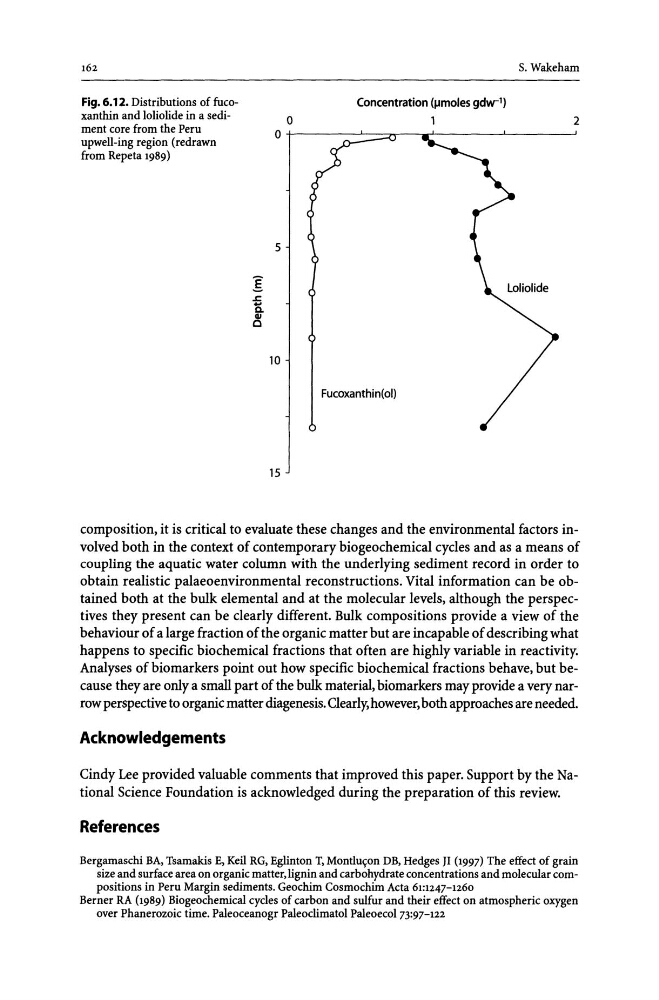
Fig. 6.12. Distributions of fucoxanthin and loliolide in a sediment core from the Peru
upwell-ing region (redrawn
from Repeta 1989)
:[
"K
~
o
Concentration (IImoles gdW-l)
1
01
~
~
5
10
Fucoxanthin(ol)
15
s. Wakeham
2
composition, it is critical to evaluate these changes and the environmental factors involved both in the context of contemporary biogeochemical cycles and as a means of
coupling the aquatic water column with the underlying sediment record in order to
obtain realistic palaeoenvironmental reconstructions. Vital information can be obtained both at the bulk elemental and at the molecular levels, although the perspectives they present can be clearly different. Bulk compositions provide a view of the
behaviour of a large fraction of the organic matter but are incapable of describing what
happens to specific biochemical fractions that often are highly variable in reactivity.
Analyses of biomarkers point out how specific biochemical fractions behave, but because they are only a small part of the bulk material, biomarkers may provide a very narrow perspective to organic matter diagenesis. Clearly, however, both approaches are needed.
Acknowledgements
Cindy Lee provided valuable comments that improved this paper. Support by the National Science Foundation is acknowledged during the preparation of this review.
References
Bergarnaschi BA, Tsamakis E, Keil RG, Eglinton T, Montluyon DB, Hedges JI (1997) The effect of grain
size and surface area on organic matter, lignin and carbohydrate concentrations and molecular compositions in Peru Margin sediments. Geochim Cosmochim Acta 61:1247-1260
Berner RA (1989) Biogeochemical cycles of carbon and sulfur and their effect on atmospheric oxygen
over Phanerozoic time. Paleoceanogr Paleoclimatol Paleoecol 73:97-122
Fig. 6.12. Distributions of fucoxanthin and loliolide in a sediment core from the Peru
upwell-ing region (redrawn
from Repeta 1989)
:[
"K
~
o
Concentration (IImoles gdW-l)
1
01
~
~
5
10
Fucoxanthin(ol)
15
s. Wakeham
2
composition, it is critical to evaluate these changes and the environmental factors involved both in the context of contemporary biogeochemical cycles and as a means of
coupling the aquatic water column with the underlying sediment record in order to
obtain realistic palaeoenvironmental reconstructions. Vital information can be obtained both at the bulk elemental and at the molecular levels, although the perspectives they present can be clearly different. Bulk compositions provide a view of the
behaviour of a large fraction of the organic matter but are incapable of describing what
happens to specific biochemical fractions that often are highly variable in reactivity.
Analyses of biomarkers point out how specific biochemical fractions behave, but because they are only a small part of the bulk material, biomarkers may provide a very narrow perspective to organic matter diagenesis. Clearly, however, both approaches are needed.
Acknowledgements
Cindy Lee provided valuable comments that improved this paper. Support by the National Science Foundation is acknowledged during the preparation of this review.
References
Bergarnaschi BA, Tsamakis E, Keil RG, Eglinton T, Montluyon DB, Hedges JI (1997) The effect of grain
size and surface area on organic matter, lignin and carbohydrate concentrations and molecular compositions in Peru Margin sediments. Geochim Cosmochim Acta 61:1247-1260
Berner RA (1989) Biogeochemical cycles of carbon and sulfur and their effect on atmospheric oxygen
over Phanerozoic time. Paleoceanogr Paleoclimatol Paleoecol 73:97-122