

160
S. Wakeham
accompanied by bacterial conversion of stenols, the unsaturated biological form of
most sterols, into stanols, the hydrogenated analogue (Gaskell and Eglinton 1975;
Nishimura 1978), and subsequently by dehydration of stanols to sterenes, the steroidal hydrocarbons (Wakeham et al. 1984). Stenol:stanol ratios that decrease with depth
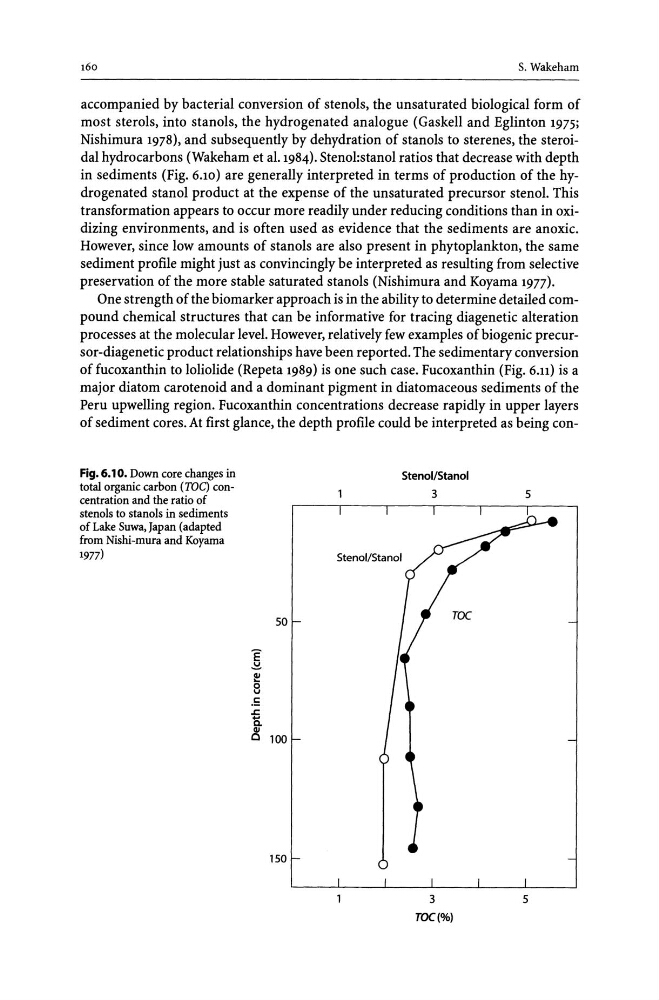
in sediments (Fig. 6.10) are generally interpreted in terms of production of the hydrogenated stanol product at the expense of the unsaturated precursor stenol. This
transformation appears to occur more readily under reducing conditions than in oxidizing environments, and is often used as evidence that the sediments are anoxic.
However, since low amounts of stanols are also present in phytoplankton, the same
sediment profile might just as convincingly be interpreted as resulting from selective
preservation of the more stable saturated stanols (Nishimura and Koyama 1977).
One strength of the biomarker approach is in the ability to determine detailed compound chemical structures that can be informative for tracing diagenetic alteration
processes at the molecular level. However, relatively few examples of biogenic precursor-diagenetic product relationships have been reported. The sedimentary conversion
offucoxanthin to loliolide (Repeta 1989) is one such case. Fucoxanthin (Fig. 6.11) is a
major diatom carotenoid and a dominant pigment in diatomaceous sediments of the
Peru upwelling region. Fucoxanthin concentrations decrease rapidly in upper layers
of sediment cores. At first glance, the depth profile could be interpreted as being conFig. 6.10. Down core changes in
total organic carbon (TOC) concentration and the ratio of
stenols to stanols in sediments
of Lake $uwa, Japan (adapted
from Nishi-mura and Koyama
1977)
E
~
!!!
0
u
.5
.s::. .... Co Qj
0
50
100
150
Stenol/Stanol
3
3
TOC(%)
5
5
S. Wakeham
accompanied by bacterial conversion of stenols, the unsaturated biological form of
most sterols, into stanols, the hydrogenated analogue (Gaskell and Eglinton 1975;
Nishimura 1978), and subsequently by dehydration of stanols to sterenes, the steroidal hydrocarbons (Wakeham et al. 1984). Stenol:stanol ratios that decrease with depth
in sediments (Fig. 6.10) are generally interpreted in terms of production of the hydrogenated stanol product at the expense of the unsaturated precursor stenol. This
transformation appears to occur more readily under reducing conditions than in oxidizing environments, and is often used as evidence that the sediments are anoxic.
However, since low amounts of stanols are also present in phytoplankton, the same
sediment profile might just as convincingly be interpreted as resulting from selective
preservation of the more stable saturated stanols (Nishimura and Koyama 1977).
One strength of the biomarker approach is in the ability to determine detailed compound chemical structures that can be informative for tracing diagenetic alteration
processes at the molecular level. However, relatively few examples of biogenic precursor-diagenetic product relationships have been reported. The sedimentary conversion
offucoxanthin to loliolide (Repeta 1989) is one such case. Fucoxanthin (Fig. 6.11) is a
major diatom carotenoid and a dominant pigment in diatomaceous sediments of the
Peru upwelling region. Fucoxanthin concentrations decrease rapidly in upper layers
of sediment cores. At first glance, the depth profile could be interpreted as being conFig. 6.10. Down core changes in
total organic carbon (TOC) concentration and the ratio of
stenols to stanols in sediments
of Lake $uwa, Japan (adapted
from Nishi-mura and Koyama
1977)
E
~
!!!
0
u
.5
.s::. .... Co Qj
0
50
100
150
Stenol/Stanol
3
3
TOC(%)
5
5