

156
S. Wakeham
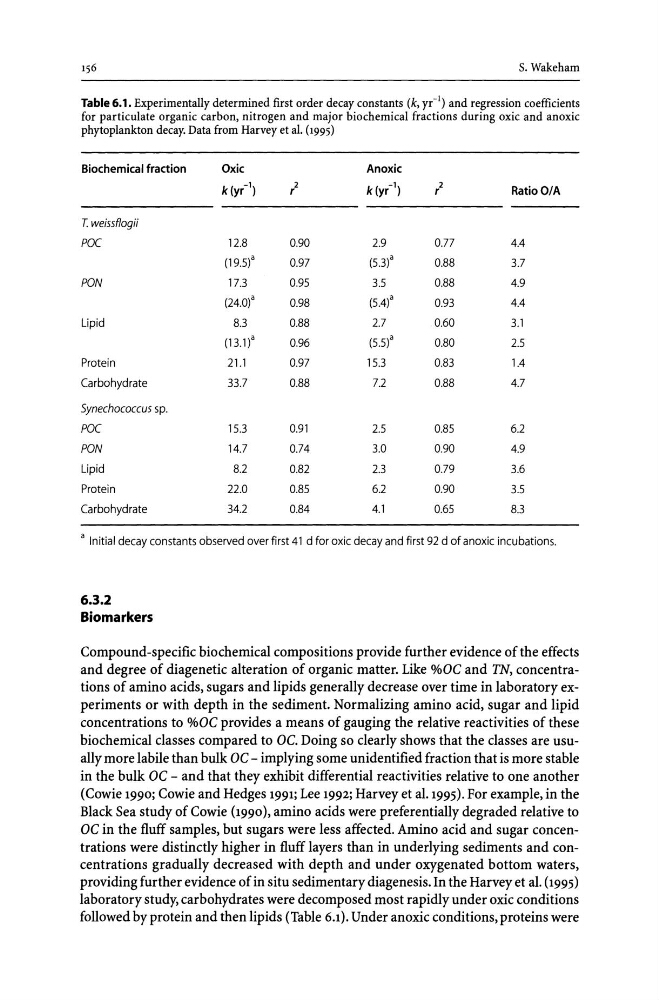
Table 6.1. Experimentally determined first order decay constants (k, yr -1) and regression coefficients
for particulate organic carbon, nitrogen and major biochemical fractions during oxic and anoxic
phytoplankton decay. Data from Harvey et al. (1995)
Biochemical fraction
Oxic
Anoxic
k(yr-')
2
k(yr-')
2
RatioO/A
r
r
T. weissflogii
POC
12.8
0.90
2.9
0.77
4.4
(19.5)a
0.97
(5.3)a
0.88
3.7
PON
17.3
0.95
3.5
0.88
4.9
(24.0)a
0.98
(5.4)a
0.93
4.4
Lipid
8.3
0.88
2.7
0.60
3.1
(13.1)a
0.96
(5.5)a
0.80
2.5
Protein
21.1
0.97
15.3
0.83
1.4
Carbohydrate
33.7
0.88
7.2
0.88
4.7
Synechococcus sp.
POC
15.3
0.91
2.5
0.85
6.2
PON
14.7
0.74
3.0
0.90
4.9
Lipid
8.2
0.82
2.3
0.79
3.6
Protein
22.0
0.85
6.2
0.90
3.5
Carbohydrate
34.2
0.84
4.1
0.65
8.3
a Initial decay constants observed over first 41 d for oxic decay and first 92 d of anoxic incubations.
6.3.2
Biomarkers
Compound-specific biochemical compositions provide further evidence of the effects
and degree of diagenetic alteration of organic matter. Like %OC and TN, concentrations of amino acids, sugars and lipids generally decrease over time in laboratory experiments or with depth in the sediment. Normalizing amino acid, sugar and lipid
concentrations to %OC provides a means of gauging the relative reactivities of these
biochemical classes compared to OC. Doing so clearly shows that the classes are usually more labile than bulk OC - implying some unidentified fraction that is more stable
in the bulk OC - and that they exhibit differential reactivities relative to one another
(Cowie 1990; Cowie and Hedges 1991; Lee 1992; Harvey et al.1995). For example, in the
Black Sea study of Cowie (1990), amino acids were preferentially degraded relative to
OC in the fluff samples, but sugars were less affected. Amino acid and sugar concentrations were distinctly higher in fluff layers than in underlying sediments and concentrations gradually decreased with depth and under oxygenated bottom waters,
providing further evidence of in situ sedimentary diagenesis. In the Harvey et al. (1995)
laboratory study, carbohydrates were decomposed most rapidly under oxic conditions
followed by protein and then lipids (Table 6.1). Under anoxic conditions, proteins were
S. Wakeham
Table 6.1. Experimentally determined first order decay constants (k, yr -1) and regression coefficients
for particulate organic carbon, nitrogen and major biochemical fractions during oxic and anoxic
phytoplankton decay. Data from Harvey et al. (1995)
Biochemical fraction
Oxic
Anoxic
k(yr-')
2
k(yr-')
2
RatioO/A
r
r
T. weissflogii
POC
12.8
0.90
2.9
0.77
4.4
(19.5)a
0.97
(5.3)a
0.88
3.7
PON
17.3
0.95
3.5
0.88
4.9
(24.0)a
0.98
(5.4)a
0.93
4.4
Lipid
8.3
0.88
2.7
0.60
3.1
(13.1)a
0.96
(5.5)a
0.80
2.5
Protein
21.1
0.97
15.3
0.83
1.4
Carbohydrate
33.7
0.88
7.2
0.88
4.7
Synechococcus sp.
POC
15.3
0.91
2.5
0.85
6.2
PON
14.7
0.74
3.0
0.90
4.9
Lipid
8.2
0.82
2.3
0.79
3.6
Protein
22.0
0.85
6.2
0.90
3.5
Carbohydrate
34.2
0.84
4.1
0.65
8.3
a Initial decay constants observed over first 41 d for oxic decay and first 92 d of anoxic incubations.
6.3.2
Biomarkers
Compound-specific biochemical compositions provide further evidence of the effects
and degree of diagenetic alteration of organic matter. Like %OC and TN, concentrations of amino acids, sugars and lipids generally decrease over time in laboratory experiments or with depth in the sediment. Normalizing amino acid, sugar and lipid
concentrations to %OC provides a means of gauging the relative reactivities of these
biochemical classes compared to OC. Doing so clearly shows that the classes are usually more labile than bulk OC - implying some unidentified fraction that is more stable
in the bulk OC - and that they exhibit differential reactivities relative to one another
(Cowie 1990; Cowie and Hedges 1991; Lee 1992; Harvey et al.1995). For example, in the
Black Sea study of Cowie (1990), amino acids were preferentially degraded relative to
OC in the fluff samples, but sugars were less affected. Amino acid and sugar concentrations were distinctly higher in fluff layers than in underlying sediments and concentrations gradually decreased with depth and under oxygenated bottom waters,
providing further evidence of in situ sedimentary diagenesis. In the Harvey et al. (1995)
laboratory study, carbohydrates were decomposed most rapidly under oxic conditions
followed by protein and then lipids (Table 6.1). Under anoxic conditions, proteins were