

CHAPTER 6 • Diagenesis of Organic Matter at the Water-Sediment Interface
155
a
Organic carbon ('Yo)
0.0
1.0
2.0
3.0
4.0
Fluff I
t.o Cl •
J
E
.!:!.
~
0- 01
o
o I
( I
Jt.-t'
'w:::: .
10
20
30
40
. &f'
4~6;"
!! ~/
~<:i. ,. I
/1 I
'91
O· I
: I I
i a.
90,'
1.
: I
: I
: I
[),
1
•
50 +1--~~--~~--r-~--r--+
b
Total nitrogen ('Yo)
0.0
0.1
0.2
0.3
0.4
-AO-----o- n
o x ' . : J : ' .::
. .,rt
~~:;':"
1 // ' -
Ilia •
: ,
I
: .
I
:6 I
1;)1 I
• .
I
/ 9. I
¢ . 4'
: 0,'
\ .
i 1
: 1
: 1
0,
1
•
_____ B54-15
- - e- - 854-26
•..• -{]-..... B54-16B
- . -0- .- B54-16
........ -6, ...... B54-17
o
10
20
30
40
•
I 50
o
"'
'S :::T
"
~
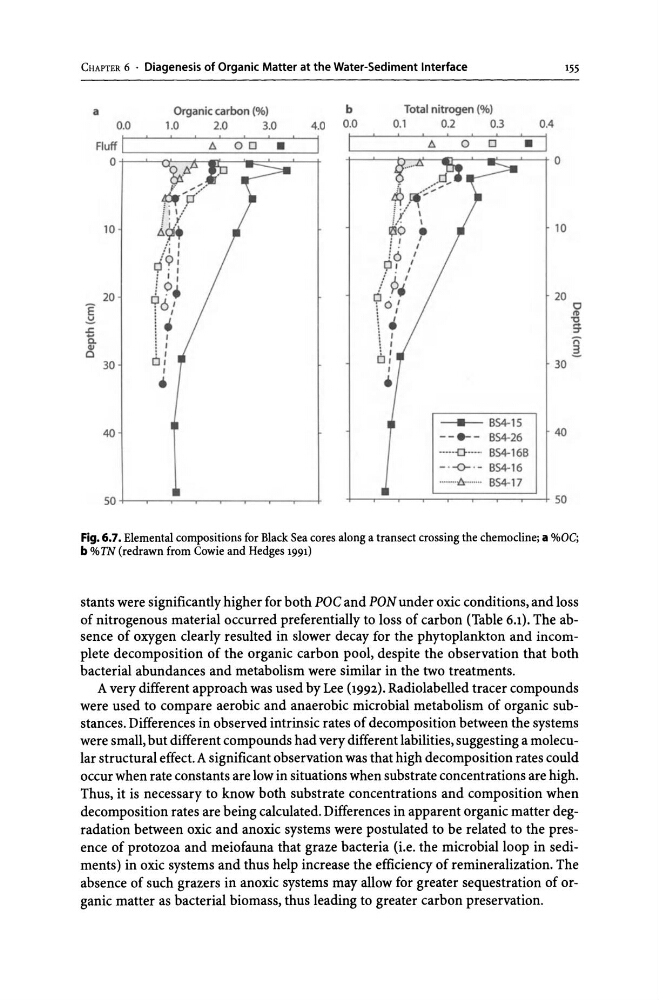
Fig. 6.7. Elemental compositions for Black Sea cores along a transect crossing the chemocline; a %OC;
b %TN (redrawn from Cowie and Hedges 1991)
stants were significantly higher for both pac and paN under oxic conditions, and loss
of nitrogenous material occurred preferentially to loss of carbon (Table 6.1). The absence of oxygen clearly resulted in slower decay for the phytoplankton and incomplete decomposition of the organic carbon pool, despite the observation that both
bacterial abundances and metabolism were similar in the two treatments.
A very different approach was used by Lee (1992). Radiolabelled tracer compounds
were used to compare aerobic and anaerobic microbial metabolism of organic substances. Differences in observed intrinsic rates of decomposition between the systems
were small, but different compounds had very different labilities, suggesting a molecular structural effect. A significant observation was that high decomposition rates could
occur when rate constants are low in situations when substrate concentrations are high.
Thus, it is necessary to know botlI substrate concentrations and composition when
decomposition rates are being calculated. Differences in apparent organic matter degradation between oxic and anoxic systems were postulated to be related to the presence of protozoa and meiofauna that graze bacteria (i.e. the microbial loop in sediments) in oxic systems and thus help increase the efficiency of remineralization. The
absence of such grazers in anoxic systems may allow for greater sequestration of organic matter as bacterial biomass, thus leading to greater carbon preservation.
155
a
Organic carbon ('Yo)
0.0
1.0
2.0
3.0
4.0
Fluff I
t.o Cl •
J
E
.!:!.
~
0- 01
o
o I
( I
Jt.-t'
'w:::: .
10
20
30
40
. &f'
4~6;"
!! ~/
~<:i. ,. I
/1 I
'91
O· I
: I I
i a.
90,'
1.
: I
: I
: I
[),
1
•
50 +1--~~--~~--r-~--r--+
b
Total nitrogen ('Yo)
0.0
0.1
0.2
0.3
0.4
-AO-----o- n
o x ' . : J : ' .::
. .,rt
~~:;':"
1 // ' -
Ilia •
: ,
I
: .
I
:6 I
1;)1 I
• .
I
/ 9. I
¢ . 4'
: 0,'
\ .
i 1
: 1
: 1
0,
1
•
_____ B54-15
- - e- - 854-26
•..• -{]-..... B54-16B
- . -0- .- B54-16
........ -6, ...... B54-17
o
10
20
30
40
•
I 50
o
"'
'S :::T
"
~
Fig. 6.7. Elemental compositions for Black Sea cores along a transect crossing the chemocline; a %OC;
b %TN (redrawn from Cowie and Hedges 1991)
stants were significantly higher for both pac and paN under oxic conditions, and loss
of nitrogenous material occurred preferentially to loss of carbon (Table 6.1). The absence of oxygen clearly resulted in slower decay for the phytoplankton and incomplete decomposition of the organic carbon pool, despite the observation that both
bacterial abundances and metabolism were similar in the two treatments.
A very different approach was used by Lee (1992). Radiolabelled tracer compounds
were used to compare aerobic and anaerobic microbial metabolism of organic substances. Differences in observed intrinsic rates of decomposition between the systems
were small, but different compounds had very different labilities, suggesting a molecular structural effect. A significant observation was that high decomposition rates could
occur when rate constants are low in situations when substrate concentrations are high.
Thus, it is necessary to know botlI substrate concentrations and composition when
decomposition rates are being calculated. Differences in apparent organic matter degradation between oxic and anoxic systems were postulated to be related to the presence of protozoa and meiofauna that graze bacteria (i.e. the microbial loop in sediments) in oxic systems and thus help increase the efficiency of remineralization. The
absence of such grazers in anoxic systems may allow for greater sequestration of organic matter as bacterial biomass, thus leading to greater carbon preservation.