

152
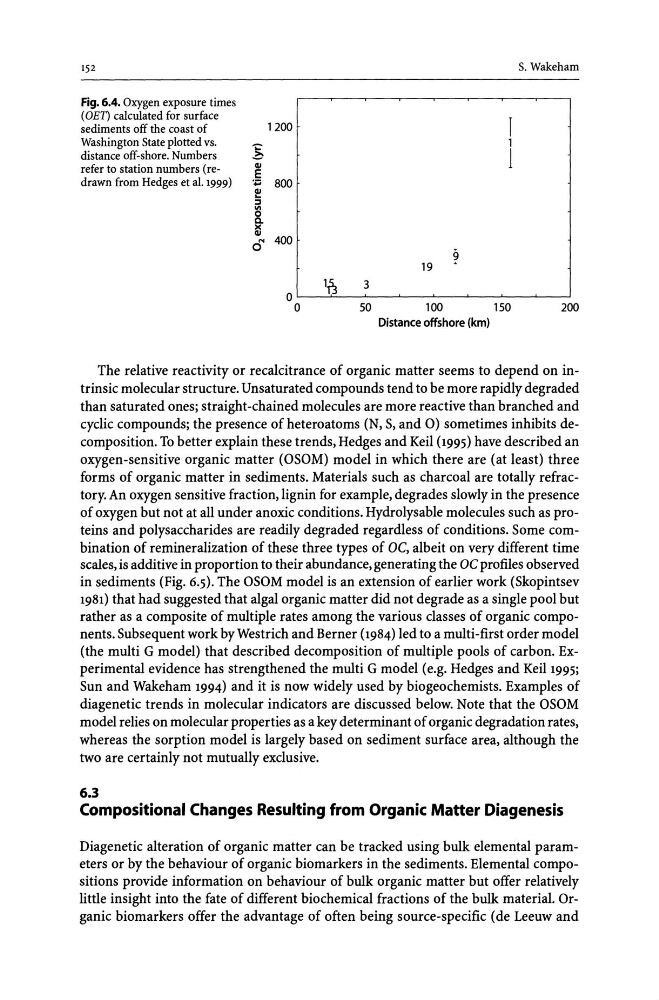
Fig. 6.4. Oxygen exposure times
(GET) calculated for surface
sediments off the coast of
Washington State plotted vs.
distance off-shore. Numbers
refer to station numbers (redrawn from Hedges et al.1999)
1200
~
E
''::; 800
~
::I
I
ON 400
0'
lQ
0
S. Wakeham
19
~
3
50
100
150
200
Distance offshore (kmJ
The relative reactivity or recalcitrance of organic matter seems to depend on intrinsic molecular structure. Unsaturated compounds tend to be more rapidly degraded
than saturated ones; straight-chained molecules are more reactive than branched and
cyclic compounds; the presence ofheteroatoms (N, S, and 0) sometimes inhibits decomposition. To better explain these trends, Hedges and Keil (1995) have described an
oxygen-sensitive organic matter (OSOM) model in which there are (at least) three
forms of organic matter in sediments. Materials such as charcoal are totally refractory. An oxygen sensitive fraction, lignin for example, degrades slowly in the presence
of oxygen but not at all under anoxic conditions. Hydrolysable molecules such as proteins and polysaccharides are readily degraded regardless of conditions. Some combination of remineralization of these three types of ~C, albeit on very different time
scales, is additive in proportion to their abundance, generating the DC profiles observed
in sediments (Fig. 6.5). The OSOM model is an extension of earlier work (Skopintsev
1981) that had suggested that algal organic matter did not degrade as a single pool but
rather as a composite of multiple rates among the various classes of organic components. Subsequent work by Westrich and Berner (1984) led to a multi-first order model
(the multi G model) that described decomposition of multiple pools of carbon. Experimental evidence has strengthened the multi G model (e.g. Hedges and Keil1995;
Sun and Wakeham 1994) and it is now widely used by biogeo chemists. Examples of
diagenetic trends in molecular indicators are discussed below. Note that the OSOM
model relies on molecular properties as a key determinant of organic degradation rates,
whereas the sorption model is largely based on sediment surface area, although the
two are certainly not mutually exclusive.
6.3
Compositional Changes Resulting from Organic Matter Diagenesis
Diagenetic alteration of organic matter can be tracked using bulk elemental parameters or by the behaviour of organic biomarkers in the sediments. Elemental compositions provide information on behaviour of bulk organic matter but offer relatively
little insight into the fate of different biochemical fractions of the bulk material. Organic biomarkers offer the advantage of often being source-specific (de Leeuw and
Fig. 6.4. Oxygen exposure times
(GET) calculated for surface
sediments off the coast of
Washington State plotted vs.
distance off-shore. Numbers
refer to station numbers (redrawn from Hedges et al.1999)
1200
~
E
''::; 800
~
::I
I
ON 400
0'
lQ
0
S. Wakeham
19
~
3
50
100
150
200
Distance offshore (kmJ
The relative reactivity or recalcitrance of organic matter seems to depend on intrinsic molecular structure. Unsaturated compounds tend to be more rapidly degraded
than saturated ones; straight-chained molecules are more reactive than branched and
cyclic compounds; the presence ofheteroatoms (N, S, and 0) sometimes inhibits decomposition. To better explain these trends, Hedges and Keil (1995) have described an
oxygen-sensitive organic matter (OSOM) model in which there are (at least) three
forms of organic matter in sediments. Materials such as charcoal are totally refractory. An oxygen sensitive fraction, lignin for example, degrades slowly in the presence
of oxygen but not at all under anoxic conditions. Hydrolysable molecules such as proteins and polysaccharides are readily degraded regardless of conditions. Some combination of remineralization of these three types of ~C, albeit on very different time
scales, is additive in proportion to their abundance, generating the DC profiles observed
in sediments (Fig. 6.5). The OSOM model is an extension of earlier work (Skopintsev
1981) that had suggested that algal organic matter did not degrade as a single pool but
rather as a composite of multiple rates among the various classes of organic components. Subsequent work by Westrich and Berner (1984) led to a multi-first order model
(the multi G model) that described decomposition of multiple pools of carbon. Experimental evidence has strengthened the multi G model (e.g. Hedges and Keil1995;
Sun and Wakeham 1994) and it is now widely used by biogeo chemists. Examples of
diagenetic trends in molecular indicators are discussed below. Note that the OSOM
model relies on molecular properties as a key determinant of organic degradation rates,
whereas the sorption model is largely based on sediment surface area, although the
two are certainly not mutually exclusive.
6.3
Compositional Changes Resulting from Organic Matter Diagenesis
Diagenetic alteration of organic matter can be tracked using bulk elemental parameters or by the behaviour of organic biomarkers in the sediments. Elemental compositions provide information on behaviour of bulk organic matter but offer relatively
little insight into the fate of different biochemical fractions of the bulk material. Organic biomarkers offer the advantage of often being source-specific (de Leeuw and