

CHAPTER 6 . Diagenesis of Organic Matter at the Water-Sediment Interface
151
8rl -------------------------------------------------------------------------,
C
",,,,'
.-'C ", , , , , ""
.~ 4 ~
~.-//,-/ «
~ "tfe'f ( (fIt.
~ I!-"'- B
21~
.","''''C
.-.-'(=0.96
ssa .L.8
m = 0.76 mg OC m- 2
,.-1
oL5~ I
o
~
~
~
100
Surface area (m2 g-l)
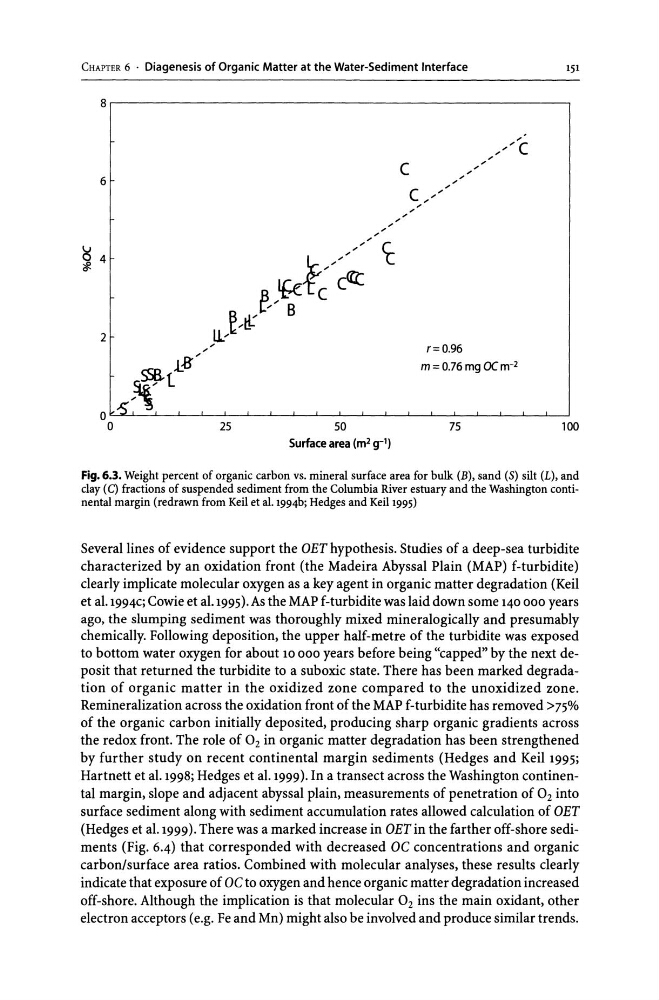
Fig. 6.3. Weight percent of organic carbon vs. mineral surface area for bulk (B), sand (S) silt (L), and
clay (e) fractions of suspended sediment from the Columbia River estuary and the Washington continental margin (redrawn from Keil et al. 1994b; Hedges and Keil1995)
Several lines of evidence support the OET hypothesis. Studies of a deep-sea turbidite
characterized by an oxidation front (the Madeira Abyssal Plain (MAP) f-turbidite)
clearly implicate molecular oxygen as a key agent in organic matter degradation (Keil
et al.1994c; Cowie et al.I995).As the MAP f-turbidite was laid down some 140 000 years
ago, the slumping sediment was thoroughly mixed mineralogically and presumably
chemically. Following deposition, the upper half-metre of the turbidite was exposed
to bottom water oxygen for about 10000 years before being "capped" by the next deposit that returned the turbidite to a suboxic state. There has been marked degradation of organic matter in the oxidized zone compared to the unoxidized zone.
Remineralization across the oxidation front of the MAP f-turbidite has removed >75%
of the organic carbon initially deposited, producing sharp organic gradients across
the redox front. The role of O2 in organic matter degradation has been strengthened
by further study on recent continental margin sediments (Hedges and Keil1995;
Hartnett et al.1998; Hedges et al.1999). In a transect across the Washington continental margin, slope and adjacent abyssal plain, measurements of penetration of O 2 into
surface sediment along with sediment accumulation rates allowed calculation of OET
(Hedges et al. 1999). There was a marked increase in OETin the farther off-shore sediments (Fig. 6.4) that corresponded with decreased OC concentrations and organic
carbon/surface area ratios. Combined with molecular analyses, these results clearly
indicate that exposure of OC to oxygen and hence organic matter degradation increased
off-shore. Although the implication is that molecular O2 ins the main oxidant, other
electron acceptors (e.g. Fe and Mn) might also be involved and produce similar trends.
151
8rl -------------------------------------------------------------------------,
C
",,,,'
.-'C ", , , , , ""
.~ 4 ~
~.-//,-/ «
~ "tfe'f ( (fIt.
~ I!-"'- B
21~
.","''''C
.-.-'(=0.96
ssa .L.8
m = 0.76 mg OC m- 2
,.-1
oL5~ I
o
~
~
~
100
Surface area (m2 g-l)
Fig. 6.3. Weight percent of organic carbon vs. mineral surface area for bulk (B), sand (S) silt (L), and
clay (e) fractions of suspended sediment from the Columbia River estuary and the Washington continental margin (redrawn from Keil et al. 1994b; Hedges and Keil1995)
Several lines of evidence support the OET hypothesis. Studies of a deep-sea turbidite
characterized by an oxidation front (the Madeira Abyssal Plain (MAP) f-turbidite)
clearly implicate molecular oxygen as a key agent in organic matter degradation (Keil
et al.1994c; Cowie et al.I995).As the MAP f-turbidite was laid down some 140 000 years
ago, the slumping sediment was thoroughly mixed mineralogically and presumably
chemically. Following deposition, the upper half-metre of the turbidite was exposed
to bottom water oxygen for about 10000 years before being "capped" by the next deposit that returned the turbidite to a suboxic state. There has been marked degradation of organic matter in the oxidized zone compared to the unoxidized zone.
Remineralization across the oxidation front of the MAP f-turbidite has removed >75%
of the organic carbon initially deposited, producing sharp organic gradients across
the redox front. The role of O2 in organic matter degradation has been strengthened
by further study on recent continental margin sediments (Hedges and Keil1995;
Hartnett et al.1998; Hedges et al.1999). In a transect across the Washington continental margin, slope and adjacent abyssal plain, measurements of penetration of O 2 into
surface sediment along with sediment accumulation rates allowed calculation of OET
(Hedges et al. 1999). There was a marked increase in OETin the farther off-shore sediments (Fig. 6.4) that corresponded with decreased OC concentrations and organic
carbon/surface area ratios. Combined with molecular analyses, these results clearly
indicate that exposure of OC to oxygen and hence organic matter degradation increased
off-shore. Although the implication is that molecular O2 ins the main oxidant, other
electron acceptors (e.g. Fe and Mn) might also be involved and produce similar trends.