

140
5.4.3.2
Zooplankton
c. Lee
Consumption by zooplankton can lead to marked changes in composition between
the phytoplankton food and excreted faecal pellets. Less than 5% of the carbon ingested
by zooplankton ends up in faecal pellets (Copping and Lorenzen 1980), but pellets and
other amorphous faecal material can be a significant part of the vertical flux, in some
areas occasionally accounting for all of it (Honjo 1996). Some compounds are not altered extensively in composition during this process. Laboratory studies have shown,
for example, that the amino acids in zooplankton faecal pellets are not very different
from their algal food in composition (Cowey and Corner 1966; Tanoue et al.1982). Lipid
compounds are much better indicators of zooplankton feeding processes. Zooplankton edit the composition of their food by selectively removing some compounds while
adding others. For example, in studies using calanoid copepods feeding on a dinoflagellate, Harvey et al. (1987) found that most fatty acids in the food were assimilated, but
the polyunsaturated components were preferentially metabolized. Sterols were removed less than the fatty acids, but unsaturated sterols were again removed preferentially. In similar laboratory feeding experiments, Prahl et al. (1984) also found unsaturated fatty acids and sterols to be preferentially removed from a green alga eaten by
a calanoid copepod. Zooplankton faecal pellets can also be enriched in individual lipids over those present in the algal food. For example, the sterol cholesterol and wax
esters, which are for the most part absent in phytoplankton, are found in faecal pellets
produced by herbivores (Volkman et al. 1980; Prahl et al. 1984). These compounds are
even more enriched in carnivores over their food source.
Perhaps the most well-known alteration reaction mediated by zooplankton is the
conversion of chlorophyll to its degradation products, particularly pheophorbide
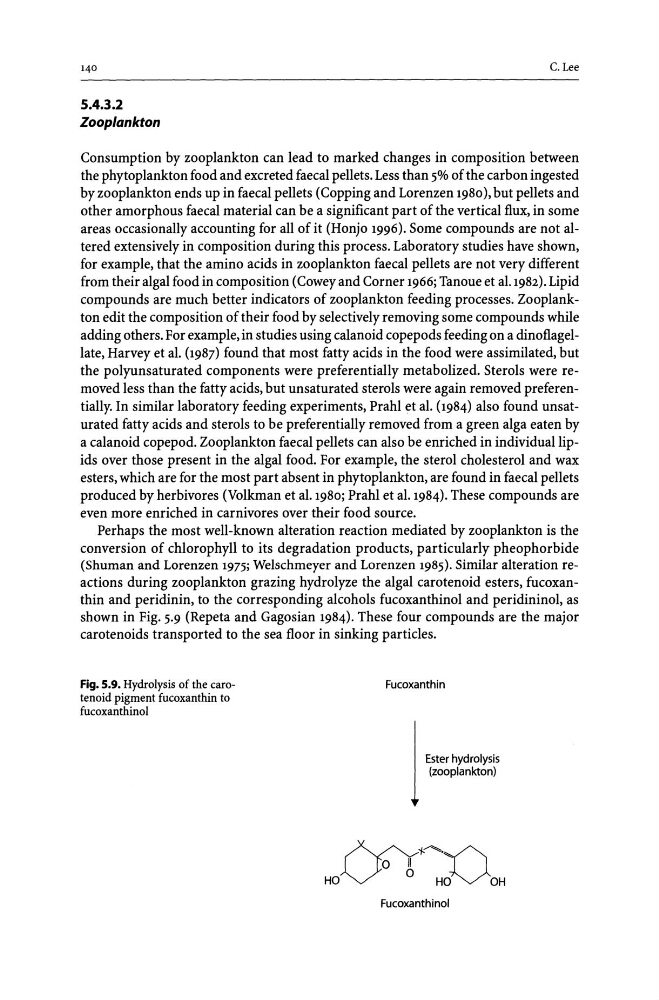
(Shuman and Lorenzen 1975; Welschmeyer and Lorenzen 1985). Similar alteration reactions during zooplankton grazing hydrolyze the algal carotenoid esters, fucoxanthin and peridinin, to the corresponding alcohols fucoxanthinol and peridininol, as
shown in Fig. 5.9 (Repeta and Gagosian 1984). These four compounds are the major
carotenoids transported to the sea floor in sinking particles.
Fig. 5.9. Hydrolysis of the carotenoid pigment fucoxanthin to
fucoxanthinol
Fucoxanthin
l
Ester hydrolysis
(zooplankton)
or i-~'0
o II
HO
0
HO
OH
Fucoxanthinol
5.4.3.2
Zooplankton
c. Lee
Consumption by zooplankton can lead to marked changes in composition between
the phytoplankton food and excreted faecal pellets. Less than 5% of the carbon ingested
by zooplankton ends up in faecal pellets (Copping and Lorenzen 1980), but pellets and
other amorphous faecal material can be a significant part of the vertical flux, in some
areas occasionally accounting for all of it (Honjo 1996). Some compounds are not altered extensively in composition during this process. Laboratory studies have shown,
for example, that the amino acids in zooplankton faecal pellets are not very different
from their algal food in composition (Cowey and Corner 1966; Tanoue et al.1982). Lipid
compounds are much better indicators of zooplankton feeding processes. Zooplankton edit the composition of their food by selectively removing some compounds while
adding others. For example, in studies using calanoid copepods feeding on a dinoflagellate, Harvey et al. (1987) found that most fatty acids in the food were assimilated, but
the polyunsaturated components were preferentially metabolized. Sterols were removed less than the fatty acids, but unsaturated sterols were again removed preferentially. In similar laboratory feeding experiments, Prahl et al. (1984) also found unsaturated fatty acids and sterols to be preferentially removed from a green alga eaten by
a calanoid copepod. Zooplankton faecal pellets can also be enriched in individual lipids over those present in the algal food. For example, the sterol cholesterol and wax
esters, which are for the most part absent in phytoplankton, are found in faecal pellets
produced by herbivores (Volkman et al. 1980; Prahl et al. 1984). These compounds are
even more enriched in carnivores over their food source.
Perhaps the most well-known alteration reaction mediated by zooplankton is the
conversion of chlorophyll to its degradation products, particularly pheophorbide
(Shuman and Lorenzen 1975; Welschmeyer and Lorenzen 1985). Similar alteration reactions during zooplankton grazing hydrolyze the algal carotenoid esters, fucoxanthin and peridinin, to the corresponding alcohols fucoxanthinol and peridininol, as
shown in Fig. 5.9 (Repeta and Gagosian 1984). These four compounds are the major
carotenoids transported to the sea floor in sinking particles.
Fig. 5.9. Hydrolysis of the carotenoid pigment fucoxanthin to
fucoxanthinol
Fucoxanthin
l
Ester hydrolysis
(zooplankton)
or i-~'0
o II
HO
0
HO
OH
Fucoxanthinol