

CHAPTER 5 . Particulate Organic Matter Composition and Fluxes in the Sea
141
5.4.4
Uncharacterized Material
In phytoplankton, most of the organic matter is made up of amino acids, carbohydrates
and lipids that can be efficiently characterized at the molecular level with conventional
chemical hydrolysis and chromatographic methods. Particles exported from the euphotic zone of the equatorial Pacific Ocean contain only a slightly lower proportion
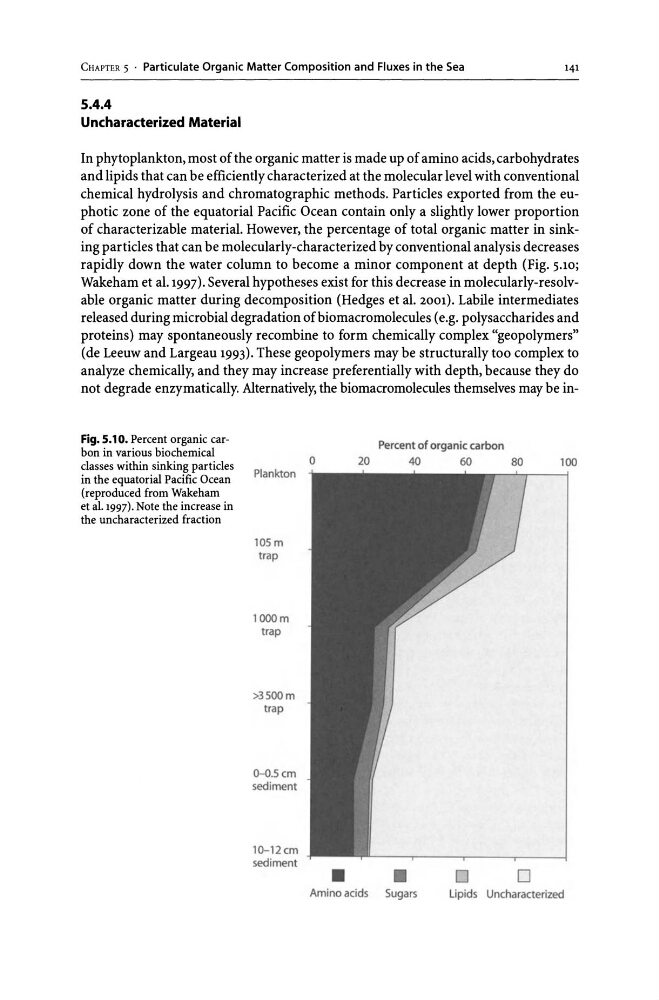
of characterizable material. However, the percentage of total organic matter in sinking particles that can be molecularly-characterized by conventional analysis decreases
rapidly down the water column to become a minor component at depth (Fig. 5.10;
Wakeham et al.1997). Several hypotheses exist for this decrease in molecularly-resolvable organic matter during decomposition (Hedges et al. 2001). Labile intermediates
released during microbial degradation ofbiomacromolecules (e.g. polysaccharides and
proteins) may spontaneously recombine to form chemically complex "geopolymers"
(de Leeuw and Largeau 1993). These geopolymers may be structurally too complex to
analyze chemically, and they may increase preferentially with depth, because they do
not degrade enzymatically. Alternatively, the biomacromolecules themselves may be inFig. 5.10. Percent organic carbon in various biochemical
classes within sinking particles
in the equatorial Pacific Ocean
(reproduced from Wakeham
et al. 1997). Note the increase in
the uncharacterized fraction
Plankton
105m
trap
l000m
trap
>3500m
trap
0-0.5 cm
sediment
10- 12cm
sediment
Percent of organic carbon
o
20
40
60
80
100
Amino acids
Sugars
Lipids Un characterized
141
5.4.4
Uncharacterized Material
In phytoplankton, most of the organic matter is made up of amino acids, carbohydrates
and lipids that can be efficiently characterized at the molecular level with conventional
chemical hydrolysis and chromatographic methods. Particles exported from the euphotic zone of the equatorial Pacific Ocean contain only a slightly lower proportion
of characterizable material. However, the percentage of total organic matter in sinking particles that can be molecularly-characterized by conventional analysis decreases
rapidly down the water column to become a minor component at depth (Fig. 5.10;
Wakeham et al.1997). Several hypotheses exist for this decrease in molecularly-resolvable organic matter during decomposition (Hedges et al. 2001). Labile intermediates
released during microbial degradation ofbiomacromolecules (e.g. polysaccharides and
proteins) may spontaneously recombine to form chemically complex "geopolymers"
(de Leeuw and Largeau 1993). These geopolymers may be structurally too complex to
analyze chemically, and they may increase preferentially with depth, because they do
not degrade enzymatically. Alternatively, the biomacromolecules themselves may be inFig. 5.10. Percent organic carbon in various biochemical
classes within sinking particles
in the equatorial Pacific Ocean
(reproduced from Wakeham
et al. 1997). Note the increase in
the uncharacterized fraction
Plankton
105m
trap
l000m
trap
>3500m
trap
0-0.5 cm
sediment
10- 12cm
sediment
Percent of organic carbon
o
20
40
60
80
100
Amino acids
Sugars
Lipids Un characterized