

CHAPTER 5 . Particulate Organic Matter Composition and Fluxes in the Sea
139
solution processes on land and during transport. Most biogenic material, on the other hand,
is formed in situ and readily begins to dissolve once the organism that formed it dies.
5.4.3
Heterotrophic Alteration
Degradation of organic matter in the sea occurs primarily through the action of bacteria and zooplankton. Biomarkers and diagenetic indicators can be used to distinguish between the presence and/or activity of each type of heterotroph.
5.4.3.1
Bacteria
Several organic compounds specific to bacteria such as muramic acid or anteiso-fatty
acids can serve as specific source indicators of the presence of these organisms, as
mentioned above. In the example from the equatorial Pacific shown in Fig. 5.7, several
bacterial biomarkers were used to show the later stages (III and IV) of diagenesis,
particularly cis-vaccenic acid and iso- and anteiso-15:0 fatty acids, which are known
to have bacterial sources (Wakeham et al. 1997). These compounds were found in sinking particles throughout the water column but generally increased in relative abundance with depth. Bisnorhopane is also a bacterial biomarker, but is found only in sediments (Fig. 5-7). Bacterial biomarkers like muramic acid have been used to quantify bacterial biomass in particulate matter and sediments (King and White 1977; Moriarty 1977).
Other compounds, especially the organic nitrogen compounds, can be particularly
useful as markers of bacterial alteration rather than indicators of bacterial biomass
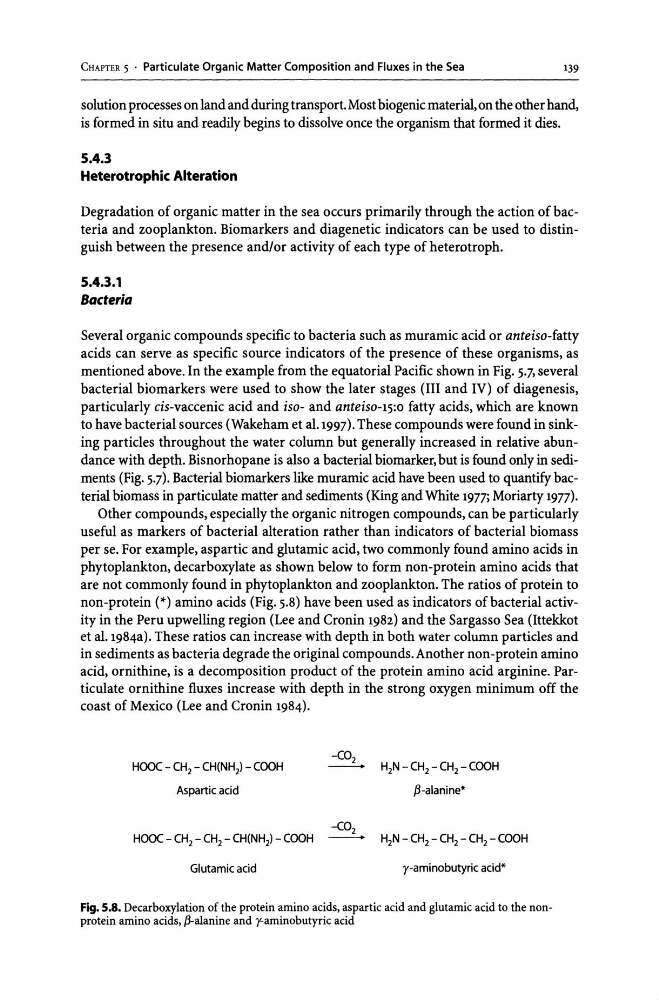
per se. For example, aspartic and glutamic acid, two commonly found amino acids in
phytoplankton, decarboxylate as shown below to form non-protein amino acids that
are not commonly found in phytoplankton and zooplankton. The ratios of protein to
non-protein (*) amino acids (Fig. 5.8) have been used as indicators of bacterial activity in the Peru upwelling region (Lee and Cronin 1982) and the Sargasso Sea (Ittekkot
et al. 1984a). These ratios can increase with depth in both water column particles and
in sediments as bacteria degrade the original compounds. Another non -protein amino
acid, ornithine, is a decomposition product of the protein amino acid arginine. Particulate ornithine fluxes increase with depth in the strong oxygen minimum off the
coast of Mexico (Lee and Cronin 1984).
HOOC - CH 2 - CH(NH 2 l - COOH
Aspartic acid
HOOC - CH 2 - CH 2 - CH(NH 2 l - COOH
Glutamic acid
-CO 2
-
H2N - CH2 - CH2 - COOH
f3-alanine*
-C0 2
H2N - CH 2 - CH 2 - CH 2 - COOH
y-aminobutyric acid*
Fig. S.S. Decarboxylation of the protein amino acids, aspartic acid and glutamic acid to the nonprotein amino acids, J3-alanine and y-aminobutyric acid
139
solution processes on land and during transport. Most biogenic material, on the other hand,
is formed in situ and readily begins to dissolve once the organism that formed it dies.
5.4.3
Heterotrophic Alteration
Degradation of organic matter in the sea occurs primarily through the action of bacteria and zooplankton. Biomarkers and diagenetic indicators can be used to distinguish between the presence and/or activity of each type of heterotroph.
5.4.3.1
Bacteria
Several organic compounds specific to bacteria such as muramic acid or anteiso-fatty
acids can serve as specific source indicators of the presence of these organisms, as
mentioned above. In the example from the equatorial Pacific shown in Fig. 5.7, several
bacterial biomarkers were used to show the later stages (III and IV) of diagenesis,
particularly cis-vaccenic acid and iso- and anteiso-15:0 fatty acids, which are known
to have bacterial sources (Wakeham et al. 1997). These compounds were found in sinking particles throughout the water column but generally increased in relative abundance with depth. Bisnorhopane is also a bacterial biomarker, but is found only in sediments (Fig. 5-7). Bacterial biomarkers like muramic acid have been used to quantify bacterial biomass in particulate matter and sediments (King and White 1977; Moriarty 1977).
Other compounds, especially the organic nitrogen compounds, can be particularly
useful as markers of bacterial alteration rather than indicators of bacterial biomass
per se. For example, aspartic and glutamic acid, two commonly found amino acids in
phytoplankton, decarboxylate as shown below to form non-protein amino acids that
are not commonly found in phytoplankton and zooplankton. The ratios of protein to
non-protein (*) amino acids (Fig. 5.8) have been used as indicators of bacterial activity in the Peru upwelling region (Lee and Cronin 1982) and the Sargasso Sea (Ittekkot
et al. 1984a). These ratios can increase with depth in both water column particles and
in sediments as bacteria degrade the original compounds. Another non -protein amino
acid, ornithine, is a decomposition product of the protein amino acid arginine. Particulate ornithine fluxes increase with depth in the strong oxygen minimum off the
coast of Mexico (Lee and Cronin 1984).
HOOC - CH 2 - CH(NH 2 l - COOH
Aspartic acid
HOOC - CH 2 - CH 2 - CH(NH 2 l - COOH
Glutamic acid
-CO 2
-
H2N - CH2 - CH2 - COOH
f3-alanine*
-C0 2
H2N - CH 2 - CH 2 - CH 2 - COOH
y-aminobutyric acid*
Fig. S.S. Decarboxylation of the protein amino acids, aspartic acid and glutamic acid to the nonprotein amino acids, J3-alanine and y-aminobutyric acid