

138
C.Lee
Carbonates are often enriched in acidic amino acids, which are thought to participate
in the carbonate precipitation mechanism (Lowenstam and Weiner 1989). These acidic
amino acids and glycine are the dominant compounds found in deep equatorial Pacific sediment traps and sediment (Lee et aI. 2000). This material does not appear to
be decomposed until it is released by dissolution of the mineral phase. The mechanism of association of organic matter to mineral grains is not well-understood and is
probably multi-faceted. Simple adsorption undoubtedly plays a major role. If the mineral is terrestrially derived, adsorption could occur before deposition in the ocean;
the organic coating could remain with the particle when the mineral grain enters the
water, could be replaced by marine DOC, or further adsorption of marine DOC could
occur. Recent work by Hedges and Keil (1999) and Keil et aI. (1997) demonstrate this
process. Berner (1995) suggested that benthic animals might coat fine-grained minerals as they pass through animal guts; this process could also occur in the water column as particles pass through zooplankton guts. And, as mentioned above, organic
matter could be contained within the inorganic skeletal matrices of organisms.
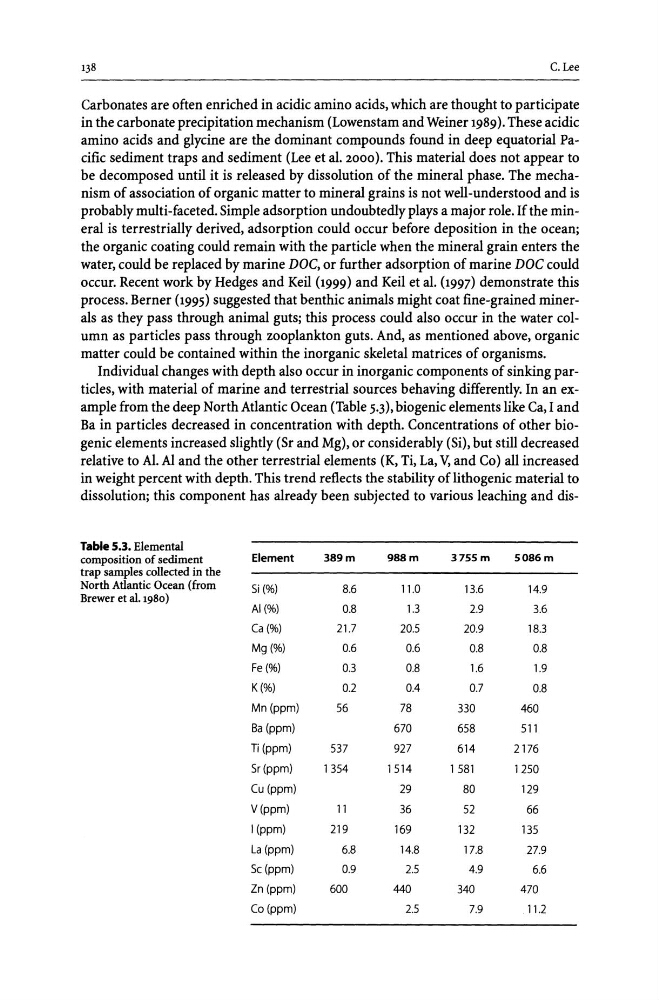
Individual changes with depth also occur in inorganic components of sinking particles, with material of marine and terrestrial sources behaving differently. In an example from the deep North Atlantic Ocean (Table 5.3), biogenic elements like Ca, I and
Ba in particles decreased in concentration with depth. Concentrations of other biogenic elements increased slightly (Sr and Mg), or considerably (Si), but still decreased
relative to AI. AI and the other terrestrial elements (K, Ti, La, V, and Co) all increased
in weight percent with depth. This trend reflects the stability of lithogenic material to
dissolution; this component has already been subjected to various leaching and disTable 5.3. Elemental
composition of sediment
Element
389m
988m
3755m
5086m
trap samples collected in the
North Atlantic Ocean (from
Si(%)
8.6
11.0
13.6
14.9
Brewer et al.198o)
AI(%)
0.8
1.3
2.9
3.6
Ca(%)
21.7
20.5
20.9
18.3
Mg(%)
0.6
0.6
0.8
0.8
Fe(%)
0.3
0.8
1.6
1.9
K(%)
0.2
0.4
0.7
0.8
Mn (ppm)
56
78
330
460
Sa (ppm)
670
658
511
Ti(ppm)
537
927
614
2176
Sr(ppm)
1354
1514
1581
1250
Cu (ppm)
29
80
129
V (ppm)
11
36
52
66
I (ppm)
219
169
132
135
La (ppm)
6.8
14.8
17.8
27.9
Sc (ppm)
0.9
2.5
4.9
6.6
Zn (ppm)
600
440
340
470
Co (ppm)
2.5
7.9
11.2
C.Lee
Carbonates are often enriched in acidic amino acids, which are thought to participate
in the carbonate precipitation mechanism (Lowenstam and Weiner 1989). These acidic
amino acids and glycine are the dominant compounds found in deep equatorial Pacific sediment traps and sediment (Lee et aI. 2000). This material does not appear to
be decomposed until it is released by dissolution of the mineral phase. The mechanism of association of organic matter to mineral grains is not well-understood and is
probably multi-faceted. Simple adsorption undoubtedly plays a major role. If the mineral is terrestrially derived, adsorption could occur before deposition in the ocean;
the organic coating could remain with the particle when the mineral grain enters the
water, could be replaced by marine DOC, or further adsorption of marine DOC could
occur. Recent work by Hedges and Keil (1999) and Keil et aI. (1997) demonstrate this
process. Berner (1995) suggested that benthic animals might coat fine-grained minerals as they pass through animal guts; this process could also occur in the water column as particles pass through zooplankton guts. And, as mentioned above, organic
matter could be contained within the inorganic skeletal matrices of organisms.
Individual changes with depth also occur in inorganic components of sinking particles, with material of marine and terrestrial sources behaving differently. In an example from the deep North Atlantic Ocean (Table 5.3), biogenic elements like Ca, I and
Ba in particles decreased in concentration with depth. Concentrations of other biogenic elements increased slightly (Sr and Mg), or considerably (Si), but still decreased
relative to AI. AI and the other terrestrial elements (K, Ti, La, V, and Co) all increased
in weight percent with depth. This trend reflects the stability of lithogenic material to
dissolution; this component has already been subjected to various leaching and disTable 5.3. Elemental
composition of sediment
Element
389m
988m
3755m
5086m
trap samples collected in the
North Atlantic Ocean (from
Si(%)
8.6
11.0
13.6
14.9
Brewer et al.198o)
AI(%)
0.8
1.3
2.9
3.6
Ca(%)
21.7
20.5
20.9
18.3
Mg(%)
0.6
0.6
0.8
0.8
Fe(%)
0.3
0.8
1.6
1.9
K(%)
0.2
0.4
0.7
0.8
Mn (ppm)
56
78
330
460
Sa (ppm)
670
658
511
Ti(ppm)
537
927
614
2176
Sr(ppm)
1354
1514
1581
1250
Cu (ppm)
29
80
129
V (ppm)
11
36
52
66
I (ppm)
219
169
132
135
La (ppm)
6.8
14.8
17.8
27.9
Sc (ppm)
0.9
2.5
4.9
6.6
Zn (ppm)
600
440
340
470
Co (ppm)
2.5
7.9
11.2