

CHAPTER 4 . Sedimentary Organic Matter Preservation and Atmospheric O2 Regulation
III
down" to a depth of -half a metre, at which time diffusive impedance through the
accumulating surface sediment covering returned the entire deposit to anoxic conditions (Buckley and Cranston 1988). Mineralogical compositions above and below the
preserved redox interface are essentially identical in two cored sections of the f-turbidite recovered -100 km apart in the MAP (Thomson et al. 1993), indicating that any
differences in this initially uniform sequence should be attributable solely to their contrasting redox histories.
The pronounced compositional contrasts across the redox boundaries of the two
MAP f-turbidite sequences give testament that long-term exposure to oxic conditions
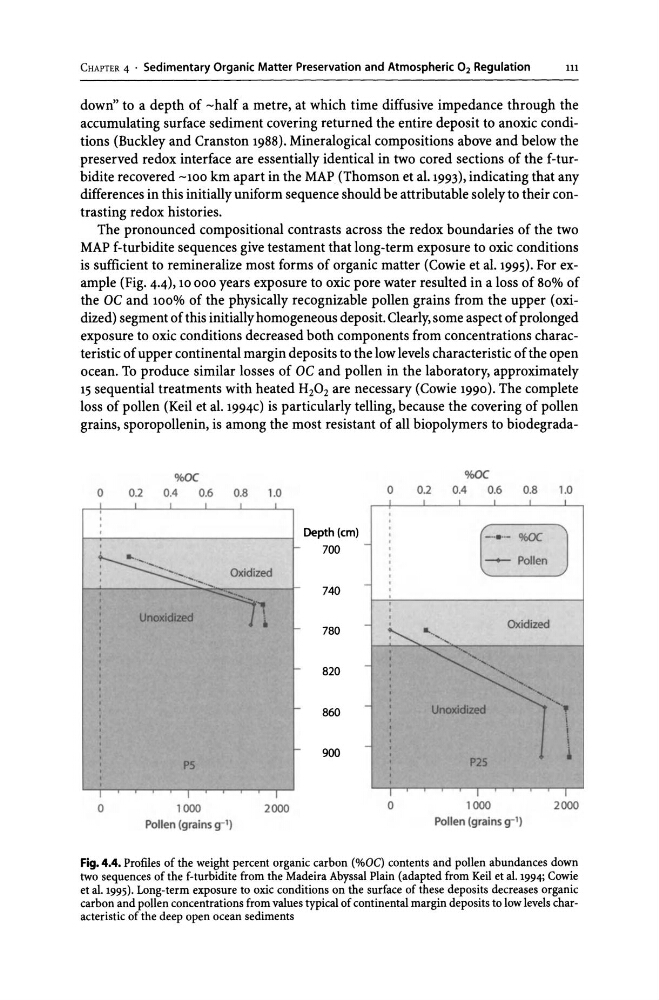
is sufficient to remineralize most forms of organic matter (Cowie et al. 1995). For example (Fig. 4.4),10000 years exposure to oxic pore water resulted in a loss of 80% of
the DC and 100% of the physically recognizable pollen grains from the upper (oxidized) segment of this initially homogeneous deposit. Clearly, some aspect of prolonged
exposure to oxic conditions decreased both components from concentrations characteristic of upper continental margin deposits to the low levels characteristic of the open
ocean. To produce similar losses of DC and pollen in the laboratory, approximately
15 sequential treatments with heated H20 2 are necessary (Cowie 1990). The complete
loss of pollen (Keil et al. 1994c) is particularly telling, because the covering of pollen
grains, sporopollenin, is among the most resistant of all biopolymers to biodegradao
o
%DC
0.2
0.4
0.6
0.8
1.0
P5
1000
Pollen (grains g-l)
2000
Depth (em)
700
740
780
820
860
900
o
o
%DC
0.2
0.4
0.6
0.8
1.0
I =:n
...................
Oxidized
..........................
..... .... ,
Unoxidized
........... ,
P25
1 000
Pollen (grains g-1)
\
\ ,
~
2000
Fig. 4.4. Profiles of the weight percent organic carbon (%OC) contents and pollen abundances down
two sequences of the f-turbidite from the Madeira Abyssal Plain (adapted from Keil et al. 1994; Cowie
et al. 1995). Long-term exposure to oxic conditions on the surface of these deposits decreases organic
carbon and pollen concentrations from values typical of continental margin deposits to low levels characteristic of the deep open ocean sediments
III
down" to a depth of -half a metre, at which time diffusive impedance through the
accumulating surface sediment covering returned the entire deposit to anoxic conditions (Buckley and Cranston 1988). Mineralogical compositions above and below the
preserved redox interface are essentially identical in two cored sections of the f-turbidite recovered -100 km apart in the MAP (Thomson et al. 1993), indicating that any
differences in this initially uniform sequence should be attributable solely to their contrasting redox histories.
The pronounced compositional contrasts across the redox boundaries of the two
MAP f-turbidite sequences give testament that long-term exposure to oxic conditions
is sufficient to remineralize most forms of organic matter (Cowie et al. 1995). For example (Fig. 4.4),10000 years exposure to oxic pore water resulted in a loss of 80% of
the DC and 100% of the physically recognizable pollen grains from the upper (oxidized) segment of this initially homogeneous deposit. Clearly, some aspect of prolonged
exposure to oxic conditions decreased both components from concentrations characteristic of upper continental margin deposits to the low levels characteristic of the open
ocean. To produce similar losses of DC and pollen in the laboratory, approximately
15 sequential treatments with heated H20 2 are necessary (Cowie 1990). The complete
loss of pollen (Keil et al. 1994c) is particularly telling, because the covering of pollen
grains, sporopollenin, is among the most resistant of all biopolymers to biodegradao
o
%DC
0.2
0.4
0.6
0.8
1.0
P5
1000
Pollen (grains g-l)
2000
Depth (em)
700
740
780
820
860
900
o
o
%DC
0.2
0.4
0.6
0.8
1.0
I =:n
...................
Oxidized
..........................
..... .... ,
Unoxidized
........... ,
P25
1 000
Pollen (grains g-1)
\
\ ,
~
2000
Fig. 4.4. Profiles of the weight percent organic carbon (%OC) contents and pollen abundances down
two sequences of the f-turbidite from the Madeira Abyssal Plain (adapted from Keil et al. 1994; Cowie
et al. 1995). Long-term exposure to oxic conditions on the surface of these deposits decreases organic
carbon and pollen concentrations from values typical of continental margin deposits to low levels characteristic of the deep open ocean sediments