

112
J, 1. Hedges
tion and typically persists for millions of years in anoxic deposits. These discrete particles (10-50 !lm) cannot be lost by diffusion and therefore must have been destroyed
as a result of severe in situ degradation. Extensive degradation is substantiated by a
pronounced increase in the percentage of nonprotein amino acids (f3-alanine plus
r-aminobutyric acid) across the oxidation front. These two diagenetic products increase from low relative concentrations «10 mole%) typical of coastal sediments in
the deeper turbidite to elevated sums (>30 mole%) in the oxidized surface horizon
that are found only in deep ocean deposits (Cowie and Hedges 1994). Although the
MAP turbidite demonstrates that conditions of long-term exposure to oxic conditions
are sufficient to produce the low concentrations of highly degraded organic matter
typical of open ocean sediments, they do not indicate how O2 exposure might affect
the organic compositions of incrementally depositing sediments along continental
margins, where essentially all OC preservation presently occurs.
To quantitatively assess the potential importance of oxicity on OC preservation in
modern deposits, it is useful to estimate the average time period that particulate material at the sediment surface is exposed to oxic conditions before accumulating to a
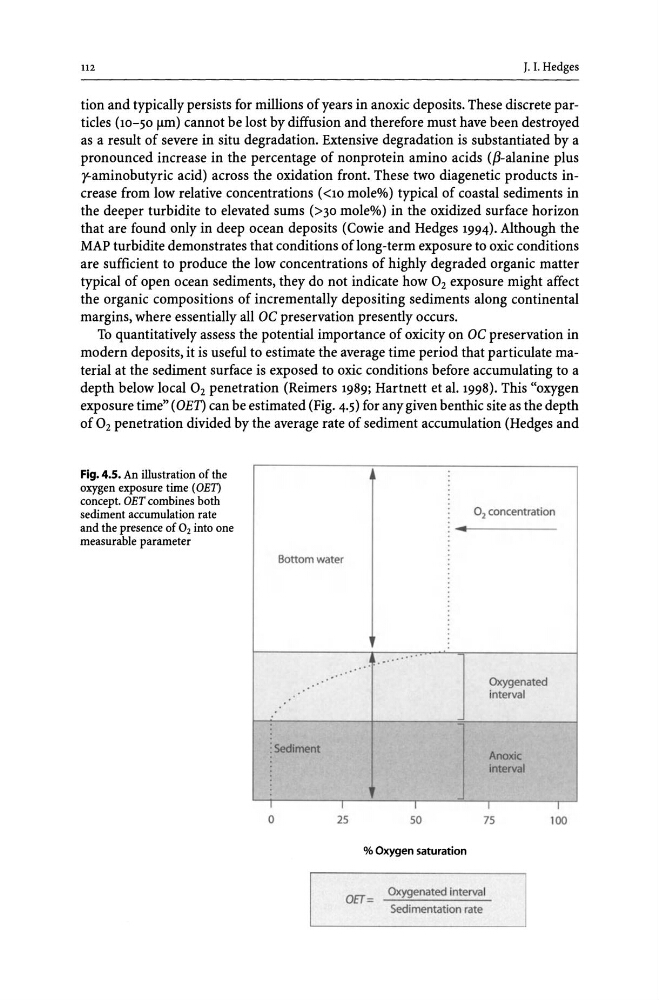
depth below local O2 penetration (Reimers 1989; Hartnett et al. 1998). This "oxygen
exposure time" (OET) can be estimated (Fig. 4.5) for any given benthic site as ilie depth
of O2 penetration divided by the average rate of sediment accumulation (Hedges and
Fig. 4.5. An illustration of the
oxygen exposure time (OEn
concept. OET combines both
sediment accumulation rate
and the presence of O2 into one
measurable parameter
o
j
0 2 con centratio n
•
Bottom water
" . - .. ... ~ .
- '
" ,
Oxygenated
interval
Sediment
]
Anoxic
interval
25
50
7S
100
% Oxygen saturation
OET",
Oxygenated interval
Sedimentation rate
J, 1. Hedges
tion and typically persists for millions of years in anoxic deposits. These discrete particles (10-50 !lm) cannot be lost by diffusion and therefore must have been destroyed
as a result of severe in situ degradation. Extensive degradation is substantiated by a
pronounced increase in the percentage of nonprotein amino acids (f3-alanine plus
r-aminobutyric acid) across the oxidation front. These two diagenetic products increase from low relative concentrations «10 mole%) typical of coastal sediments in
the deeper turbidite to elevated sums (>30 mole%) in the oxidized surface horizon
that are found only in deep ocean deposits (Cowie and Hedges 1994). Although the
MAP turbidite demonstrates that conditions of long-term exposure to oxic conditions
are sufficient to produce the low concentrations of highly degraded organic matter
typical of open ocean sediments, they do not indicate how O2 exposure might affect
the organic compositions of incrementally depositing sediments along continental
margins, where essentially all OC preservation presently occurs.
To quantitatively assess the potential importance of oxicity on OC preservation in
modern deposits, it is useful to estimate the average time period that particulate material at the sediment surface is exposed to oxic conditions before accumulating to a
depth below local O2 penetration (Reimers 1989; Hartnett et al. 1998). This "oxygen
exposure time" (OET) can be estimated (Fig. 4.5) for any given benthic site as ilie depth
of O2 penetration divided by the average rate of sediment accumulation (Hedges and
Fig. 4.5. An illustration of the
oxygen exposure time (OEn
concept. OET combines both
sediment accumulation rate
and the presence of O2 into one
measurable parameter
o
j
0 2 con centratio n
•
Bottom water
" . - .. ... ~ .
- '
" ,
Oxygenated
interval
Sediment
]
Anoxic
interval
25
50
7S
100
% Oxygen saturation
OET",
Oxygenated interval
Sedimentation rate